
Exeter Collaboration for Academic Primary Care (APEx) Blog
Exeter Collaboration for Academic Primary Care (APEx) Blog
Posted by ma403
5 August 2026Dr Serge Engamba · NIHR SPCR GP Commercial Research Fellow, APEx (Exeter Collaboration for Academic Primary Care)
Delivering Research Where It Matters: Unlocking Primary Care’s “Sleeping Giant”
On 15 July, I had the privilege of speaking at the APEx Seminar Series. I want to begin by thanking the team for the invitation, as well as the forty or so colleagues who gave up part of a July lunchtime to join the conversation.
My talk, “Delivering Research Where It Matters,” centred on a puzzle I keep returning to—and one that I believe is important for the future of clinical trial delivery in the UK.
The Recruitment Paradox
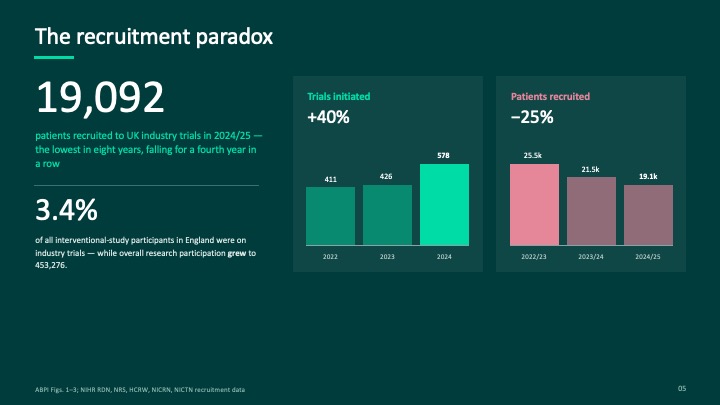
The UK initiated roughly 40% more commercial trials in 2024 than in 2022, yet patient recruitment has fallen for the fourth-year in a row, hitting its lowest level since 2017/18. This means we are opening more studies but reaching fewer people. I wanted to explore why this is happening and make the case that general practice could be a large part of the answer.
The “Sleeping Giant” of Primary Care
Much of the seminar focused on what I think of as primary care’s “sleeping giant” problem:
This gap is not just about income or speed, but it also represents a significant issue of health equity. Hospital trials are likely to systematically under-recruit the older, multimorbid, deprived, rural, and non-English-speaking patients who are disproportionately cared for in general practice. If those patients are missing from the evidence, the evidence cannot represent the population it is meant to serve. When framed this way, commercial research becomes fundamentally about securing representative evidence; a clear priority for any academic audience.
Moving From Theory to Practice
To move beyond theory, I shared my experience recruiting for PANORAMIC—a primary-care platform trial that randomised nearly 30,000 participants nationwide. As the UK’s fastest-ever recruiting interventional clinical trial in primary care, it clearly demonstrated what happens when research infrastructure is built around practices rather than merely attached to them. In our region, we used a central hub that carried the administrative workload of the study, leading to previously research-naïve practices in deprived areas becoming some of our strongest recruiters, and allowing us to include a large number of participants from underserved groups. I am using this experience to help local stakeholders across the South West Peninsula build successful models for delivering commercial research in primary care, supported by my GP commercial research fellowship from the School for Primary Care Research.
Where Academia Fits
Primary care sits at the far end of the translational pathway, where treatments meet everyday practice. This is where regulators increasingly ask for real-world evidence, and where industry’s evidence gap is growing. Academia already possesses much of the machinery this moment requires: methodological expertise, world-leading routine NHS data, and university clinical trials units, including Exeter’s own. Pair that academic credibility with general practice’s reach and inclusiveness, and academic primary care moves from being just a venue for delivering system studies to becoming a leading research partner, potentially bringing research opportunities to where the right participants are. It also starts empowering new models, such as Investigator-initiated trials, which could be a strong stepping stone for practices new to commercial research.
Continuing the Conversation
As ever, the discussion afterwards was the best part—thoughtful, sceptical in the right places, and genuinely energising. My sincere thanks again to the APEx Seminar team.
If you are thinking about commercial research in primary care, from either side of the table, I would be glad to continue the conversation.