
Exeter Collaboration for Academic Primary Care (APEx) Blog
Exeter Collaboration for Academic Primary Care (APEx) Blog
Posted by ma403
12 August 2026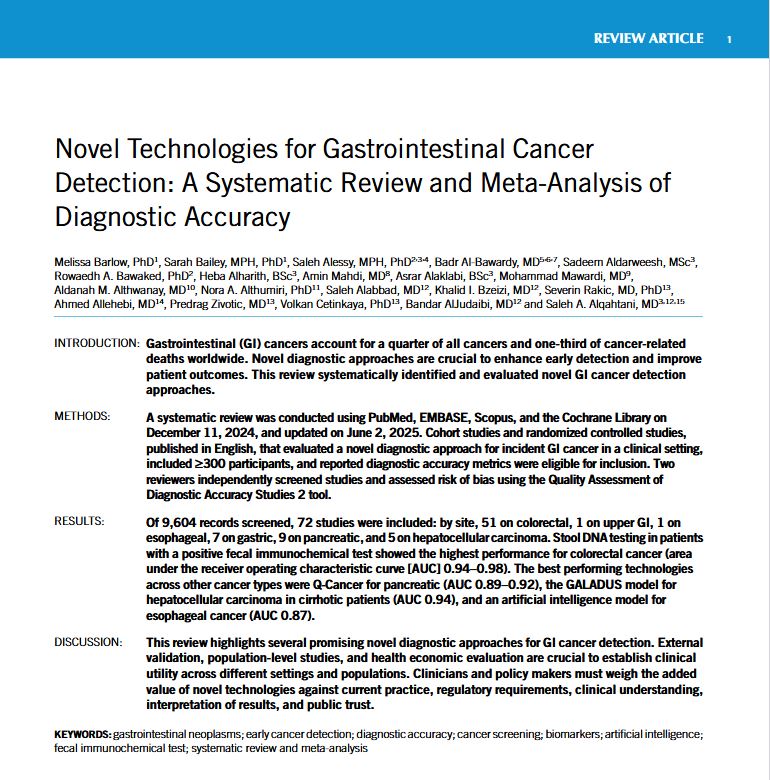
In recent years, researchers have developed a wide range of promising diagnostic technologies, though very few have been evaluated in real-world clinical settings, making it difficult to know which are truly promising for implementation. In our recent international collaboration with researchers and clinicians at the King Faisal Specialist Hospital and Research Centre in Saudi Arabia and the World Bank,we reviewed the evidence for emerging technologies for gastrointestinal (GI) cancer detection in our recent publication: “Novel Technologies for Gastrointestinal Cancer Detection: A Systematic Review and Meta-Analysis of Diagnostic Accuracy”, published in Clinical and Translational Gastroenterology earlier this year (1).
Our aim was to identify which approaches show the greatest diagnostic accuracy and to highlight the steps needed to move beyond test evaluation and towards successfully implementing them.
What we did
We conducted a systematic review and meta-analysis of the evidence of 72 cohort studies that evaluated novel diagnostic technologies for colorectal, pancreatic, gastric, liver, and oesophageal cancer detection. Unlike many previous reviews, we only included only cohort studies as they more closely reflect how diagnostic tests perform in everyday clinical practice, rather than under ideal research conditions.
What we found
Several technologies stood out for their diagnostic accuracy within their intended clinical settings:
While these technologies target different cancers and clinical settings, they all demonstrated strong diagnostic performance and have the potential to improve earlier detection.
The gap between promise and practice
High diagnostic accuracy alone is not enough. Before new technologies can become part of routine care, they must also demonstrate that they:
Without this, even the most accurate test risks remaining underused.
What next?
The next phase of research must move beyond accuracy alone. Implementation research will be critical to determine whether these innovations truly improve outcomes. The international partnerships formed through this work (including with King Faisal Specialist Hospital and Research Centre and the World Bank) are continuing to evolve, creating opportunities to test and implement these technologies in real-world settings and across different healthcare systems.
Final thoughts
We are entering a new era of cancer detection, driven by big data and artificial intelligence. The technologies are promising, and in some cases, already highly accurate. The clinical question is changing. It is no longer “Do these tools work?”, it is “Can we make them work in real clinical practice?”.
Reference
1. Barlow M, Bailey S, Alessy S, Al-Bawardy B, Aldarweesh S, Bawaked RA, et al. Novel Technologies for Gastrointestinal Cancer Detection: A Systematic Review and Meta-Analysis of Diagnostic Accuracy. Clin Transl Gastroenterol. 2026 Jun 4. doi:10.14309/ctg.0000000000001058