Exeter Collaboration for Academic Primary Care (APEx) Blog
Exeter Collaboration for Academic Primary Care (APEx) Blog
Posted by ma403
22 September 2026Recently published research from the University of Exeter Psychology Department and Exeter Collaboration for Academic Primary Care (APEx) Mental Health Theme sought to answer this question.
Every day, our brains are constantly scanning the world around us. We cannot pay attention to everything, so the brain must decide what information is most important. One way it does this is by learning patterns in our environment. When certain sights, sounds or situations regularly predict something important, the brain begins to prioritise them, helping us respond quickly to what comes next.
Most of the time, this process helps us navigate the world efficiently. We learn to notice signals that predict rewards, opportunities, or potential threats. But what happens when depression influences this system?
For decades, psychologists have known that people experiencing depression often pay more attention to negative information. This idea comes not only from what people report about their experiences, but also from laboratory experiments that can track attention in real time. These experiments allow researchers to measure where attention is directed within fractions of a second, revealing how the brain prioritises information even before we are consciously aware of it.
Much of this research has focused on how people respond when negative information is already present. However, our recent study asked a different question: could depression influence an even earlier stage of processing, affecting how the brain responds to signals that predict negative information may be about to appear?
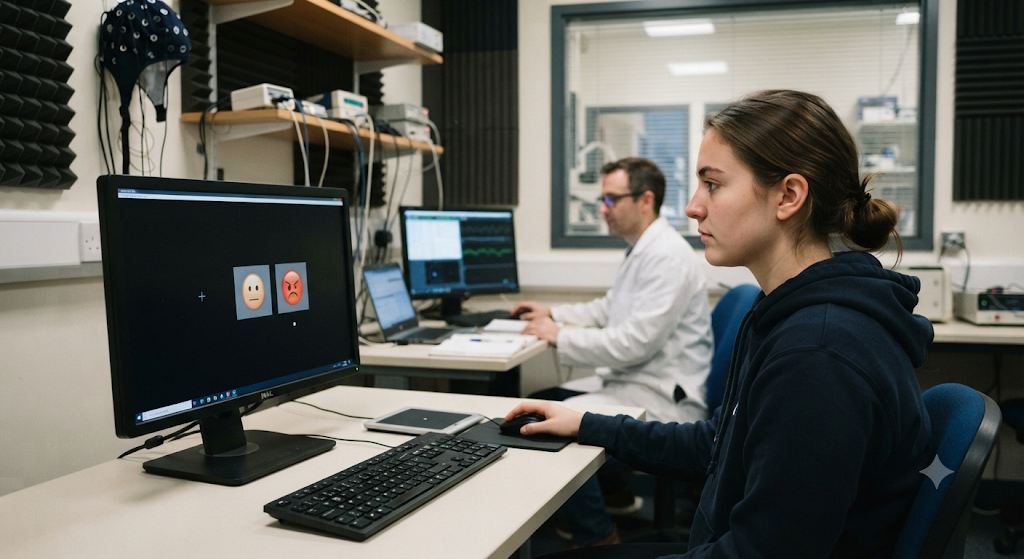
To investigate this, we recruited more than 240 adults and used a task that measured how attention was allocated to simple visual cues. These cues were emotionally neutral, but they reliably signalled whether a sad or neutral face would appear moments later. Over time, participants’ brains could learn the relationship between the cue and the information that followed.
We found a clear pattern.
People reporting higher levels of depressive symptoms were more likely to direct their attention towards cues that predicted the appearance of sad faces. In other words, their brains appeared to assign greater priority to signals associated with upcoming negative information.
Importantly, the cues themselves were not negative. They were simply pieces of information that helped predict what might happen next. This suggests that depression may influence how the brain learns about and responds to patterns in the environment, leading attention to be preferentially allocated towards signals associated with negative outcomes.
You can think of this as a kind of anticipatory process. Rather than simply reacting when something upsetting appears, the brain may already be preparing to seek out information or negative information that might arrive in the future.
These findings offer a new perspective on how depression changes the brain and its early-stage mental processes. Understanding these processes could help researchers build a more complete picture of why negative moods, thoughts, and expectations can become so persistent when people experience depression. Our findings suggest that depression may subtly increase the priority given to signals that predict negative experiences.
So, the story of depression may involve not only how we respond to our environment, but how we respond to what we expect our environment to be.
Publication: