
Exeter Collaboration for Academic Primary Care (APEx) Blog
Exeter Collaboration for Academic Primary Care (APEx) Blog
Posted by ma403
17 March 2026Prevention is no longer optional in primary care – it is essential. The NHS 10 Year Plan calls for three major shifts:
Achieving these shifts requires more than policy ambition. It requires practical, scalable models that work in the reality of everyday general practice.
Our research team, in collaboration with the Royal College of General Practitioners (RCGP) Physical Activity and Lifestyle Team is building a programme of research focused on one core challenge:
How do we sustainably embed physical activity promotion in primary care?
A central strand of this work is our evaluation of the parkrun practice initiative.
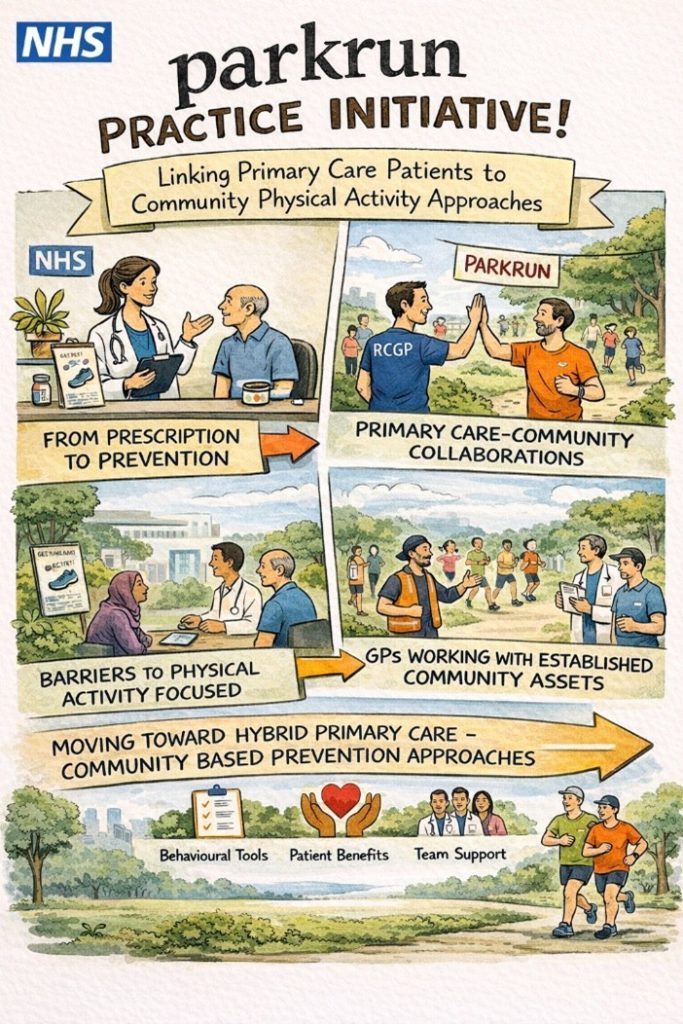
Linking primary care and community
The parkrun practice initiative, developed with the RCGP, connects GP practices with local parkrun events – free weekly, community-based 5K events that welcome people of all abilities. Rather than prescribing exercise, practices link patients to an existing, inclusive community asset.
There are now over 1,800 parkrun practices in the UK.
This model embodies the NHS shift from hospital to community and from treatment to prevention. But how does it work in practice?
Moving beyond enthusiasm to sustainability
Our SPCR-funded evaluation explores how practices implement and deliver the parkrun practice initiative, what enables success, and what creates friction for practices? Through in-depth interviews with clinical and non-clinical staff, we are examining:
We are not just concerned with whether the parkrun practice is a good idea, we’re exploring, what does it take for it work sustainably?
Early insights from our research suggest that while the parkrun practice initiative is easy for practices to adopt, sustaining it in everyday care requires more than initial enthusiasm. In many cases, implementation is driven by a highly motivated champion, with wider staff engagement fluctuating as practices balance competing priorities.
The main resource required is time. The initiative’s toolkit materials help practices promote the initiative, but participants reported limited guidance on practical issues such as referral pathways or communication with local parkrun organisers.
Healthcare professionals also highlighted potential barriers for patients, including course location, transport, and concerns about inclusivity. Awareness of outcomes was usually limited to individual anecdotes rather than systematic feedback. Social prescribing pathways were seen as a promising way to link patients to parkrun, but are often underused.
Overall, these early findings suggest that while the initiative is simple to start, long-term sustainability may depend on shared ownership within practices, clearer guidance, and stronger links with community partners.
Building a prevention research programme
The parkrun practice evaluation is not a standalone project. It forms part of a wider programme of work developing and testing ways to integrate physical activity into routine primary care, including behavioural science-informed toolkits, co-designed resources and implementation support strategies.
Together this work:
By evaluating how community assets like parkrun can be meaningfully embedded into everyday practice, we are helping translate national ambition into practical delivery.
The NHS shifts cannot rely on isolated initiatives, they require infrastructure, partnerships and sustained support.
If you are interested in our research, please do get in touch
Dr Rosina Cross R.Cross2@exeter.ac.uk
Dr Emma Cockcroft E.J.Cockcroft@exeter.ac.uk
Ms Jess Marshall J.Marshall4@exeter.ac.uk