
Exeter Collaboration for Academic Primary Care (APEx) Blog
Exeter Collaboration for Academic Primary Care (APEx) Blog
Posted by ma403
1 September 2026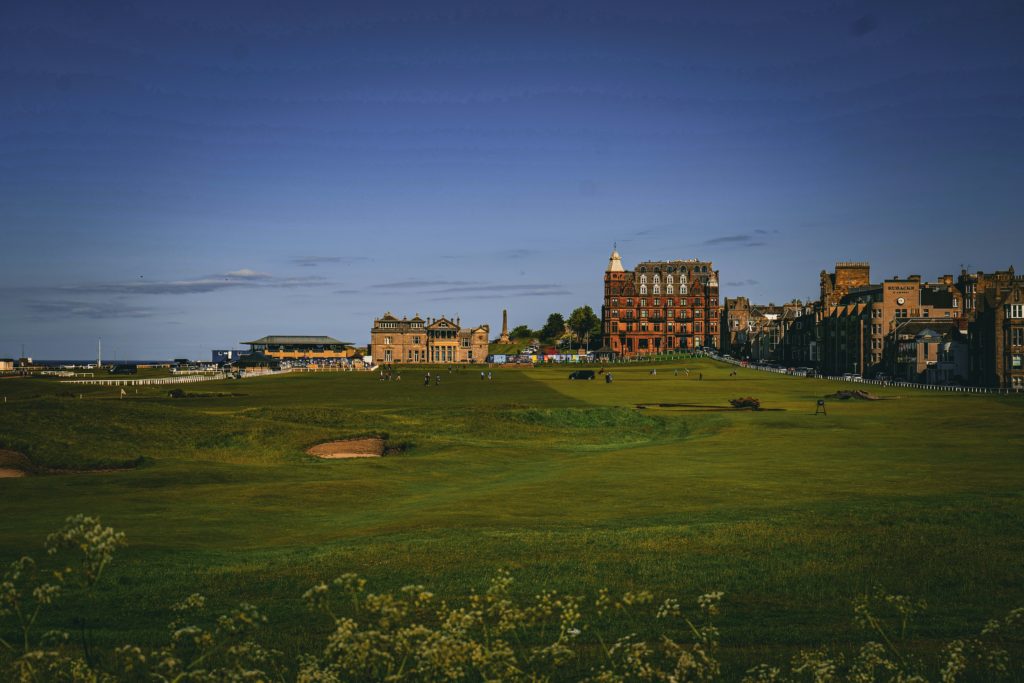
The theme of this year’s national Society for Academic Primary Care conference was “Leading the future of primary care” and it took place at the University of St Andrews from 24th to 26th June. St Andrews is a historic coastal town, 30 miles north-east of Edinburgh on the east coast of Fife. It is celebrated as the home of golf with no less than 10 courses and is the location of the third oldest university in the UK, which was established in 1413 (after only Oxford and Cambridge). Its medieval heritage, prestigious university and vibrant coastal setting create a distinctive character. In the latest Guardian University Guide, St Andrews was ranked number one in the UK in Maths, History, Art History, and International Relations. The current student population comprises 8,381 undergraduates and 1,975 postgraduates (including taught, research and online).
Travel to and from the event was somewhat tricky for Exeter colleagues – St Andrews is a very long way from Devon and the weather en-route was untypically hot, which resulted in delays and sadly non-functioning air conditioning, just when it was absolutely crucial. I was extremely lucky to avoid the woes of Cross-Country rail travel, as I combined attendance at the conference with a few days’ holiday with my husband. We opted to stay in Anstruther, a charming fishing village about 10 miles from St Andrews.
Meetings of SAPC special interest groups (SIGs) and the PHoCuS network for non-medical primary care researchers were scheduled for the first morning, so I had already attended two meetings by the time the conference was opened by St Andrews Professors Frank Sullivan and Deborah Williamson. Insightful opening plenaries on the future primary care workforce were given by Dr Victoria Tzortziou Brown, Professor Stewart Mercer and Dr Charlotte Mason-Apps and then a full programme of parallel sessions and workshops got underway.
As ever, deciding which sessions to attend was challenging, but I tried to support colleagues whenever possible. Exeter had a strong presence, with Sinead McDonagh, Gary Abel, Asma Chabouni and Serge Engamba in action on the first day. Of particular interest to me were presentations given by Celine Esuruoso & Stephanie Powell (Imperial College London) in the prevention, lifestyle, social prescribing and community session on community-engaged student projects during undergraduate GP placements and Amy Taylor’s (Nottingham) observational evaluation of the Pharmacy First service in the medicines, prescribing quality session.
Plenary speakers got the second day off to a stimulating start and included Professors Joanne Protheroe (Keele), Lindsey Pope (Glasgow) and Val Wass (Keele), whose presentations concerned various aspects of the future of medical education in primary care. Exeter was particularly well-represented in parallel sessions 5 and 6 (continuity, care coordination & primary–secondary interface), with presentations from Sara Eddy, Serge Engamba, Mary Carter and Penny Xanthopoulou. Unfortunately, these sessions coincided with presentations in other parallel sessions from Exeter colleagues Eleanor Bryant, Tom Kallis and Ian Porter. Particular highlights of the day for me (apart from getting my presentation over and done with!) were Lucy Potter (Bristol), speaking eloquently about her realist evaluation of improving access to general practice for and with people with severe and multiple disadvantage in the access, equity and inclusion session and Richard Byng’s (Plymouth) thought-provoking plenary at the end of the day on primary care responses to the mental health crisis.
I’m afraid I can’t comment on the conference dinner at the end of day 2, as my post-flu energy levels caused me to bail out. I understand that the event included pipers, haggis and much merriment. I was rather sorry to miss it.
The award-winners session, followed by the “dangerous ideas soapbox” got day 3 off to a stimulating and entertaining start, which included challenges from speakers to “deep end” terminology and to PSA screening in asymptomatic men. Our colleague, Oksana Kryshevich, had to wait until almost the last slot of the conference to give an excellent presentation about her systematic review examining non-cancer outcomes after an urgent referral in the workforce, roles and service models session.
As usual the conference ended with prizes – congratulations to everyone who received one – and an announcement of next year’s location, which will be Oxford (30th June – 2nd July, deadline for abstracts will be 31st January 2027).
All in all, it was a most enjoyable conference, and I learned a lot from presenters from all over the UK and beyond. It was the third national ASM I have attended and, to my mind, it compared very well to 2022 (University of Central Lancashire, Preston) and 2011 (Bristol). The St Andrews and SAPC hosts were unfailingly helpful and friendly and the conference took place in a beautiful part of Scotland which I had not previously visited – I will be back!