
Exeter Collaboration for Academic Primary Care (APEx) Blog
Exeter Collaboration for Academic Primary Care (APEx) Blog
Posted by ma403
9 September 2026Professor David MG Halpin
Honorary Professor of Respiratory Medicine
Approximately 40,000 patients in England are on long term oxygen therapy (LTOT) in the community. Most of them have chronic obstructive pulmonary disease (COPD) but some have other lung diseases such as cystic fibrosis or bronchiectasis, and some have chronic heart failure. They are prescribed oxygen for chronic hypoxaemia (i.e. low blood oxygen levels) and generally use it for at least 15 hours per day but sometimes require it for 24 hours per day. The oxygen is usually supplied from tanks containing liquid oxygen or from concentrators which purify oxygen from room air.
There are longstanding guidelines on assessing whether patients need oxygen, and over 15 years ago the NHS published commissioning guidelines on establishing home oxygen service assessment and review (HOS-AR) services (1) to facilitate the prescription of oxygen for people who needed it and reduce the number of people inappropriately prescribed oxygen.
As well as describing the assessment service, the guidelines recommended that all patients with on LTOT should be reviewed at regular intervals. The guidelines state that if the review indicates that a patient is “no longer deriving clinical benefit from the oxygen (either because the patient is not hypoxaemic or they gain no benefit from the therapy), discussion should take place about withdrawing it.” However, there is no guidance on what an assessment of clinical benefit should include and there were no appropriate tools to assess clinical effectiveness and adverse effects. This is not just a problem in England, the situation is the same around the world.
Together with Professor Michael Dreher, from the Department of Pneumology and Intensive Care Medicine in Aachen, Germany, I led a programme to develop a Questionnaire for Oxygen Therapy Evaluation (QuOTE) to standardise the assessment of symptoms in patients using LTOT, and identify problems related to its use (2). The aim was to develop a tool that quickly and easily allowed patients to report their LTOT experience that could be used at every visit. We hoped to be able to produce a single page questionnaire that resembled and was as easy to complete as the COPD Assessment Test (CAT), with the hope that it would standardise and structure clinical assessment and facilitate discussion between patients and clinicians, just as the CAT does. To support and inform the work we also conducted a systematic targeted literature review of PROMs in LTOT and chronic respiratory failure.
We convened a group of 13 clinical and academic respiratory clinicians from across Europe to work on the development process. We worked to identify a “long list” of domains that should be included, based on clinical experience and patient surveys. These include physical activity, dyspnoea, sleep quality, mental clarity, LTOT side effects, use patterns and issues with the equipment. We then used Delphi methodology to identify the domains and questions to include in the questionnaire.
In round 1 each expert ranked their top five domains by clinical importance and applicability at follow-up visits. This produced a core set of high-priority content areas to inform item development. Once topics had been identified and prioritised, each author drafted specific questions addressing the agreed domains, generating 23 candidate items. In the next Delphi round items were reduced to two per domain (18 questions), and in the final round the overall number was reduced to nine questions, consistent with the predetermined goal of no more than 10 items with English wording that was clear, concise and appropriate for routine clinical use.
The final questionnaire uses five-point scales (Much better, Better, Same, Worse, Much worse) for the six items assessing change in symptoms since the previous visit. Two yes/no items capture oxygen-related side effects and two five-point comparative quantity scales (A lot more, More, Same, Less, A lot less) assess adherence to prescribed LTOT and problems with oxygen equipment. We included “smiley-face” emoticons alongside the written anchors to provide additional clarity without increasing complexity.
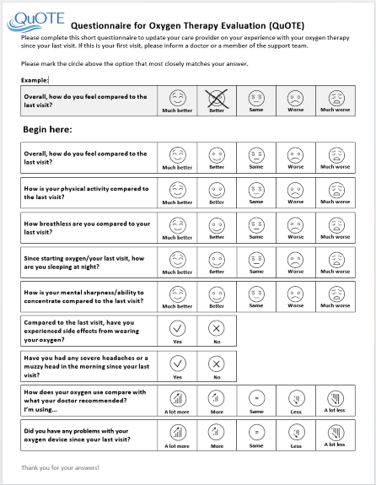
Patient responses can be scored into three domains, and the scores can be compared across visits to identify trends in symptoms/functioning alongside adverse effects and oxygen use/equipment issues, to guide clinical discussion. QuOTE scores are intended to support within-patient monitoring over time rather than to compare benefit across patients or in relation to categorical thresholds defining standards of care.
To ensure accessibility and usability across settings, the QuOTE was translated and localised from English into French, German, Spanish and Portuguese. Usability in all of the languages was tested by asking native-speaking patients with chronic respiratory illness currently prescribed LTOT to complete the questionnaire and answer 4 evaluation questions. The responses showed the QuOTE had a high degree of clarity and acceptability.
The current lack of a standardised assessment tool leaves physicians relying on informal conversations and sporadic physiological measures to assess treatment response. QuOTE allows a standardised structured follow-up assessment for patients on LTOT and facilitates more consistent, patient-centred decision-making. This is the first version of the QuOTE, and iterative modification may be warranted once it is used in clinical practice. To assess the benefit of using QuOTE a prospective study evaluating clinical outcomes in patients whose care includes use of the QuOTE compared to usual care will be needed, but we hope that adoption by clinicians will provide timely, real-world feedback and potentially refinement of the items and response options.
The development of the questionnaire was supported by Inogen Inc. who make oxygen concentrators, and it can be freely downloaded at https://quote.oxygenassessmenttool.com
References
1. NHS Primary Care Commissioning. Home Oxygen Service – Assessment and Review. Good practice guide. London. 2011.
2. Dreher M, Catalán JS, Vogelmeier CF, Rabec C, Wijkstra P, Patout M, Morelot-Panzini C, Jebrak G, Winck JC, Kania A, Franzen KF, Gangemi A, Hart N, Halpin DMG. The Questionnaire for Oxygen Therapy Evaluation (QuOTE): A Simple O2 Therapy Assessment. ERJ Open Res. 2026:00105-2026.