
‘These awarded projects demonstrate how far the metamaterials community has progressed towards meaningful industrial exploitation. The winners exemplify the kind of collaboration we now need—where strong fundamental research is tightly coupled to manufacturability, scalability, and real industrial challenges. Through this collaboration between the Henry Royce Institute and the UK Metamaterials Network, we look forward to the impact, commercialisation and real world exploitation that will emerge from these sprint projects.’
— Professor Alastair Hibbins, joint-lead of UK Metamaterials Network
Find out more:
Two successful University of Exeter ICP funded metamaterials projects.
Congratulations to Dr David Horsell, Dr Steven Hepplestone, and Dr Cameron Gallagher, academics aligned with the Centre for Metamaterial Research and Innovation (CMRI) one of the University of Exeter’s recognised Research Centres, on having their metamaterials projects successfully funded by the Henry Royce Institute Metamaterials Industrial Collaboration Programme (ICP) 2025. They will be working with PepsiCo and Technical Composite Systems Ltd across the areas of thermal and structural metasurfaces.
The Henry Royce Institute programme enables universities and research and technology organisations (RTOs) to collaborate with industry partners, offering grant funding for research, development and innovation sprint projects for metamaterials to support technology translation. It funds projects that can respond to major national challenges and accelerate progression from breakthrough discovery to real-world applications.
This achievement builds on the successful selection of the University of Exeter to host a state-of-the-art facility, MetaHUB (EPSRC). With a focus on ‘nano metamaterials’, a new class of advanced materials designed at microscopic scale, the hub will pave the way for new jobs and businesses across many sectors from medical sensors to next generation computer components. Supported by £19.6 million in public and private backing, MetaHUB will boost the high growth technologies and sectors that will drive the Plan for Change in the South-West and beyond.
Potential application areas for metamaterials are limitless as opportunities to push the boundaries of metamaterial research and technology are developed. A metamaterial is a 3D structure with a response or function due to the collective effect of meta-atom elements that is not possible to achieve conventionally with any individual constituent materials. Both projects are investigating metasurfaces which are a 2D version of a metamaterial where the structural elements are confined to a 2D plane.
What are Metamaterials? – UK Metamaterials Network
Dr David Horsell (Project lead) and Dr Steven Hepplestone from Exeter will collaborate with Simon Lawton (R&D Senior Principal Engineer) and John Bows (R&D Director) at PepsiCo on ‘Thermal metasurfaces to address energy reduction in the food Industry’. The group will look at taking how metamaterials can be used to improve the efficiency of heat transfer in industrial processes.
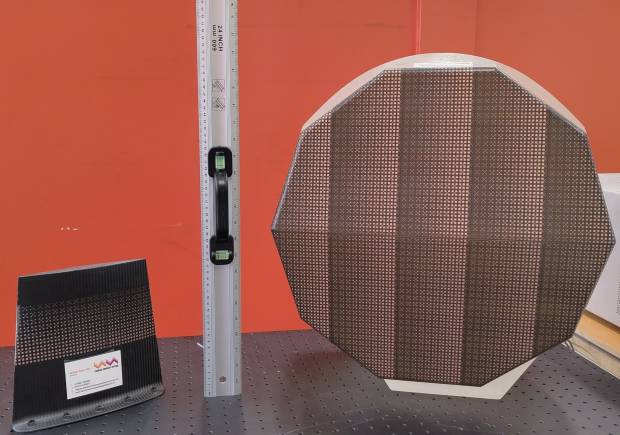
Dr Cameron Gallagher from Exeter will be collaborating with Dr Michael Sloan (Project lead), Company Director from Technical Composite Systems Ltd on ‘Structural Metasurfaces’. The group will design, manufacture and test a microwave metasurface that can be embedded into a glass fibre composite. They will look at how the glass fibre metamaterial composite responds to an applied electromagnetic wave, targeting an improved performance with respect to RADAR and RF signature management. The project will demonstrate manufacturing readiness for reinforced composite metamaterials.