

Posted by ccld201
9 February 2026Over thirty-five years after its establishment, the Venice Commission of the Council of Europe[1] has become a central reference point in transnational constitutionalism. Established in 1990 to assist States emerging from authoritarianism in Central and Eastern Europe, it has evolved into a global constitutional actor with a distinctive capacity to articulate and diffuse standards of democracy, human rights, and the rule of law. Its advisory role, grounded in comparative law expertise and institutional independence, has shaped constitutional reforms in Europe and beyond.
One of the Commission’s most influential contributions has been its Rule of Law Checklist. Adopted in 2016, it soon became a benchmark document for assessing constitutional and legal systems, relied upon by the European Court of Human Rights, the Court of Justice of the European Union, EU institutions monitoring the rule of law, national courts, and civil society organizations. The Checklist distilled the common normative core of various legal traditions into a set of concrete, operational benchmarks.
The Making of the Updated Rule of Law Checklist
Nearly a decade after the adoption of the original Checklist, the Commission undertook its first major update while largely maintaining the original structure. The Updated Rule of Law Checklist emerged from a mandate set in motion by the Reykjavik Declaration, adopted at the Summit of Heads of States and Government of the Council of Europe in May 2023 and the subsequent call of the Committee of Ministers. Its preparation was entrusted to a dedicated working group and unfolded through an unusually broad and sustained consultation process, involving institutions across the Council of Europe and beyond, as well as courts, international organizations, academia, and civil society, complemented by a series of academic seminars and conferences held throughout 2024 and 2025. As a member of the Venice Commission, I experienced first-hand a process defined by openness and sustained engagement, in which members were repeatedly invited to contribute both in writing and in discussion, making this Update one of the most intensively consulted and collectively shaped texts the Commission has produced.
Adopted at the Commission’s 145th plenary session in December 2025, the Updated Rule of Law Checklist reflects profound shifts in the legal and political landscape, ranging from democratic backsliding and rule of law regression to rapid technological change, the expanding influence of private actors, and the challenges of rule of law restoration (para 9-14). This post offers an account of the update, its major innovations, and its broader implications for democracy and human dignity.
Rule of Law, Democracy and Human Rights
In its founding instrument, Resolution 90(6) of the Council of Europe’s Committee of Ministers of 1990, the Venice Commission was conceived as a body whose ‘specific field of action shall be the guarantees offered by law in the service of democracy’ (Art. 1.1). The Commission was tasked with prioritizing work concerning the efficiency and strengthening of democratic institutions, the rule of law, and human rights and freedoms.
These concerns have remained the recurring themes of prime importance. It is in this spirit that The Updated Rule of Law Checklist offers a conceptual clarification of the relationship between the rule of law, democracy and human rights; considered as ‘closely intertwined’ and ‘interdependent,’ this relationship is portrayed as follows:
Democracy relates to the involvement of the people in the decision-making and deliberative processes in a society, contributing to legitimising public decisions; human rights seek to protect individuals from arbitrary and excessive interferences with their freedoms and liberties and to secure human dignity, while the Rule of Law focuses on limiting and independently reviewing the exercise of public powers… Democracy, human rights and the Rule of Law share a common objective: prevention of accumulation and arbitrary use of power.(para 21)
Preserving the Core of the Rule of Law
The Update preserves the five foundational benchmarks of the 2016 Checklist, a natural outcome for a tested ground, which remain the conceptual core of the rule of law framework, namely legality; legal certainty; prevention of abuse (misuse) of power; equality before the law and non-discrimination; and access to justice. Although conceptually retained, each section has been clarified, expanded and updated. Particularly noteworthy are the following elements:
Legality: The Updated Checklist includes new safeguards concerning executive law-making, the proper use of urgent procedures, and the need for transparent, inclusive, and deliberative legislative processes, including when AI is used in parliamentary work. (para 21)
Legal Certainty: The Updated Checklist highlights risks associated with retrospective laws, especially those tailored to pending judicial cases (i.e., lex singularis), and underscores the need for consolidated public access to laws and case law (para 47-74).
Prevention of Abuse (Misuse) of Power: The Updated Checklist includes more developed safeguards against corruption, conflicts of interest, and arbitrary interference (para 65-77).
Equality and Non-Discrimination: The Updated Checklist deepens the discussion of positive obligations and expands on the risks posed by algorithmic discrimination, profiling, and automated decision-making (para 89-100).
Access to Justice: An entirely new sub-section on the use of digital technologies and AI within the judiciary is introduced, underscoring that such technologies cannot replace judicial reasoning, must be transparent and explainable, and remain subject to human oversight (para 101-131).
Two New Benchmarks and Two New Challenges
Two elements that were previously embedded within other sections are now elevated to the status of independent benchmarks, namely checks and balances and constitutional review. They respond directly to contemporary patterns of democratic decline and reflect their fundamental function in the broader rule of law framework.
In addition and importantly, the Update introduces a new concluding section addressing ‘Particular Challenges to the Rule of Law.’ Two themes are identified.
Restoration of the Rule of Law: The Updated Checklist reflects the growing recognition that, once institutions have been eroded, rebuilding them becomes a complex normative and practical task. Restoration must adhere to core rule of law principles even as it seeks to undo prior violations (para 152-160).
Legal and Civic Education: The Updated Checklist recognizes that the rule of law depends on more than formal guarantees. Legal professionals must be trained in rule of law values. Equally, societies, require civic education that fosters respect for human dignity and the rights and freedoms of individuals, highlighting the significance of school education:
Primary and secondary school education promoting the importance of human dignity and the rights and freedoms of individuals are of particular importance in building a peaceful society in which minority and individual rights are safeguarded from unjustified interference by majoritarian rule. (para 163)
Accordingly, civil society organizations should be enabled to educate the public about these values. Moreover, robust civic education for all citizens, especially youth, is essential to a rule-of-law-based institutional order.
Conclusion
The Updated Rule of Law Checklist is a timely and necessary response to a changing constitutional environment. It does not seek to redefine the rule of law but to refine and operationalize it for contemporary conditions. Its two new benchmarks, checks and balances and constitutional review, fill gaps revealed by recent crises. Its expanded treatment of technology, private power, and judicial digitalization aligns rule of law with the realities of the digital age. And its attention to rule of law restoration and civic education recognizes that the rule of law must not only be protected but actively cultivated. In this sense, the Updated Checklist continues to embody the Venice Commission’s broader vision and vocation: to articulate the guarantees offered by law in the service of democracy, and to assist states and institutions in preserving a public order grounded in rule of law values, human rights, and human dignity.
Qerim Qerimi is a Professor of International Law and International Law of Human Rights at the University of Prishtina and former rector of the university. He is a member of the Council of Europe’s Venice Commission and Chair of its Scientific Council. The views expressed here are solely the author’s.
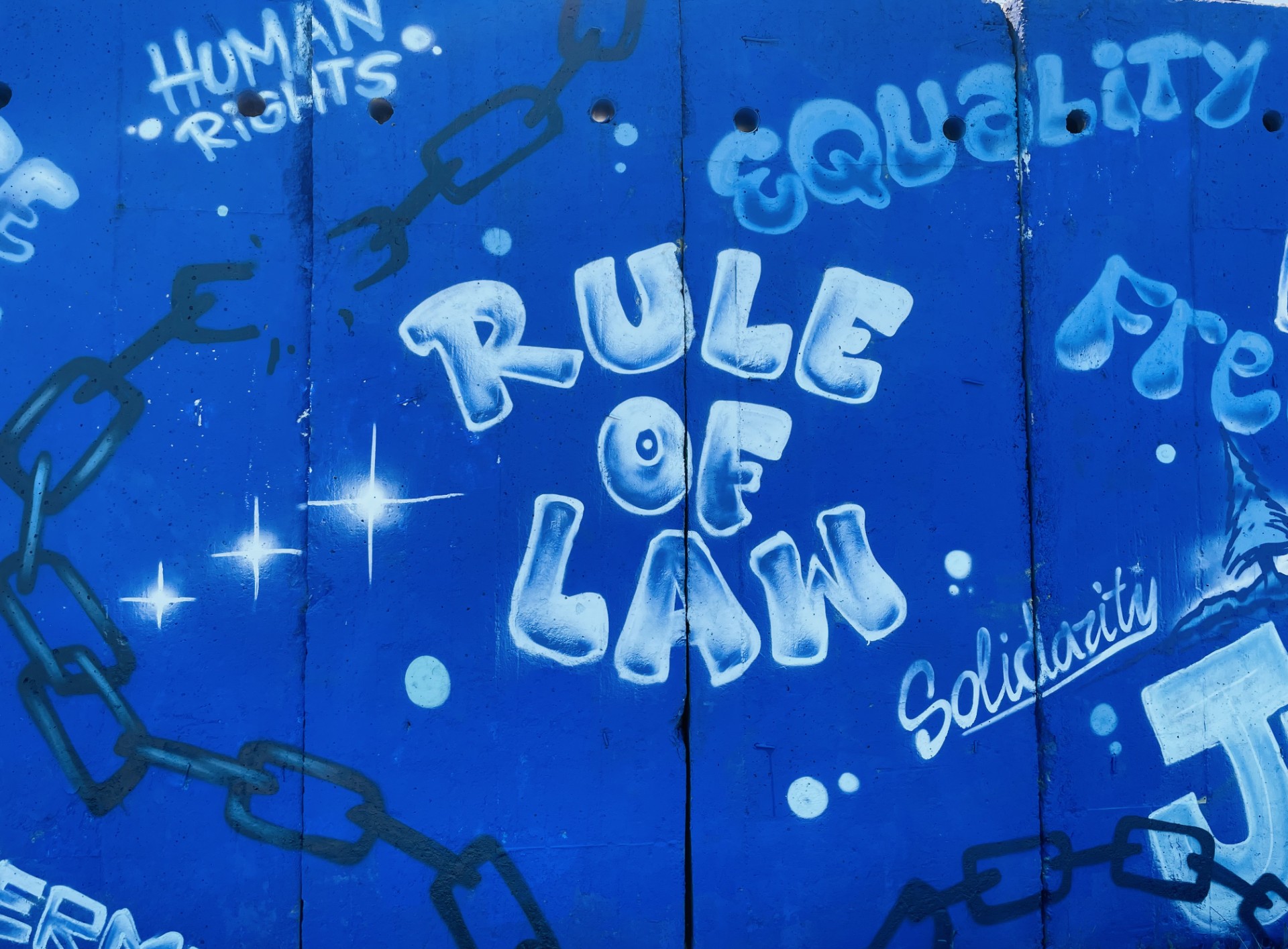
The photograph illustrating this post was taken by Qerim Qerimi at the headquarters of European Union Rule of Law Mission in Kosovo.
[1] Formally the European Commission for Democracy through Law.