

Posted by ccld201
23 March 2026At least 34,412 migrants have died or gone missing when they attempted to reach European Union (EU) territory along perilous Mediterranean routes since 2014. Undocumented migrants who die and whose remains are recovered at the EU’s borders are often not identified within the EU. Their families are not informed about the fate of their loved ones, burials are often anonymous, and the legal and procedural responses of States and the EU are fragmented and inadequate. These deaths and disappearances reveal a stark gap between formal obligations and the lived reality of those who die and disappear at the border, a gap that amounts to a systemic failure to secure posthumous dignity, in light of the EU’s foundational commitment to respect for human dignity.[1]
The concept of posthumous dignity emerges as both an independent legal entitlement of the deceased and a procedural obligation. The neglect and consequent invisibilisation of the border dead and disappeared,[2] through insufficient identification and search efforts, shape what it means for migrants to die or to disappear at the EU’s borders. The lack of responsiveness of legal and procedural frameworks at the national and EU levels fails to guarantee posthumous dignity. While dignity is owed to the deceased as a normative and legal imperative,[3] its realization depends upon the actions of the State and other actors, notably in ensuring identification, burial in accordance with religious or cultural rituals, and communication with grieving families.
This post argues that the failure to operationalize posthumous dignity shapes social and political life in Europe. It constitutes not merely procedural neglect but a structural injustice echoing forms of disappearance addressed by transitional justice.[4] By examining both the obligations of States and the emerging practices of non-state actors, this post demonstrates that legal arrangements, procedures on the ground, and the efforts of non-state actors construct a relationship with the border dead and disappeared in ways that have often been understudied. To this end, the post underscores the relevance of transitional justice mechanisms in this context, as ones providing a necessary lens for understanding accountability in a transnational context where the dead and disappeared and their families remain largely unacknowledged.
The realisation of posthumous dignity depends upon the positive obligations of States, notably under the European Convention on Human Rights (ECHR) The European Court of Human Rights has held that Article 2 of the Convention imposes positive procedural obligations on States, including to investigate deaths when State failures have caused loss of life, as in Öneryildız v Turkey. The European Court of Human Rights has interpreted Article 3 (Prohibition of torture) to encompass situations in which a failure to investigate disappearances constitutes inhuman or degrading treatment of surviving family members, as illustrated by Varnava and Others v Turkey. Article 8 (Right to respect for private and family life) extends to the burial of the dead, such that a violation occurs when States fail to allow families to bury their loved ones or to inform them of the place of burial.[5]
Despite these obligations, the border dead and disappeared often remain unaccounted for, with limited investigative efforts and inadequate procedural frameworks both in national and EU law. The absence of consistent mechanisms to identify their human remains, communicate with their families, or ensure dignified burial reflects a structural invisibilisation in this context. This invisibilisation reveals that posthumous dignity is not merely denied but also requires active realisation by the State.
In accordance with obligations under the ECHR and the principle of due diligence,[6] States are responsible for recovering corpses and remains at the border and for using all available means, including forensic methods, to identify them. Beyond individual cases, these obligations reflect a broader collective responsibility: by ensuring identification, dignified treatment, and communication with families, States lay the groundwork for transitional justice mechanisms, including reparations, memorialization, and truth-seeking, which recognize and address the harm suffered by affected communities. The failure to exercise due diligence in these matters constitutes a structural denial of posthumous dignity and highlights the ongoing ethical and legal responsibility of States toward the border dead and disappeared.
This denial of legal obligations toward the border dead and disappeared demonstrates how posthumous dignity is systematically undermined. States frequently fail to establish responsive procedural frameworks to investigate deaths, identify remains, or inform families, particularly in frontline countries such as Italy, Greece, and Spain.[7] These gaps are compounded by the lack of coordinated EU-level mechanisms. In practice, invisibilisation is very often a consequence of inadequate forensic and investigative resources, the lack of political will and the transfer of responsibilities to non-state actors. Domestic legislation mostly triggers obligations only in cases of suspected crimes, failing to respond to broader humanitarian and procedural needs.[8] This structural neglect produces a recurring pattern in which migrants, whose deaths and disappearances have been attributed to the lack of safe and regular migration pathways, restrictive migration policies, perilous routes and the actions of smugglers and traffickers, are left outside the scope of legal and political recognition. This pattern reveals how posthumous dignity depends on the active implementation of due diligence.
In response to this neglect, non-state actors have assumed a vital role in upholding posthumous dignity and in caring[9] for the dead.[10] Forensic anthropologists, NGOs, and private citizens contribute to identification as well as to the memorialization of border deaths and disappearances. Their involvement highlights a collective sense of responsibility operating alongside, and often in place of, State action. By providing procedural and symbolic recognition, these actors underscore that posthumous dignity is not only a legal entitlement but also a social and ethical obligation that transcends formal institutions.
The neglect of the border dead and disappeared raises concerns comparable to those confronted by transitional justice processes, particularly the right to truth, which these mechanisms aim to realize. The failure of States to investigate, identify, and inform families perpetuates trauma and injustice among already marginalized groups, but also directly impacts communities in frontline States where the presence of the border dead has become a common occurrence.[11] Recognizing posthumous dignity as a legal and procedural category therefore calls for mechanisms of truth-seeking, forensic identification, and memorialization, adapted to the transnational nature of border deaths. Such measures reveal how transitional justice frameworks can reassert State responsibility, operationalize posthumous dignity, and address the ethical, legal, and political consequences of invisibilisation at Europe’s borders.
Mohamed Elsayeh is a Postdoctoral Research Fellow at the Center for International Studies (Sciences Po/CNRS) in Paris and holds a PhD in Law from Sciences Po, where his doctoral thesis examined legal responses to the treatment of migrants’ remains recovered at the European Union’s borders.
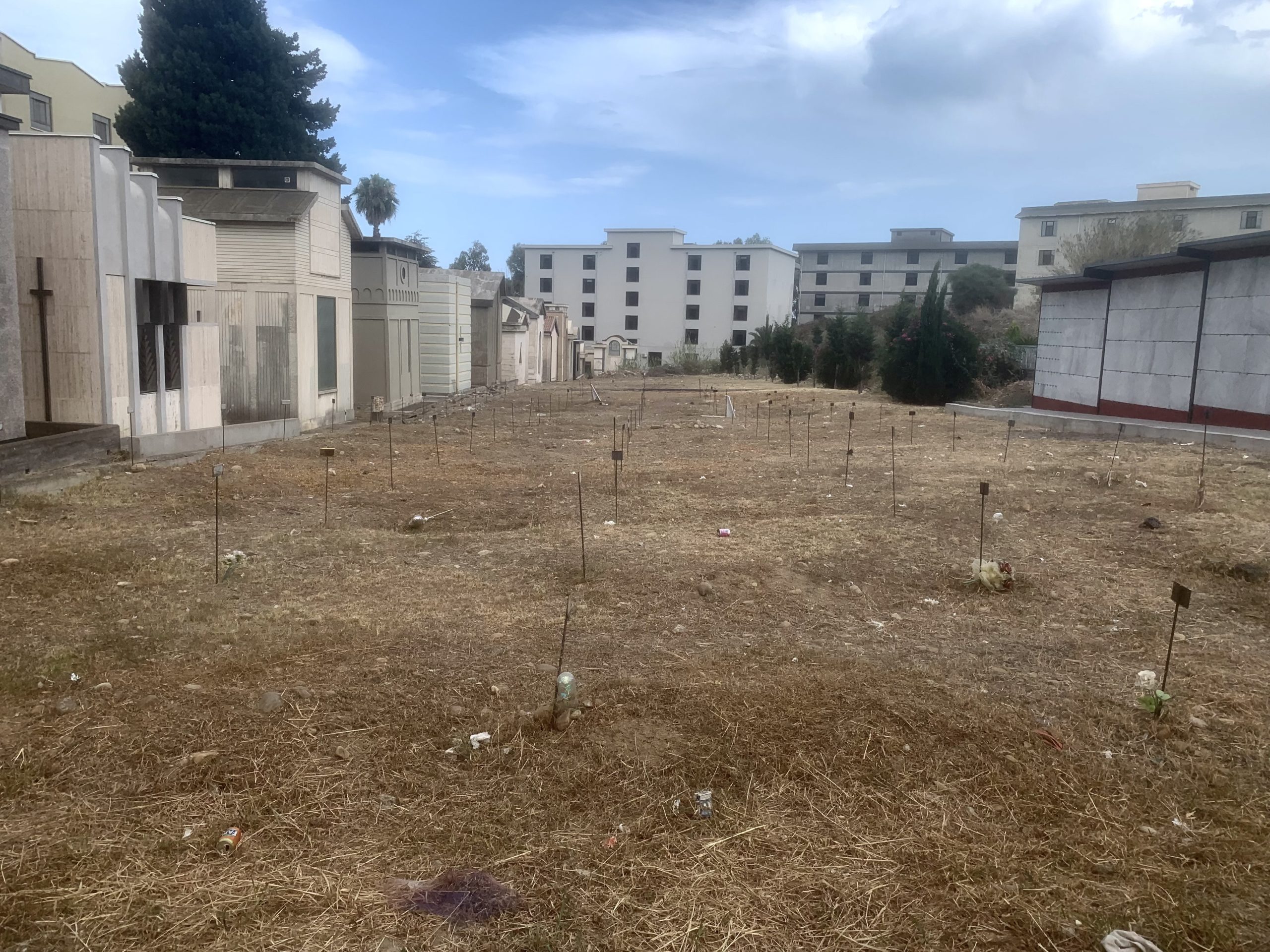
Photograph: Anonymous grave markers at the Cimitero Monumentale di Catania (Monumental Cemetery of Catania), Sicily, July 2024. Taken by Mohamed Elsayeh.
[1] Consolidated Version of the Treaty on European Union [2012] OJ C 326/13, art 2.
[2] The term ‘border dead and disappeared’ is used in this article to refer both to persons who have lost their lives at international borders, beyond the conventional jurisdiction of a State, and to individuals who remain missing and are often presumed dead.
[3] See Jeremy Waldron, ‘How Law Protects Dignity’ (2012) 71(1) The Cambridge Law Journal 200-222.
[4] The United Nations Security Council describes transitional justice as encompassing the range of judicial and non-judicial mechanisms through which societies address large-scale past abuses in order to ensure accountability, justice, and reconciliation, including prosecutions, reparations, truth-seeking, and institutional reform: United Nations Security Council, The rule of law and transitional justice in conflict and post-conflict societies (2004) UN Doc S/2004/616, para 8.
[5] See ECtHR, Hadri‑Vionnet v Switzerland 55525/00 (Fifth Section, 14 February 2008) and ECtHR, Sabanchiyeva and Others v. Russia 38450/05 (First Section, 06 September 2013).
[6] Vassilis Tzevelekos and Elena Katselli Proukaki, ‘Migrants at Sea: A Duty of Plural States to Protect (Extraterritorially)?’ (2017) 86 Nordic Journal of International Law, noting that, in the context of transnational migration, States have positive obligations under the ECHR and the principle of due diligence to protect migrants on the high seas. This principle may be extended to the recovery and identification of remains.
[7] See International Committee of the Red Cross, ‘Counting the Dead: How Registered Deaths of Migrants in the Southern European Sea Border Provide Only a Glimpse of the Issue’ (ICRC 2022) and Arianna Jacqmin, ‘Voyages after Death: Identifying Bodies from the Mediterranean Sea’ in Veronica Fynn Bruey and Steven W. Bender (eds), Deadly Voyages: Migrant Journeys across the Globe (Lexington Books 2019).
[8] One notable example is Article 116 of the Italian Regulation for the Implementation of the Code of Criminal Procedure (Norme di attuazione, di coordinamento e transitorie del codice di procedura penale), which does not require an autopsy in cases where there is no suspicion of a crime: Decreto legislativo 28 luglio 1989, n. 271, art 116, available at: https://www.normattiva.it/uri-res/N2Ls?urn:nir:stato:decreto.legislativo:1989;271.
[9] For a discussion of care in relation to the dead, see Adam Rosenblatt, ‘Caring for the Dead’ in Adam Rosenblatt, Digging for the Disappeared: Forensic Science after Atrocity (Stanford University Press 2015) 177, arguing that caring actions materially alter the conditions and status of dead bodies, even though they remain beyond the enforceable guarantees of human rights.
[10] See Amade M’charek and Sara Casartelli, ‘Identifying dead migrants: forensic care work and relational citizenship’ (2019) 23(7) Citizenship Studies 738–757.
[11] Syd Bolton and Catriona Jarvis, ‘All Rights Reserved’ (Last Rights Project 2018) 12.