
Posted by Edward Mills
15 December 2025And “Nowel” crieth every lusty man.
Chaucer, ‘The Franklin’s Tale’, l. 1255
As term ends and the Christmas break descends, let’s take a look back at the last term’s worth of activity on the blog. It’s been a busy twelve weeks, with new and returning authors alike sharing their work on a wide variety of medieval (and medieval-adjacent) topics. It’s been particularly heartening to publish announcements of new and forthcoming publications, with companion pieces appearing to accompany new work on topics both familiar to long-term readers (nunneries and Matthew Paris) and less so (neurodivergence and horse heraldry). Several of our popular series have also returned: the ‘Learning Anglo-French’ project contributed two ‘research postcard’ entries (from Somerset Heritage Centre and Eton College), while Ana Dias reinvograted our ‘spotlight’ series.
Taken together, the entries this term — both those listed above and those viewable from our homepage — showcase the sheer scope of work being undertaken in the Centre, and (we hope) make a powerful case for the sort of collaborative, cross-disciplinary work that medievalists do so well. Importantly, they all began with an email: a simple ‘might-this-be-a-good-fit-for-the-blog?’. The answer, as you may have guessed, was almost always ‘yes’. Looking ahead to 2026, we have some exciting posts lined up, but are especially keen to welcome new voices to our medievalist conversation. If you’re connected to Exeter, are working (in some way) on something medieval, and would like to share it with the wider world, do get in touch (via e.mills4@exeter.ac.uk).
The blog will return on Monday 12th January, along with the start of the new term. From all of us at the Centre for Medieval Studies, we wish you a restful winter break, and a happy New Year.
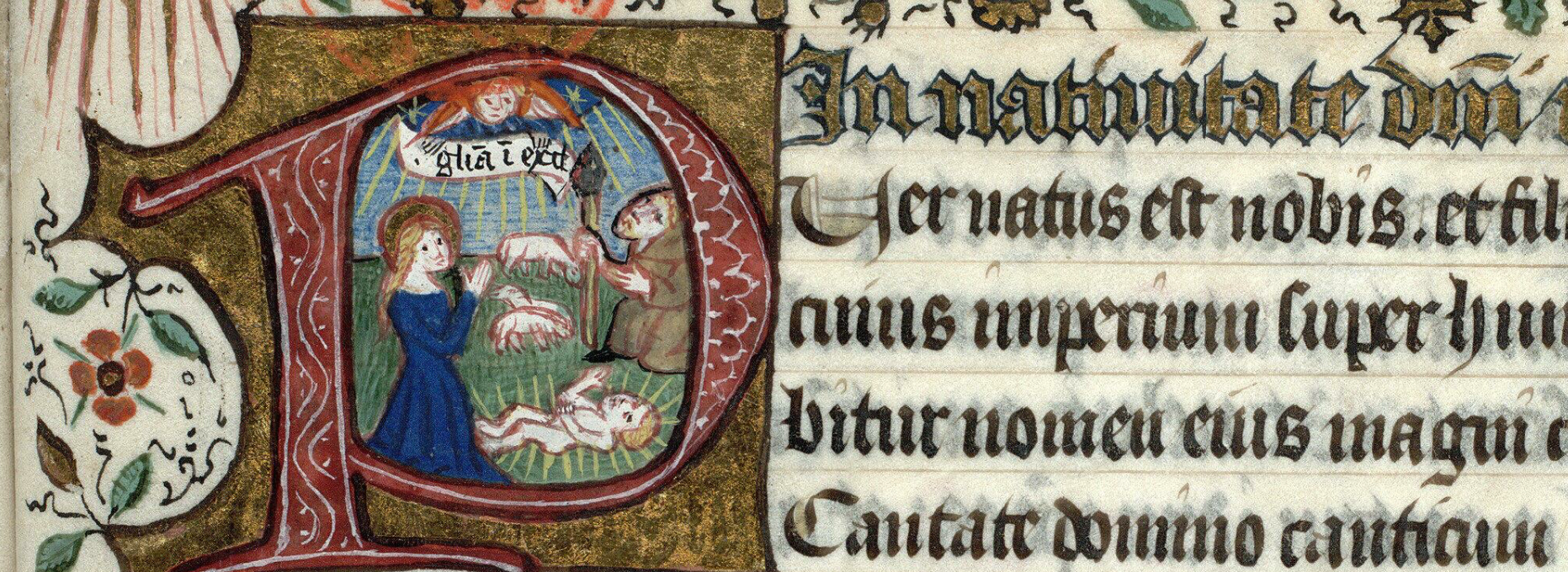
Featured image: the annunciation to the shepherds, from Paris, Bibliothèque Mazarine, MS 527 (fol. 129r).