
Posted by Lucas McMahon
23 February 2026Last week, Lucas McMahon introduced his recently-published work on the legendary Byzantine ‘beacon chain’ of the ninth century, and how his pioneering GIS work shows that such a chain would indeed – just – have been possible to construct. This week, he returns to the topic, asking the inevitable follow-up question: why build it in the first place?
From the earliest days of Islam, the Roman Empire was the prime, eschatological enemy. After several failed Umayyad attempts at seizing Constantinople, the conquest was shifted further to a vague future date. The Abbasid Revolution in the middle of the eighth century set a new dynasty over the caliphate, and the political centre moved from Syria to Iraq. The Abbasids contented themselves with raiding the Roman Empire, and while a few of these were large and dangerous, we see little in terms of serious Abbasid effort at eliminating their rival. An exception to this was during the caliphates of al-Maʾmun (813-33) and al-Muʿtasim (r. 833-42). Al-Maʾmun engaged in major ideological competition with the Empire, and seems to have been working on breaking open its eastern defenses, which was followed up by al-Muʿtasim.
The establishment of the beacon chain by the Byzantines dates to the later years of al-Maʾmun. While the military threat was real – al-Maʾmun had even temporarily relocated the capital back to Damascus for the campaigns – competition was also taking place on another plane. The first hint of this competition is the location of the first beacon, Loulon, which was probably taken from the Abbasids in 831. While on a prominent peak on the frontier, putting the first beacon there made it a sort of trophy.
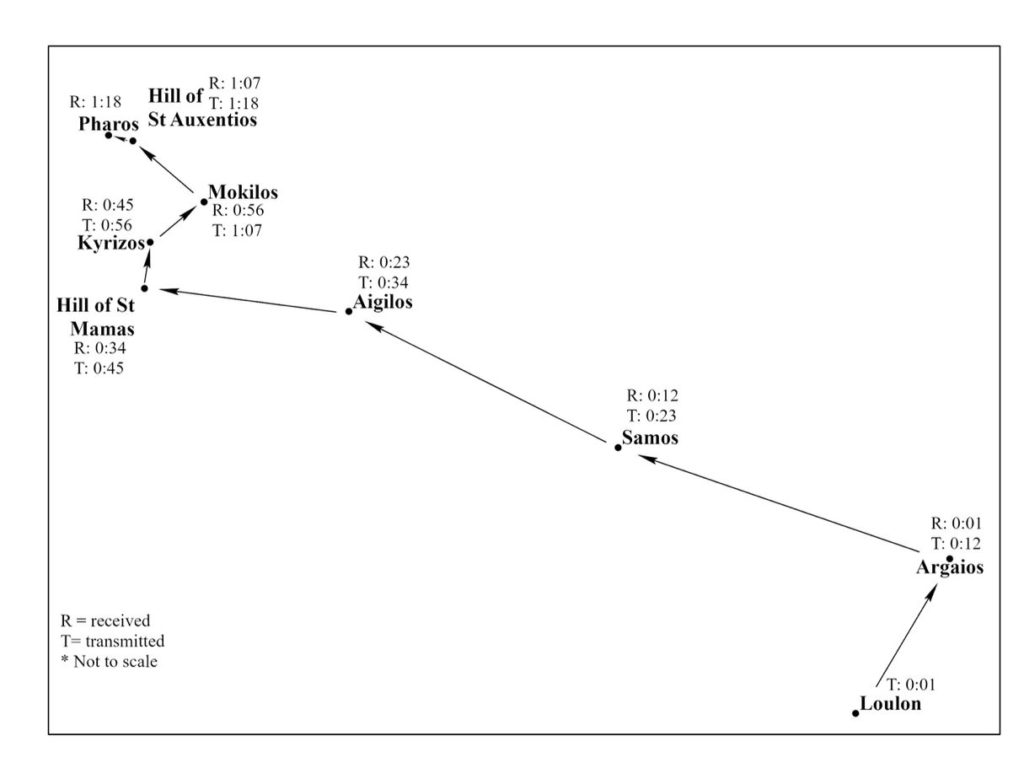
The second indication goes back to how the chain could send different messages, and the curious statement that it did so within one hour. Synchronized clocks at both first and last stations meant that different messages would be sent (and expected) at different hours of the day, while the solution to the latter problem (of speed) was proposed by Philip Pattenden and underscores just how cleverly the beacon chain was designed. Loulon is situated about six degrees of longitude east of Constantinople, meaning that it was around 22 minutes ahead of the capital. The longitudinal difference meant that an “hour” actually lasted a little over 80 minutes, which extends a little bit of breathing room into the system to get the fires going in time.
Longitude was not calculated accurately until the eighteenth century, but scholars in antiquity had tried to do so. Ptolemy’s calculations were notably flawed but his work needed little correction for Anatolia. The Abbasids were also both seeking ancient scientific texts written in Greek, and trying to improve upon them. Under al-Maʾmun, a flurry of efforts were made to calculate the size of the Earth. Observatories were constructed at Sinjar and Damascus, and a number of Arabic works are known from this period on astronomy. Al-Maʾmun was carrying out longitude measurements near the Roman border when he died. The Greek sources also report efforts to bring Leon the Mathematician to Baghdad to gain his learning.
None of the sources make the explicit connection to longitude, but it is far too much of a coincidence that two neighbouring imperial powers whose courts were in regular contact with each other just happened to have an interest in measuring the Earth at precisely the same moment. The beacon chain thus served an immediate, practical end – it brought information about when a major Abbasid campaign might be getting under way far faster than a messenger could. However delicate, it was a tripwire. But it was also part of ideological and cosmological competition between two rulers who both claimed global dominion and expressed it by trying to measure the Earth. The Abbasids sought out ancient knowledge, while the Romans made use of what they already had as part of a re-expression of Roman-ness in light of the dawning realization that Islam was an ideological competitor that was not going to go away. The telegraph was this competition made physical, and when the conflict moved northeast in subsequent years, the chain was abandoned as it no longer served either a practical or ideological purpose.
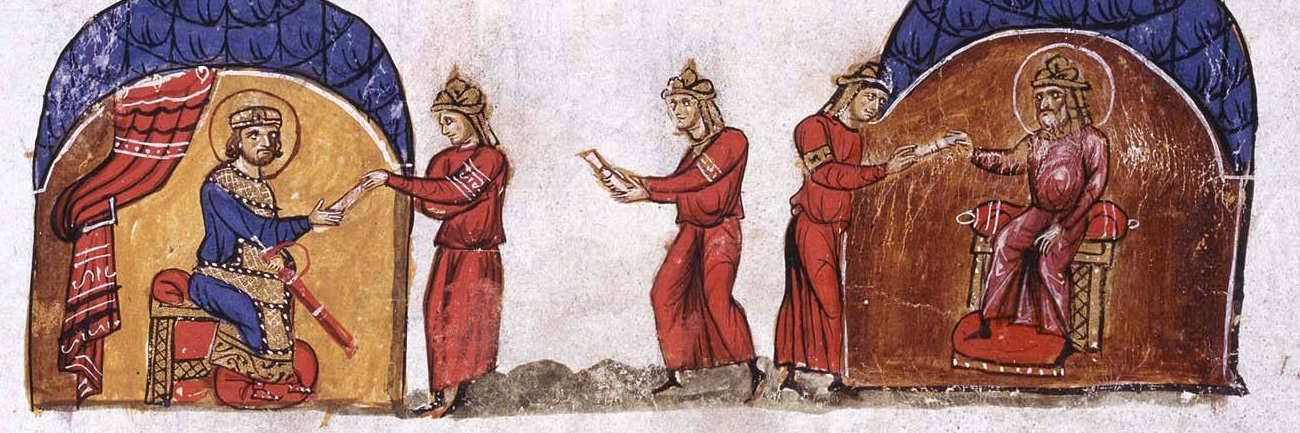
Lucas’ full article is available Open Access in the latest issue of Dumbarton Oaks Papers. Featured image: al-Maʾmun sends a messenger to the Emperor Theophiolos. Madrid, Biblioteca nacional de España, MS VITR/26/2