
Posted by Edward Mills
8 December 2025For our final post of the year, we’re delighted to welcome back Greg Emerick, who completed a BA in History (followed by an MA in Medieval Studies) at Exeter between 2020 and 2024. Greg now works as a trainee archaeologist at Cotswold Archaeology, and in this post, he reflects on how his studies at Exeter set him up for graduate work.
Having thoroughly enjoyed my undergraduate History degree at Exeter, I decided to specialise further in the medieval period which particularly piqued my interest. Postgraduate study in the Middle Ages allowed me to deepen this focus through the range of disciplines taught at Exeter, as I studied modules ranging from English and French language to archaeology. It was this interdisciplinary approach to the course which directly led to my first graduate role in the commercial archaeology sector for Cotswold Archaeology, recruiting in February through the BAJR website.
The 15-credit ‘Field Study’ module proved more decisive than I could have anticipated during module selection. Initially, I hoped to cover a variety of subjects to broaden my experience, without a clear long-term career plan. However, these fieldtrips introduced me to the skills that have become core aspects of my daily work. Completing context and sample sheets and drawing features in section and plan on permatraces came naturally after I had documented observations and archaeological interpretations in the field during the course. Producing sketch, hachure plans and photographs – essential parts of ‘Field Study’ – also taught me the importance of a good photo with the appropriate scale needed for archaeological reports.
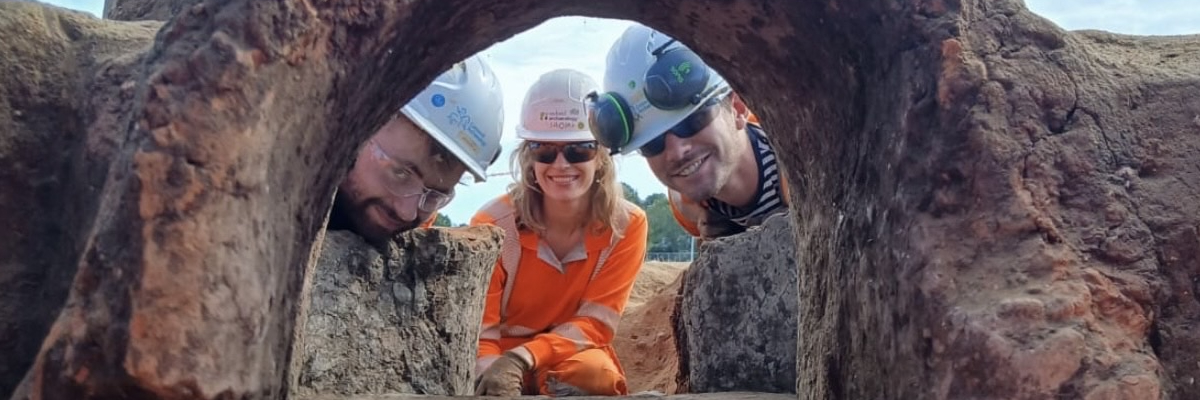
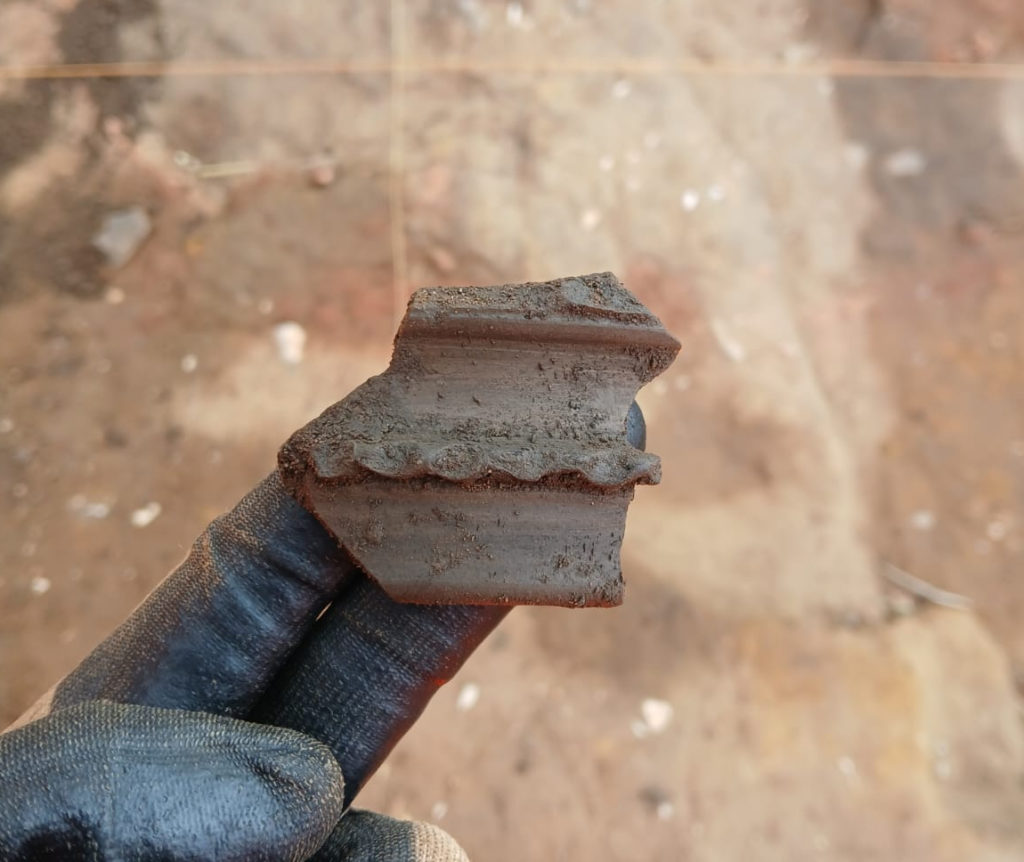
Initially, the physicality of ‘field work’ was a contrast to these more academic ‘field trips’, heightened by the distance and travel time to particular sites. However, after a few weeks’ adjustment to using tools like mattocks, shovels or trowels while excavating and recording ditch slots, pits, kilns and a variety of other features – without any previous experience on voluntary digs – it soon became second nature. As a trainee, I have been fortunate to find an arrowhead within a cluster of neolithic pits, as well as be part of a small team to uncover a rather intact Roman pottery kiln, featuring on the next series of Digging for Britain. Certainly, there is a real thrill in not knowing what features you may work on or uncover next.
I found that embracing postgraduate work in medieval studies for all its diversity in modules really enabled me to make the most of the course, and ultimately guided me toward one of the several career paths it supports. Though I did not have a set career plan during much of my Master’s degree, by learning skills from so many different disciplines I was able to enjoy the journey as new opportunities revealed themselves.
Thanks very much to Greg for sharing his experiences. Featured image: Greg (right) looking through the uncovered, largely intact flue of the pottery kiln, before taking structural samples for environmental analysis and further dating. More information about postgraduate study through the Centre for Medieval Studies is available via the Centre’s website.