
Posted by Gregory Lippiatt
26 January 2026In addition to its regular schedule of seminars, the Centre for Medieval Studies also plays host to a number of reading groups. With the schedule for these groups now available on the Centre’s website, Gregory Lippiatt (with additional input from Thomas Hinton) shares how these groups came to be, and offers a preview of what’s to come.
An academic career can often be characterised as a progression in learning more and more about less and less. The general education of school gives away to the wide exploration of a particular discipline as an undergraduate; this leads to a focus on a particular period, methodology, or theme in a master’s degree, to be replaced in turn by a thesis on a very specific topic within this specialisation as a doctoral candidate. Those of us in academic posts are so occupied with the demands of publications, teaching, and administration that it can be difficult to recover that wider intellectual horizon beyond our immediate interests.
About five years ago, I thought we might provide an opportunity to combat this myopia by organising regular reading groups in the Centre for Medieval Studies that would bring us together as a community to look at items of common interest that nevertheless lay outside of any particular specialism. There was at the time a desire among the doctoral students for more opportunity to engage with Latin, practising Latin through original texts seemed a natural theme for the group. Concerns expressed by some doctoral students about the usefulness of classical Latin training for their medieval sources gave me the idea to organise the readings around texts from Antiquity that had wide reception in the Middle Ages: this way we could explore both what had changed from classical to medieval Latin while seeing how stable the Latin tradition had remained given the continuity of the canon.
We began, naturally enough, with Isidore’s Etymologiae, but have looked at, among others, Virgil, Ovid, St Augustine, Dictys of Crete, and, most recently, the De re militari, a fourth-century military manual by Vegetius. In the quieter summer terms, we read the monastic hours of Whitsun, the staccato rhythm and repetition of the psalms from St Jerome’s Vulgate standing in stark contrast with the mellifluous complexity of Ciceronian and Virgilian style. But whatever we are reading, we are always drawn to the surprising meanings and choices made by these authors. Our sessions are never simple translation exercises: our reading prompts discussion about original intention and medieval reception, wider contextual perspectives, mythologies, etymologies, and the familiarity and strangeness of human experience across the ages.
Anyone who has studied medieval texts knows that where Latin goes, the vernacular languages are never far behind, and so it was perhaps inevitable that the Latin Reading Group would in time be joined by a Medieval French Reading Group running on the same principles, jointly convened by Tom Hinton and Edward Mills. Over the last few years, we have read the Queste del Saint Graal, Floire et Blancheflor and Le Jeu de Saint Nicolas, working our way through these enjoyable narratives over the course of the academic year. Last term saw a further innovation: medieval French temporarily vacated the arena in favour of medieval Occitan, as we spent a term looking at troubadour songs. It was a new and exciting experience; at times, we found the ambiguity of lyric imagery and word order to be as challenging as the Occitan language itself, but attendees met the task with impressive gusto and imagination. With medieval literature increasingly being read via English translation, these activities offer our students and colleagues an invaluable opportunity to get the kind of fine-grained reading experience that can be difficult to access within the scope of curricular activities, and all in a friendly and supportive environment.
Our reading groups are open to everyone, and encompass a range of academics, undergraduate and postgraduate students, alumni, and interested members from the wider community. We span a range of abilities, and our discussion is often enriched by the observations and questions of beginners, which force us to think more carefully about aspects of language that the more experienced might otherwise have taken for granted. The reading group has become one of the highlights of my week in term-time, providing exactly the sense of gratuitous exploration, challenge, and community that I had hoped it would, thanks to the wonderful people who turn out regularly to tackle the unknown so enthusiastically. This term in the Latin Reading Group we will be reading the Thebaid, a first-century war epic by the poet Statius, who would even turn up in Dante’s Purgatorio. Meanwhile, Medieval French Reading Group returns with the Anglo-French prose Brut. More information on dates and times is available on the Centre website; we would love for you to join us!
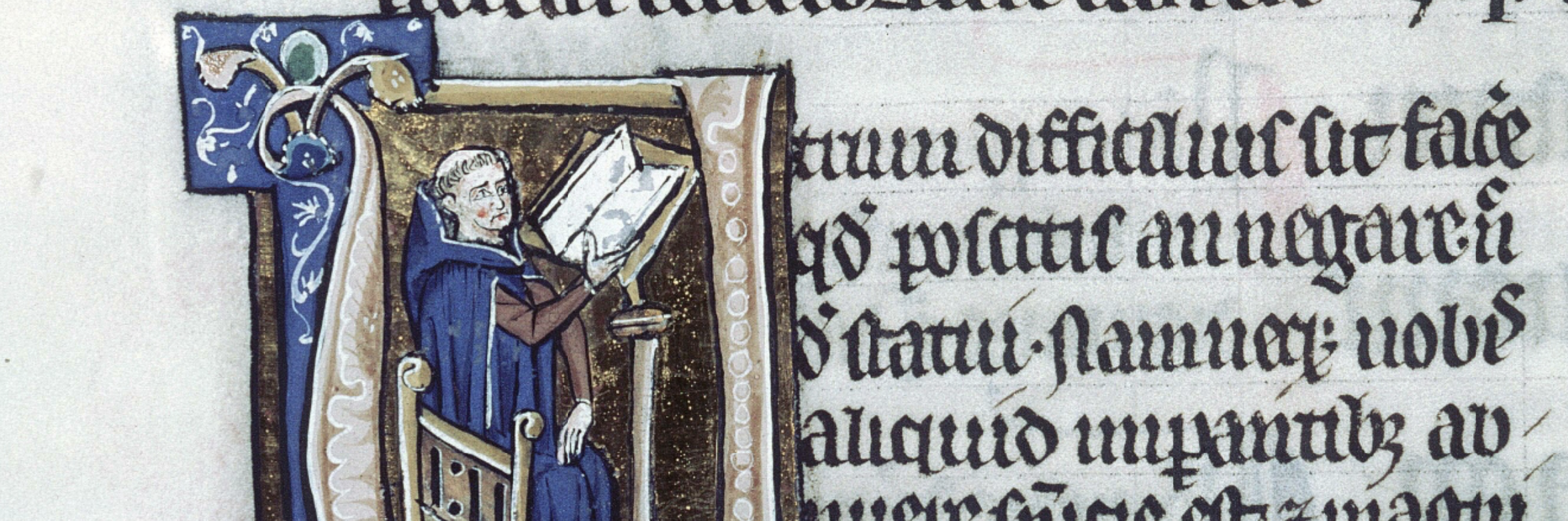
Featured image: Orléans, Médiathèque, MS 41 (p. 214).