
Posted by Edward Mills
2 March 2026We’re excited to launch a new series on the blog this week. In ‘Introducing …’, members of the Centre will share a particular tool, source, or methodology that’s important in their work, and which they feel is deserving of wider attention. This week, Edward Mills looks at a pair of tools from France that help to scratch that ever-present itch for manuscript pictures.
Everyone loves manuscript images. One of the great things about working with manuscripts is that you’re never short of visual material to work with: whether you’ve taken the images yourself or accessed a digitisation, you’re sure to be able to find an arresting image with which to open your next PowerPoint presentation. Levi Roach’s recent inaugural lecture did exactly this, with the screen filled by a colossal image of a charter that provided even non-specialists with plenty of points of visual interest and provoked many questions.
Sometimes, though, you’re coming at the problem from the other way round: you’re exploring a concept, and want to look at how it’s represented in manuscript illustration. Perhaps you’re putting together a conference call for papers on (say) ‘medieval reading’ and need an image to use as a header, or are wondering how ‘madness’ is shown in pictoral sources. Most of us don’t have millions of manuscript images (all neatly tagged by content) on our computers, but happily for our purposes, someone does. Enter the power-couple of digitally-supported iconography: Biblissima and Mandragore.
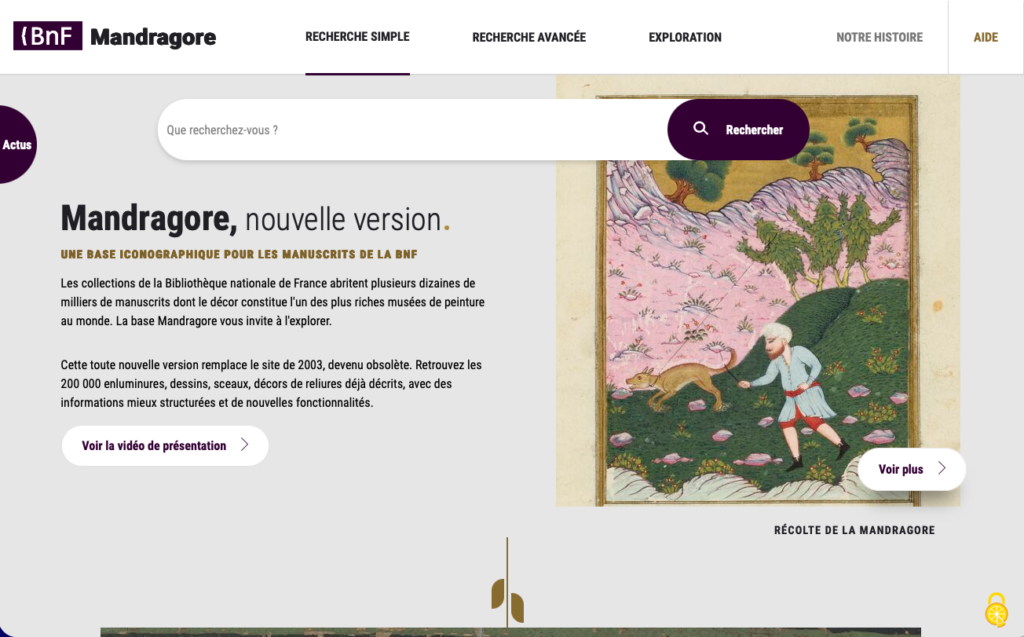
‘Power-couple’ is one way to describe these two resources, but another (perhaps more accurate) would be siblings who both took the same career path. Fundamentally, the two tools allow you to do the same thing: to search for representations of a motif (whether abstract, such as ‘conflict’, or concrete, such as ‘London’), and to view a list of matches across thousands of medieval manuscripts. They’re both the result of the incredible work that goes in the French digital humanities space, and of the two, Mandragore is the elder sibling, having been around since the late 1990s. Mandragore describes itself as ‘une base iconographique pour les manuscrits de la BnF’, which sets out its stall fairly clearly: it’s a discrete project that’s firmly centred on cataloguing illustrations found in manuscripts owned by the Bibliothèque nationale in Paris.
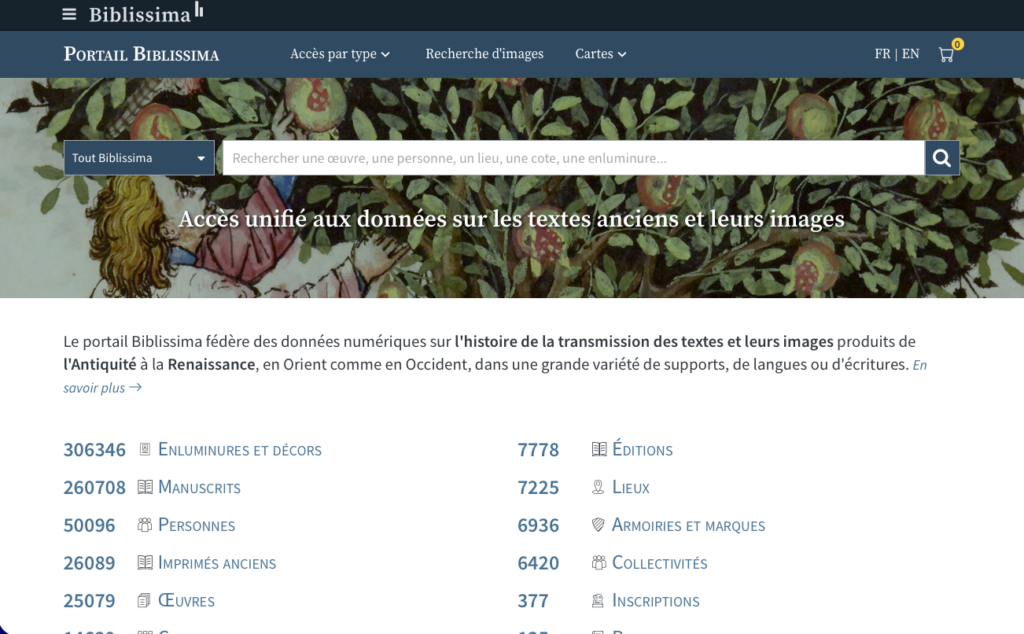
Biblissima, by contrast, has both a shorter history and a wider scope (apologies for the mixed metaphors). An ongoing research project since 2012, it’s not, strictly speaking, a database in its own right. Instead, it’s built around a gateway (in French, portail) that’s a ‘library of libraries’, pulling in data from other platforms that use the open IIIF (International Image Interoperability Framework) and presenting that data in a unified interface. This goes beyond just image description, with Biblissima’s entries also covering whole manuscripts, people involved in their production (from scribes to dedicatees), individual works, and places associated with them. That said, images (grouped under what Biblissima calls enluminures et décors) still form the largest single category.
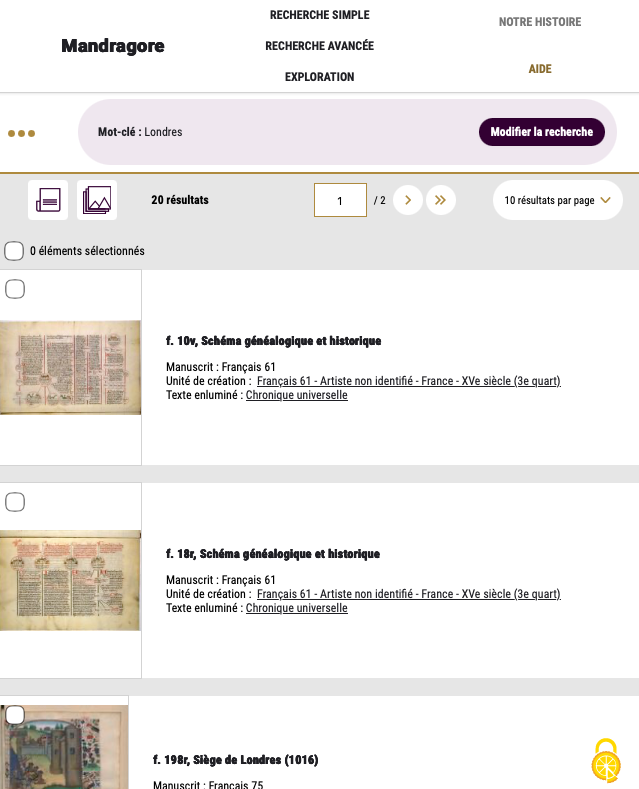
Given these differences of scope and intent, evaluating the two against one another would be a bit like comparing apples and oranges. Both platforms also have uses of which I haven’t even scratched the surface, such as Biblissima’s mapping features and the thesaurus found within Mandragore. When used alongside one another, though, they’re an incredibly powerful way to essentially carry out a Google image search of medieval manuscripts. The two images below show what Mandragore (left) and Biblissima (right) give you when you search for ‘London’: two completely different lists of results, from different places and different holdings.
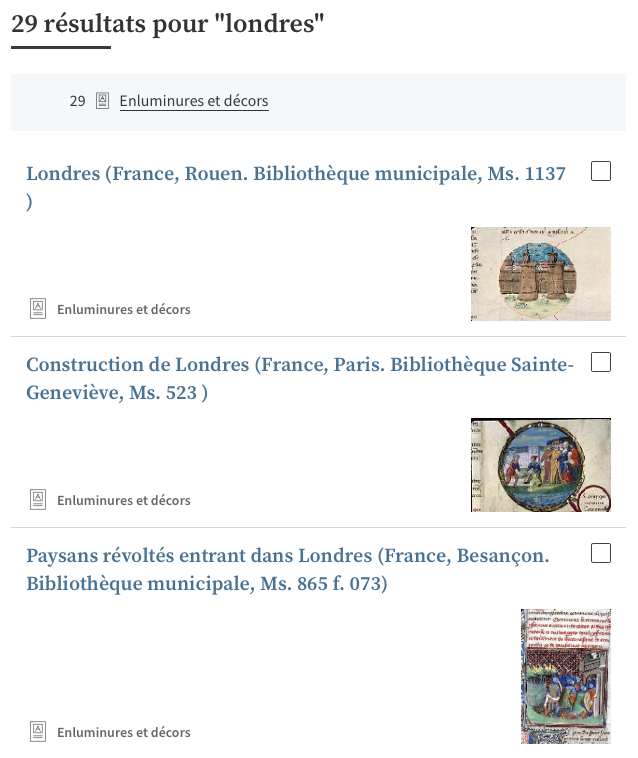
Of course, any resource such as these has its limitations. The first is linguistic: while some parts of Biblissima work with English search terms, and the site as a whole has an English option, you’re still more likely to find what you’re looking for if you use the French term (for non-Francophones: have your dictionary of choice ready!). On a more fundamental level, the results are themselves shaped by the interests of the people doing the tagging: since there isn’t (to the best of my knowledge) any machine-learning going on here to tag the images, an image will only appear in a results list if it has been explicitly identified as relevant to that topic. The first image result in Biblissima (above) is a good example of this: it’s from a fifteenth-century Chronique universelle (‘Universal Chronicle’) now in the Bibliothèque municipale de Rouen, and shows the city of London. It seems logical, then, to tag it as representing ‘London’, but the same image is missing from results for — to pick a few more specific things visible in the minature — mur (‘wall’), portail (‘gateway’), or tour (‘tower’).
Nevertheless, when using these tools, it’s hard not to be amazed at both how easy they are to use and by how powerful they are. These two attributes aren’t often found together, which is itself a testament the sheer amount of hard graft that has gone into both projects (in both cases, decades). Do take the time to explore Biblissima and Mandragore for yourself, and I hope it proves useful as you look to track down that perfect piece of visual interest. Plus, if nothing else, you’ll now know where the images for the Centre for Medieval Studies’ Instagram page come from.
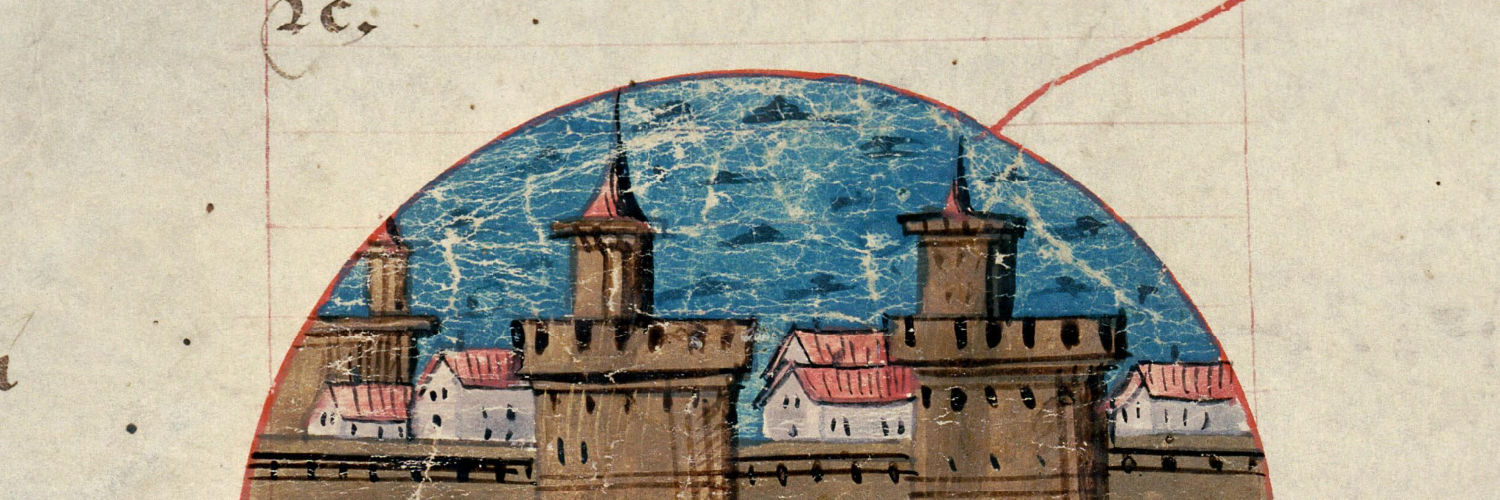
Featured image: Rouen, Bibliothèque municipale, MS 1137.