
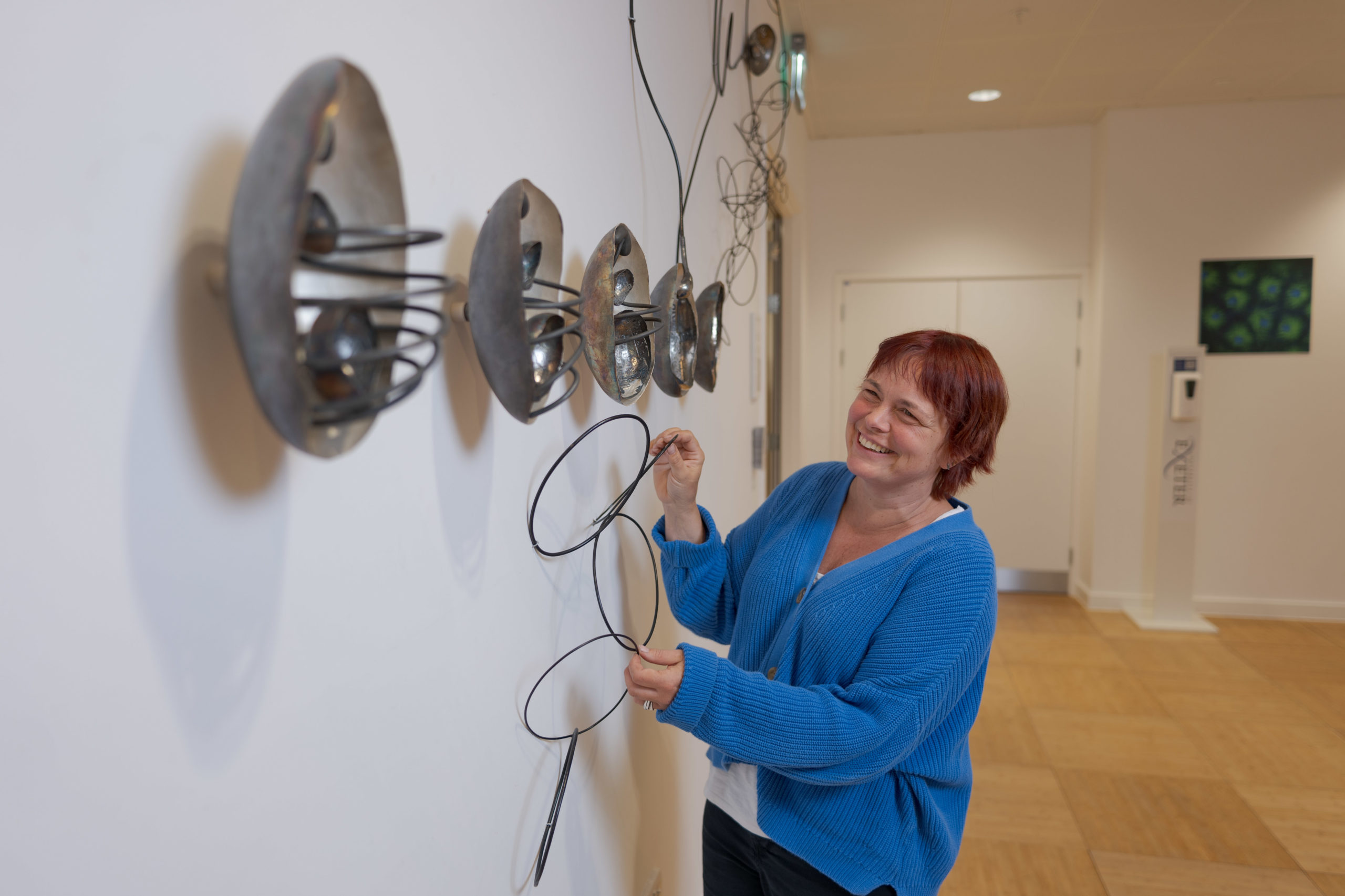
Artist Jacky Oliver with her sculpture “Coil and Spring” at Living Systems Institute
In this interview, Dr Becky Conners from the Department of Biosciences talks about her journey into public engagement, and the role this plays in her work on structural biology – including most recently, her contributions to both the Somerscience and FUTURES festivals on the importance of bacterial phages.
CH: Would you like to introduce yourself?
BC: I’m Becky Conners and I’m a postdoctoral researcher in the Department of Biosciences. I work on bacteriophages, so these are viruses which infect bacterial cells.
CH: You’re dealing with things that affect human health, but considering that you’re looking at that on a much smaller scale, what made you decide to bring public engagement into your work?
BC: I think I’ve always had an interest in public engagement. I’ve done quite a few bits, right from when I was doing my PhD. I just really enjoy people’s response. It’s great when someone’s interested in what you work on.
Because we’re so focused on this tiny little thing, it’s really good when you do public engagement because you have to bring the broader picture into it. I find that quite motivating; it reminds me why I was doing it in the first place. Often it gives you a different perspective. People will ask me questions I don’t know the answer to and I’ll go and research it.
CH: And what are some public engagement activities that you’ve done in the past? What’s brought out those things you enjoy about public engagement?
BC: We worked on microsporidia parasites, and with that, we commissioned an art project which is installed in the Living Systems Institute. I think it’s quite a good talking point. It definitely gets people interested.
As part of that, we organised an art and science workshop in St James’s School, and we’ve got really good feedback from the students. A lot said they had never thought about combining art with science, so it gave them ideas of different careers that might be good for them as well.
Apart from that, I’ve done a Pint of Science talk, and someone who came was a teacher interested in visiting the labs. So we arranged a visit for children from her school to have a look. I felt like we made quite a difference – you forget sometimes that people don’t know what research labs look like, and it’s interesting to them to just see people doing research.
And recently, we ran a stall at Somerscience. That was really good: just the range of different people, different ages. Obviously, the people who come already have an interest in science, but there’s something nice just talking to people about your research.
CH: Especially working with families: the parents might be coming with an interest in science, but their kids might not! And this could be the thing that makes them think about it a bit more.
You’ve covered a few different activities. What are some of the key things you’ve tried to be aware of going into those, and are there any common challenges?
BC: The language you use is really important. Just to try and keep everything simple, because we use so much jargon! Obviously not talking down to people, but just explaining everything you’re doing. Also because we work on things that are really tiny, it’s sometimes difficult for people to visualise. So just having ways of explaining what that means. It gets easier the more you do it. You get to know what engages people.
When I first started, I found it quite difficult to find the right department to get help from. With something like a science fair it’s important that your stall looks good, so it’s good to know where you can get things from so your stall looks as professional as the companies that are there.
CH: Following the engagement activities you’ve done, is there anything different you’d like to bring into this work?
BC: We’ve got FUTURES, and I think we’ll do Somerscience again. I haven’t got any other major plans, but I’m always thinking about it!
It’s important to me to try and make science accessible. I’d hate anyone to think science wasn’t for them! I really enjoy the engagement, and I find it quite motivating to get back in the lab afterwards.
CH: It’s that reciprocal arrangement, isn’t it? Because you go away having learnt from that experience, and you’ve got members of the public thinking about things in a different way.
What would your advice be to anyone looking to start public engagement, particularly anyone conducting practical research that people perhaps won’t come across organically?
BC: I advise anyone to go for it – certainly to try it, because you might as well see if you enjoy it. I think every researcher should be able to talk about their research on a level that anyone can understand, and outreach can be good for practising that.
It is possible with whatever you work on – sometimes it’s just finding that one bit that gets people interested. Definitely give it a go; I’m sure most people will enjoy it.