
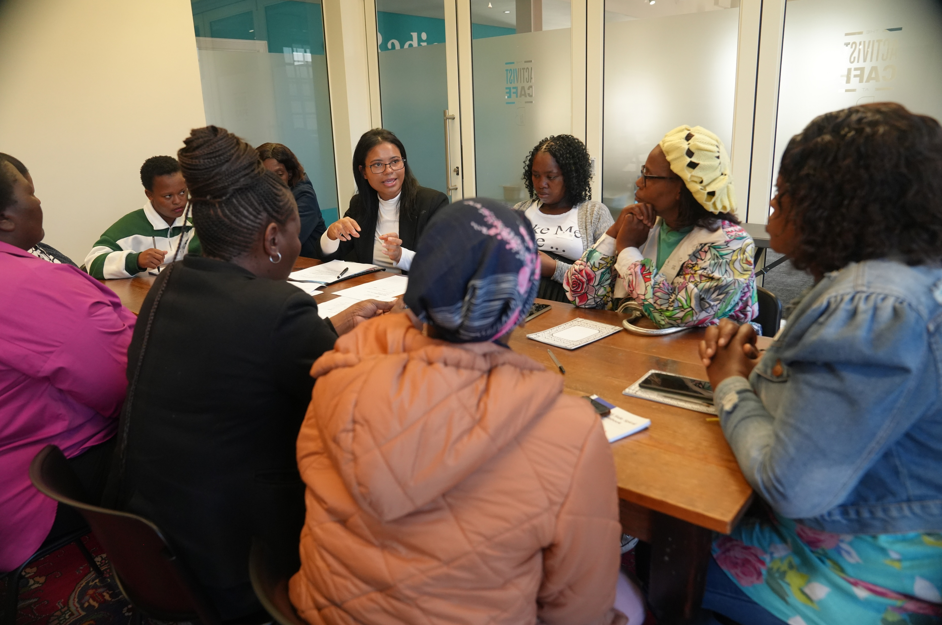
Professor Federico Caprotti and Dr Whitney Pailman share updates on their work exploring the relationship between community resilience, entrepreneurship, economic mobility and navigating infrastructure disruptions in urban, informal settlements in South Africa. With support from the Engaged and Participatory Research Fund, the researchers worked closely with local residents and policymakers.
Amount of award: £3529
Our project engaged residents of the Qandu-Qandu informal settlement in Khayelitsha, Cape Town, South Africa. Building on earlier off-grid innovation pilots, including solar energy initiatives and business models, urban innovation and overlapping infrastructures, and work on ‘traumatic infrastructures’*, it brought together perspectives from energy access and urban geography. This work aimed to highlight the links between community resilience, entrepreneurship, economic mobility, and navigating infrastructure disruptions in South African informal settlements. Community voices were at the centre of this project, offering insights into off-grid infrastructures, lived experiences of disruption to infrastructure, and entrepreneurship as a pathway to economic mobility.
Using a combination of collaborative workshops, co-designing sessions, and the creation of a co-produced video, we invited community members to share their first-hand experience of infrastructure disruptions, resilience, and economic mobility. The workshops in particular brought together residents of the Qandu-Qandu community, City of Cape Town policymakers, researchers from both University of Cape Town and University of Exeter, and a local consultancy, Transition Partners. The sessions highlighted key challenges associated with “traumatic infrastructures”, daily strategies, and motivating factors for participants, as well as helping us identify research questions and gaps. These activities also indicated possible next steps for policymakers, identifying areas where policy messaging could be strengthened through better communication of community insights.
Community members reported that they found the sessions and the broader research process beneficial, particularly the opportunity for direct policy engagement, and having a platform to communicate their daily, often overlooked challenges to policymakers at the City level. Participants appreciated that the work would be shared through a range of outputs, to enable their perspectives to reach wider audiences. The sessions invited them to learn how others in the community practically navigated daily challenges, as well as the diverse ways in which they demonstrated resilience. The workshops also created a space for sharing information on issues that, despite their importance, often receive limited practical attention within relevant policy spheres.
Through our co-produced video session, participants were able to communicate key messages and lived experiences in a moving and accessible way. Its visual and narrative format allowed for a depth of expression that resonated strongly with both community members and external stakeholders.
Intentional, collaborative research design was vital for keeping participants meaningfully engaged throughout, and enabling genuine co-production. Giving participants space to define the most critical issues helps surface new, underexplored research avenues and reveal important connections across topics. While translating these insights into policy is a longer-term process, our work highlights valuable policy implications for off-grid innovation and the navigation of infrastructure-linked trauma in urban informal settlements. It also underscores the need for creative, tailored dissemination to ensure messages reach and resonate with diverse audiences.
We plan to take forward research on the energy-digital access nexus in informal urban areas, an important but largely unexplored perspective which has emerged from the engaged and participatory sessions. This Engaged and Participatory Research funding has been crucial in enabling meaningful dialogue with community members and stakeholders, and we aim to build on these networks through future follow-on funding and collaborative grant proposals. Ongoing, close engagement with local communities remains essential for developing effective solutions to these complicated energy and infrastructure challenges.
* ‘traumatic infrastructures’ refers to the trauma that arises from (ongoing) exposure to unsafe, unreliable, or inadequate infrastructure and services. In urban informal settlements, this includes daily risks such as fires, flooding, and chronic shortages of water, sanitation, and electricity. Our work has found that such exposure creates stress and anxiety, not only from the events themselves but from the constant need to anticipate and mitigate their impacts. The concept encompasses both the physical infrastructure and the socio-technical and socio-spatial systems that reproduce them, including governance gaps, unequal provision, and unaffordable basic services.