
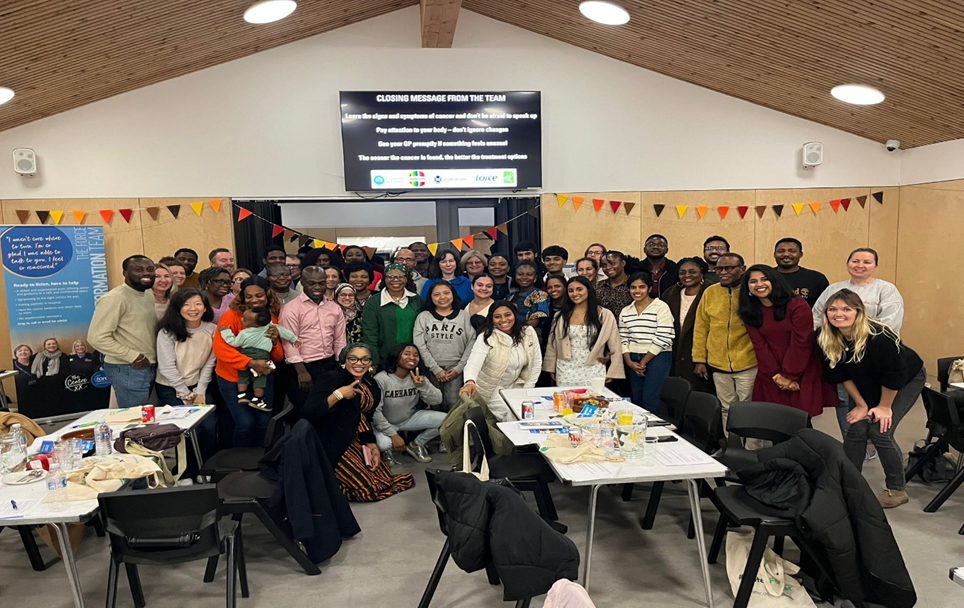
In our final blog piece from our 2024-25 cohort of Engaged and Participatory Research Fund awardees, Lucy Kirkland tells us more about Community Conversations about Cancer, a project which investigated inequalities and underrepresentation in cancer diagnosis, working with a network of community partners across Exeter.
Amount of award: £3,471
Community Conversations About Cancer focused on bridging the gap between cancer diagnosis researchers and underrepresented communities who experience worse cancer outcomes. A community-led awareness and engagement event invited these two groups to join together. Working with Nigerian Community In Exeter (NCIE), Inclusive Exeter, Force Cancer Charity, Exeter Leukaemia Fund, and oncology staff at the Royal Devon and Exeter Hospital, our main aims were to create culturally sensitive engagement, building trust and listening to people’s experiences. Collaborators included Tanimola Martins, Melissa Barlow, Libin Antony, Rosie Mew, Sarah Bailey, Joy Okumbor, Edith Chinnah, Samuel Oluwafemi, Neomi Alam, Auguster Gold, Alex Moseley, Kayleigh Brown, Molly Southwood, and Francesca Aquilina.
Funding enabled the co-design and delivery of an interactive, community-led event, attended by members of African, Ukrainian, Indian, Bangladeshi, Pakistani, Arabic, Filipino, Greek, and Chinese communities. Recruitment was led by trusted community leaders, and the event was designed to create a safe and welcoming space. Participants heard powerful, relatable stories from community members about living with and beyond cancer, alongside insights from an oncologist and an inspirational Patient and Public Involvement and Engagement (PPIE) representative, with opportunities to ask questions throughout. Local charities FORCE Cancer Charity and Exeter Leukaemia Fund (ELF) provided practical guidance, signposting, and volunteering opportunities, while Cancer Research UK (CRUK) and Coppafeel! contributed symptom-awareness resource packs for every attendee.
Working in partnership with trusted community leaders ensured the event was accessible, culturally relevant, and respectful of the diverse communities present. This reinforced the principle that meaningful engagement begins within communities, not institutions, and is grounded in trust, listening, and collaboration. Despite a limited budget, the project achieved high-impact engagement and strengthened community connections for fifty attendees.
The event delivered benefits across multiple groups. For researchers, it strengthened our relationships with communities who are traditionally under-represented in cancer research and PPIE, with sixteen attendees expressing interest in ongoing involvement, demonstrating the value of beginning with listening rather than predefined agendas. Participants reported feeling “welcomed and seen”, “included and heard”, and “empowered with accurate information”. This relational approach supported the discussion of sensitive topics while respecting the complexity of participants’ lives and prior experiences with healthcare. We expect this to contribute to longer-term improvements in trust, inclusivity, and future research practice. For community partners, capacity building enabled attendees to develop confidence, knowledge, and pathways to meaningful involvement, with six expressing an interest in volunteering with FORCE and three with ELF, helping to enhance the diversity and representation of the communities they serve and, over time, reducing inequalities in participation.
Meaningful PPIE is slower, relational, and based on trust. While traditional structures are often well-intentioned, they can risk excluding the very communities they seek to engage. Flattening power dynamics, working through trusted community leaders, and recognising impact in relationships, confidence, and relevance were critical. Repeat engagement relying on transparency, and active listening proved essential to both project success and long-term sustainability.
Following on from this project, the team are continuing to develop community-led PPIE approaches, supporting new contributors, and embedding engagement as a core part of inclusive and relevant research.
Photography credit: Melissa Barlow