
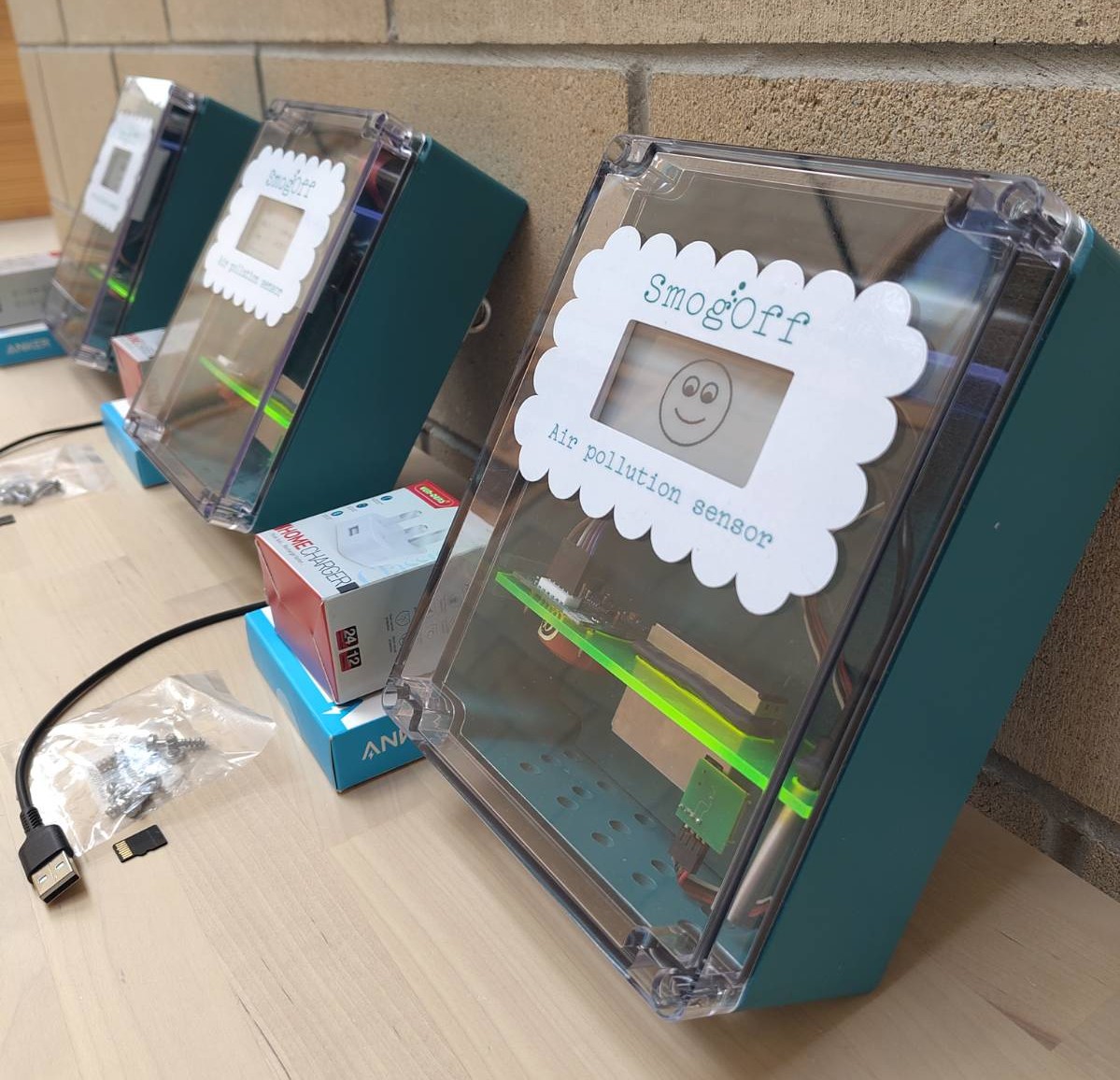
Dr Jo Garrett and the team from Then Try This share insights into their work on SmogOff, a project supported by Civic University Agreement funding to engage local communities with air quality monitoring, and encourage new understanding of air pollution and its impact on our local environments.
In 2025 we received funding from the University of Exeter’s Civic University Agreements fund to re-design and test our air pollution sensor system SmogOff. Then Try This, directed by David Griffiths and Dr Amber Griffiths, supports environmental and social research, working with a range of universities, councils, and fellow non-profits.
Combining Dr Garrett’s expertise in citizen science and human-nature interactions with Then Try This’s commitment to public-facing environmental research, the project focussed on creating an accessible system for monitoring air pollution. Our priority was to make the design easier for people to replicate themselves, make some improvements on known issues with the previous version, and send it out to three community groups for testing. Another layer to this project was involving Dr Garrett to independently interview the participating groups before and after using their sensors, to see what we could learn about their motivations, experiences using the sensors, and understanding of the data.
Although there are loads of air pollution sensors out there (including open source ones like ours), we saw a few gaps which led us to start the project back in 2021 – firstly a need for sensors that were both relatively low cost but also calibrated to official government sensor stations, and secondly a desire for the data to be visible and open to people walking past the sensors in real-time. This second priority meant designing a stand-alone unit that could go on a lamp post or railing on the streets, and so it needed to be battery powered.
In their interviews at the start of the project, the community groups talked about their motivations for taking part – these included current data limitations; to share data and engage the community; a desire to lobby for action; to gather evidence and data; specific concerns about air pollution; and a desire to help with the development of the sensor. We ran an initial online training session on how to use the sensors, and provided ongoing technical support throughout. This involved trouble-shooting when there were issues and also the presentation of the results. The participants had initial concerns over their own skills (predominantly around the technical aspects), the time commitment for battery changes (which needed doing daily), whether their community would be supportive, and whether the sensor boxes might be vandalised. We did our best to support the skills side of things, and to reassure that it would be no problem if the boxes were stolen or broken as that was part of the experiment – we were actively interested in whether that would actually happen or not!
We learned that the participants tended to be overly cautious about where they located their sensors, mounting them high up so people couldn’t see them, or in private gardens for example. This was simply due to caution and concern over theft/vandalism, however it negated the purpose of having a screen so passers by could see the data, and also likely led to much lower pollution readings than expected. In future we would re-iterate early on in these projects how much the sensor location matters.
Overall, the use of the SmogOff sensor was shaped by a complex mix of motivations, enabling factors, and practical barriers. Participants were driven by a desire to address gaps in existing air quality data, engage their communities, and support the development of an open, accessible sensing tool. Use of the sensor enabled meaningful engagement in one case, and, in another, provided reassurance where results aligned with previous monitoring.
For the team, the collaboration was useful because Dr Garrett acted like an independent broker between the work and the people using it, getting more honest reflections on the issues they faced to help improve things. It provided an opportunity to focus on project delivery, while Dr Garrett gained confidence in leading this type of work. The project revealed some practical issues with the device, which we are keen to address as we continue our collaboration, ensuring future work is adapted to further develop the success of our aims.