

In her blog piece, Amy Chinner-Evans draws on recent Patient and Public Involvement and Engagement, which aimed to address uncertainty in medical decision-making. Working with patients with multiple long-term health conditions (MLTCs), her collaboration will inform ongoing research as part of her wider PhD programme.
Amount of award: £300
“Medicine is a science of uncertainty and an art of probability” – Sir William Osler (1849-1919)
Uncertainty is common when making decisions about healthcare. It is recommended that healthcare providers talk about this uncertainty with patients experiencing multiple long-term health conditions (MLTCs) so decisions about healthcare can be made together. However, there is currently a lack of guidance for doctors on how to talk about uncertainty with their patients. There is also a lack of research into what patients and doctors think about discussing uncertainty when making health-related decisions.
Including patient and public involvement (PPI) in this research from the start was important to help us understand what matters to people with lived experience of MLTCs with regards to discussions about uncertainty as part of healthcare decision making. This will help refine our research going forwards to ensure that we focus on areas of importance for patients and the public. It will also help identify who to involve at each stage of the research to ensure consideration of diverse contextual influences, building supportive partnerships to influence change.
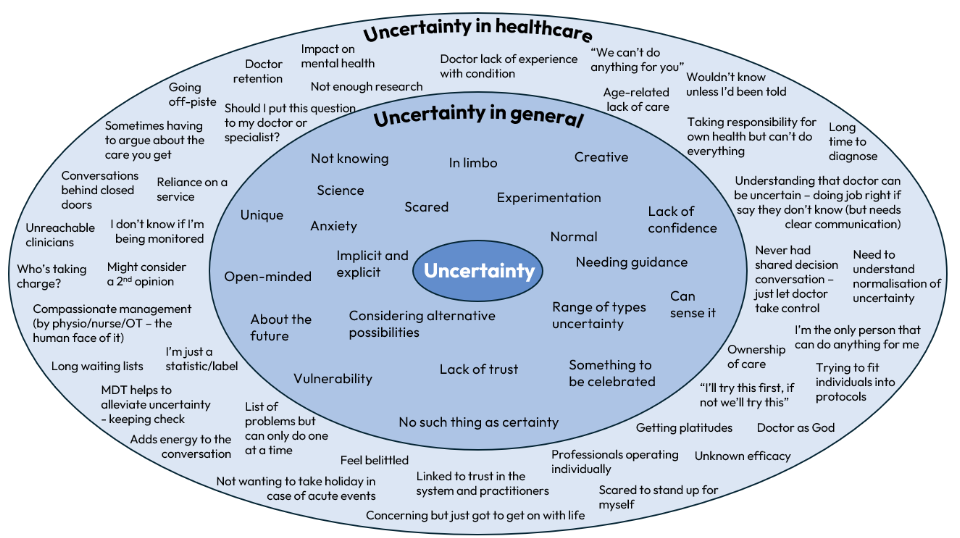
Through an online workshop, we aimed to explore what uncertainty means to people with lived experience of MLTCs and who they think might be interested in or affected by this research. I thought it was important to first understand what “uncertainty” means to people who have experience of living with MLTCs day-to-day. Therefore, for the first activity we completed an adapted circle mapping exercise (Robinson, 2024) to explore two questions:
- What does uncertainty mean to you in general?
- What does uncertainty mean within the context of healthcare?
Following a short break, we then moved on to a stakeholder mapping activity (adapted from the Research Excellence Framework (REF) impact toolkit (Tilley et al., 2018) and Improvement Service (n.d.)) to explore who should be involved in this research going forwards to improve its relevance and impact for people with MLTCs and primary care in practice. The PPI members identified range of potential stakeholders and mapped them onto a matrix of interest and influence.
Feedback from PPI collaborators about the benefits of participating in this workshop included:
“It gives me the confidence to have a more honest consultation with HCPs”
“I could share … things that I cannot always share”
“Brought to my attention the importance of a subject which is fundamental to the clinician and patient relationship”
From a researcher perspective, I found this workshop particularly helpful to allow me to centre the voices and experiences of the PPI members in relation to the communication of uncertainty. It was an invaluable opportunity to reflect people’s contrasting experiences and differences in viewpoints e.g. reflections on the dual nature of uncertainty. This was beneficial for the development of my own thinking around the concepts central to my research questions (which really helped to improve my upgrade presentation!) and to guide considerations of who to involve in future study development and dissemination work.
I am currently building on this PPI work to develop a qualitative interview study, exploring the experiences and perceptions of the communication of uncertainty for both people with MLTCs and GPs. This is part of a wider PhD programme of work to inform the development of an evidence-based educational intervention to support GPs with the communication of clinical uncertainty as a component of shared decision-making with people with MLTCs. PPI collaborators with lived experience of MLTCs will continue to be involved throughout the design and completion of this work to ensure the research design and outputs remain relevant for this population.
With sincere thanks to Alex Aylward (Independent PPIE volunteer), Leon Farmer (PPIE collaborator) Lynn Tatnell (Independent PPIE volunteer), and Anonymous (PPIE collaborator) for their time and feedback as part of this workshop.
References:
Improvement Service. (n.d.). Introduction to the Power/Interest Grid. Retrieved 28th May from https://www.improvementservice.org.uk/business-analysis-framework/consider-perspectives/powerinterest-grid
Robinson, L. (2024). Creative data generation methods: The self-portrait and relational map. Retrieved 12 December from https://www.ncrm.ac.uk/resources/online/all/?id=20836
Tilley, H., Ball, L., & Cassidy, C. (2018). Research Excellence Framework (REF) impact toolkit. https://odi.org/en/publications/research-excellence-framework-ref-impact-toolkit/