
Photography credit – Ben Knight
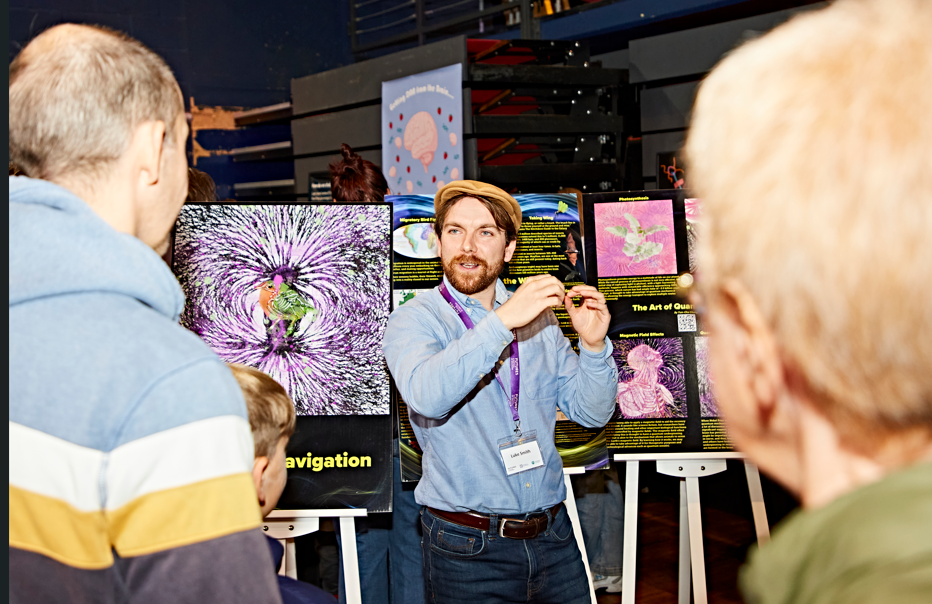
Dr Luke Smith from the Department of Physics and Astronomy speaks to the public engagement team about how public engagement can be used to address misinformation and inspire new audiences, sharing his experiences of studying quantum biology and the future applications of this microscopic world.
CH: Would you like to introduce yourself?
LS: I’m Luke. I’m a post-doctoral research fellow, and I study broadly the field of quantum biology. This seeks to understand whether the counterintuitive features of physics at the quantum scale – so the scales of, say, atoms and molecules – empower biological processes.
CH: You hear the word ‘quantum’ and it has this association with being very erudite, almost science fiction. So what made you interested in bringing this subject to members of the public?
LS: I think precisely that association. Quantum is counterintuitive in a sense because it differs from our interpretation of the world at the macroscopic level. There are areas like quantum healing, which uses pseudoscience to sell some sort of product. And they’re based on things that aren’t scientifically founded, but use the word ‘quantum’ because it’s mysterious to the public.
Part of public outreach is to show that in an emerging area such as quantum biology, the field is founded upon very rigorous rules. It’s important that the public is able to trust this science and understand where it comes from.
CH: Clearly there is intrigue – whether or not that’s founded in legitimate science – so how does that public participation feed back into your work?
LS: Because quantum is in part founded upon mathematics, it’s hard to convey that directly to the public. You have to look for how those systems can be interpreted in visual ways, or their macroscopic effect. This allows you to step back and see a bigger picture, and being aware of what the public is interested in does help you see new avenues for your research to be impactful.
CH: From those public engagement activities, what are the key things you’ve taken away, and what are some challenges you have had to navigate?
LS: In my case it was going beyond what I do day-to-day, and translating that into something that the public is going to be able to understand and get interested in. And this was achieved through this VR experience.
I like seeing when the public get wowed by what’s going on. When you’re working day-to-day with it, it becomes second nature. It’s still interesting, but you don’t step back to realise that bigger picture.
But there is a challenge in that. Once you have that initial spark of interest engaging the public, how do you carry that forward to have the most impact?
CH: Building on that, would you be interested in getting involved in public engagement in the future? Are there particular communities you’d like to work with, or activities you’d like to try?
LS: For sure. I’ve carried out this event at the British Science Festival and two of the FUTURES Festivals, and some internal events at the Living Systems Institute as well. Each time, I’ve incrementally grown the project. I would like to develop it into a larger platform people can engage with, perhaps online, so they can access these resources more easily. One thing I would like to get started is a podcast, demystifying quantum science for the public, but also providing a platform for underrepresented researchers.
Because science isn’t about one person, it’s about a joint effort, and a community coming together with some common goal or dream in mind. It’s important to show the public that there’s a human side to it.
CH: What would your advice be to someone looking to undertake public engagement for the first time, particularly someone working in this field, trying to make their research known to audiences who might be more familiar with the pseudoscience or mystified version of things.
LS: When you’re creating this platform for public engagement, it needs to be engaging. And that may take it beyond the fundamental aspects of research, because the public aren’t going to just be interested in a technical presentation.
But it has to be conveyed that these things are built on rigorous science and foundations as well. And that’s difficult in a short event where the majority of what you’re able to accomplish is pulling the public in with interest. You need to go in with multi-level explanations, and get a feel for an individual-by-individual basis as to what people are receptive to. Not everyone wants to delve into things there and then, so having resources they can follow up with is very useful. That way you inspire new generations to go into science, or follow whatever ambitions they want to, but formed on information.
You also allow the public to fully understand what is possible beyond the hype and pseudoscience, so that they’re not misinformed. And that will help in terms of allowing the most effective technologies and applications to be developed to benefit society.