
Dr Alison Williams and Michelle Black, Leading Edge Curriculum Leads
What does it truly mean to prepare students for life beyond university?
At Newcastle University, the Education for Life 2030+ Strategy responds to this question by
placing core skills and attributes at the heart of a university-wide commitment to preparing
students for their futures.
Why Newcastle created the Education for Life Skills and Attributes
The development of Newcastle’s Education for Life Skills and Attributes emerged from a simple but
powerful question: What kinds of graduates do we want to develop for the future?
This question is familiar in higher education, but it has renewed urgency in the context of
technological change, global disruption, social injustice, and the growing need for lifelong
learning. Underpinning our Education for Life 2030+ strategy is a fundamental commitment to
support our students to be fit for their futures.
Our task was to create a model that recognises the complexity of the challenges facing our
students while offering a practical, inclusive and future-focused approach that can be
embedded within and beyond every degree programme.
We recognised that skills development was already happening in many places across our
curriculum – but often only implicitly. The challenge was to make these opportunities more
visible, intentional and equitable across all our programmes. We needed an approach that
supported students to recognise and reflect on their skills and attributes development across
their whole university journey, and to help academic teams to embed this meaningfully into
their programmes.
What shaped our thinking
The design process was informed by both scholarship and collaboration. We drew on
international frameworks, employer insights, and sector-wide research to identify a rich set of
capabilities that align with the needs of today’s learners and tomorrow’s workforce. This was
paired with a wide-ranging process of co-creation involving academic and professional services
colleagues, students, alumni, and governance groups.
Crucially, our thinking was given focus by Ehlers’ (2024) triple helix model of future-oriented
learning, which conceptualises the development of learners across three interwoven domains:
academic, personal, and professional. This approach provided us with the opportunity to
rethink skills and attributes development more holistically, inclusive of students’ academic
experiences as well as part-time work, clubs and societies, caring responsibilities and alike.
We adapted Ehlers’ model to suit our context, embedding it in a Newcastle-specific values-
driven structure that reflects Newcastle’s identity and aspirations.
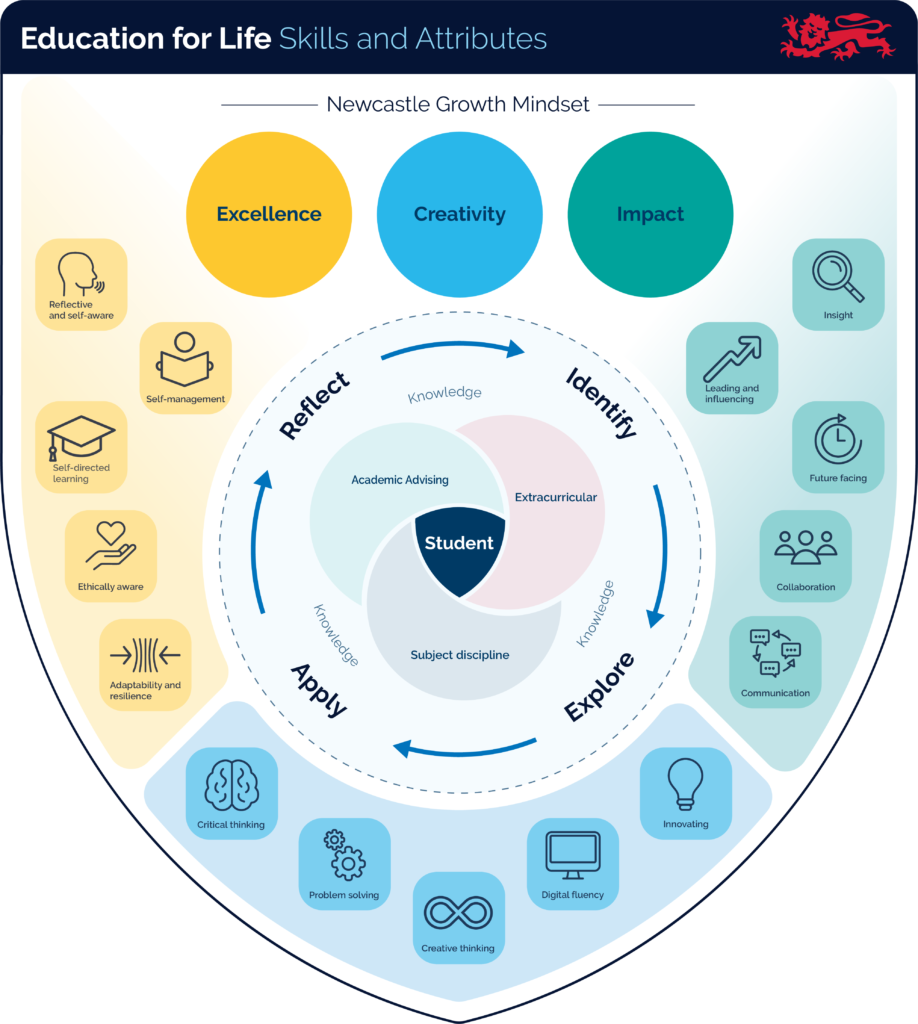
The Newcastle Growth Mindset Clusters
We structured our approach around our university’s aspirational values – Excellence,
Creativity, and Impact – which act as three growth mindset clusters for the skills and attributes.
Positioned within the broader institutional strategy, they provided a foundation for clusters of
skills and attributes that reflect the kind of mindset we want our students to develop as they
learn, explore ideas, and apply their knowledge in real-world settings.
Each cluster includes five skills and attributes, giving a total of fifteen. This number reflects core
skills and attributes identified in research and employer literatures as essential for future
graduates. We don’t expect all students to develop all fifteen; instead, we will support
colleagues to make intentional, discipline-relevant choices so students can identify, explore,
apply and reflect on their skills and attributes throughout their university journey.
A student-centred, values-led approach
Our aim is coherent yet flexible – aligning with diverse disciplines, levels of study, and delivery
modes while centring students’ future needs. By embedding growth mindset clusters, we o er
more than transferable skills; we provide a model that fosters empowered, purposeful learners.
Our approach is student-facing and student-led, with the fifteen skills and attributes visible in
programme documentation, surfaced in teaching, and reflected upon throughout the student
journey.
Looking ahead
Newcastle’s Education for Life Skills and Attributes approach is more than a checklist – it is a long-term
commitment to embedding future-facing learning in every programme. As we implement it
across the University, we aim to support students to become confident, creative, and capable
graduates.
As a core part of the Leading Edge Curriculum Framework, it combines scholarship, co-design,
and our institutional values to shape a distinctive educational experience – one that ensures
students are fit for the future.
Dr Alison Williams is Dean of Postgraduate Research at Newcastle University
Michelle Black is Learning Design & Curriculum Development Advisor at Newcastle University