
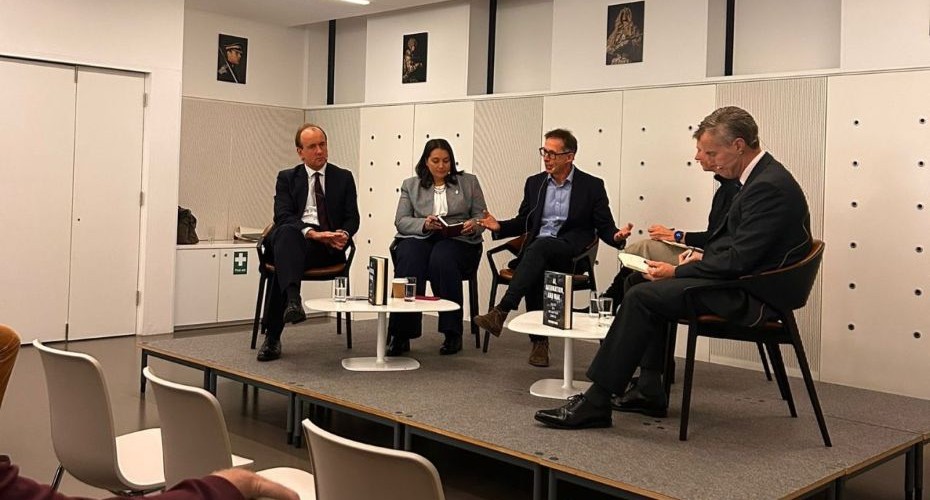
The National Army Museum was the venue for the book launch of Professor Anthony King’s new book AI, Automation, and War. The panel, consisting of Zac Stenning, Clodia Matthews, Simona Soare and Rob Bassett Cross, brought a wide range of operational and academic experience to this difficult and vital topic. The panel was expertly chaired by Clodia Matthews who posed a series of challenging questions to the panel.
Anthony King began by laying out the central thesis of his book. AI will not automate war. But it will change – and already has changed – some aspects of military operations. Above all, fusing and processing masses of data it will facilitate and improve military intelligence and situational awareness. In particular, AI allows the armed forces to plan more quickly and effectively; to conduct cyber operations; and perhaps most importantly to target more quickly, more deeply and with greater fidelity than ever before. However, to harness the power of AI, the armed forces are forming a deep partnership with the tech sector, which is collaborating with them to build new data architectures and algorithms. To make AI work, civilian technicians have deployed into operational headquarters, working for commanders, alongside military staff. A military-tech complex is appearing of profound historic import.
The panellists often challenging observations in response to Anthony King’s work. Rob Bassett Cross laid out the major obstructions to the application of AI. He pointed to the regulatory environment and the difficulties of generating good data for the battlefield. He pointedly noted that while Henry V would recognise the muddy struggle on the ground in Ukraine, those battles took place under something which looked more like Star Wars.
Picking up on this cue, Simone Soare suggested that the potential for AI was prodigious, on the basis of her extensive experiments and simulations with the armed forces. AI might not just be limited to subfunctions of targeting or planning, but might soon be able to develop the capacity to filter a mass or data so that it framed, informed, and perhaps even determined the cognition of the commander. AI on her account would be a constitutive element in a new socio-technical military network. Clodia Matthews emphasised in her questioning that we could not forget the technical aspects of AI: the data, the neural networks, and the computer stacks required to operate algorithms.
The panel did not come up with any final solutions! But laid out a vision of how AI has been transformed war, strategy and military operations, and how it might in the future. And they had some fun too!