
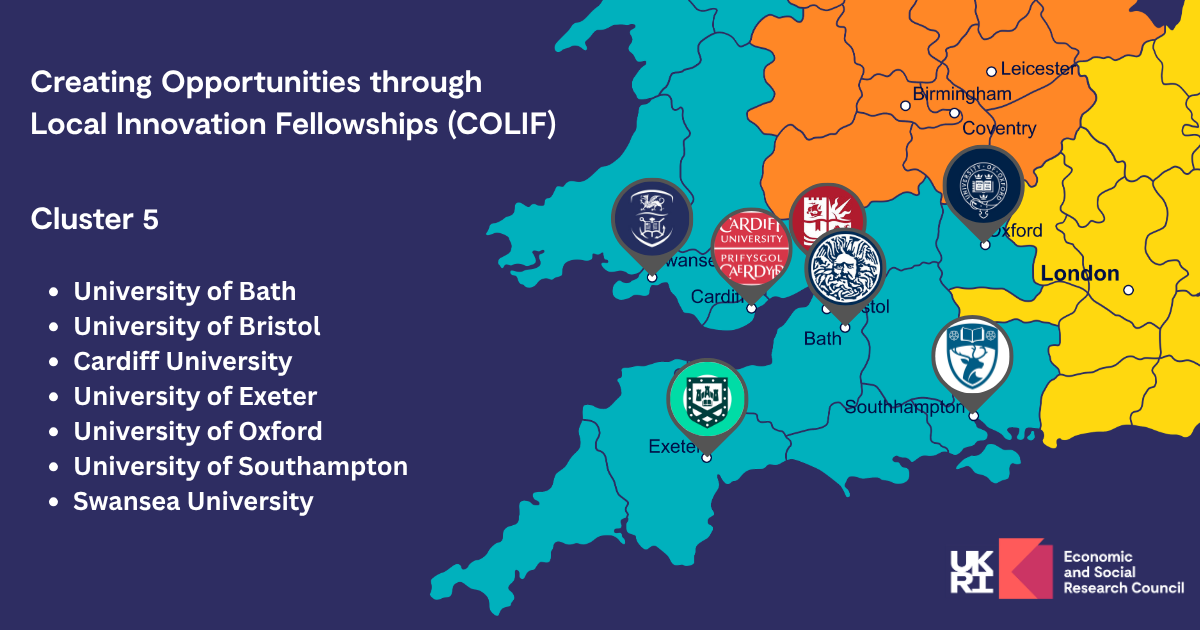
Launched as a pilot scheme in 2025, the Creating Opportunities through Local Innovation Fellowships (COLIF) scheme was introduced to foster local opportunities through collaboration between Higher Education Institutions, and local industries, policymakers, and communities. UKRI funding was awarded to universities across the country, to be used as part of a cross-institutional collaboration exploring geographically-relevant challenges.
As part of this programme, the University of Exeter partnered with the Universities of Bath, Bristol, Oxford and Southampton, as well as Cardiff and Swansea Universities. Through this partnership, they worked with civic partners, who designed research questions for two separate projects, tackling inequalities within the region.
Green Skills (working with the New Forest National Park Authority)
The first of these initiatives used the allocated funds to work with the New Forest National Park Authority investigating the status of the local green employment sectors. Green employment, referring to jobs with a direct connection to environmental conservation and restoration, was identified as needing further recognition and support.
The study produced a series of recommendations for improving the development and recognition of green skills, ranging from small-scale changes to infrastructural amendments. To give a few examples, providing more equitable green employment pathways; embedding sustainability into curriculums; and developing Green Skills Hubs were each scene as vital for the local success of the sector. The solution, then, much like the research behind it, should be built on collaboration, and the incorporation of expertise from academia and beyond. You can find the full report here: Improving visibility and access to green careers in Hampshire and the Solent.
Inclusive Employment (working with the Oxfordshire Inclusive Economy Partnership)
In conjunction with the Oxfordshire Inclusive Economy Partnership, the second COLIF project similarly explored questions linked to local labour markets, but with a particular focus on inclusivity. This drew on perspectives from local authorities, education providers, and the Voluntary, Community and Social Enterprise (VCSE) sector to develop a more holistic understanding of the challenges to inclusive employment, and how stakeholders can effectively mitigate against these.
The resulting project report highlighted the importance of lived experience perspectives in these conversations, recognising that stakeholders should incorporate community voices from the beginning, and navigate the complexities of the issue with those who understand it closely. It also advised all stakeholders to reflect on their actions – have they effectively built a space for shared learning, and cultivated trust within communities? You can find the full report here: Oxfordshire Inclusive Economy Partnership (OIEP).
*
The 2025 COLIF pilot raised some valuable questions around the process of developing opportunities, and the role of Universities in promoting regional growth. Contributors to the project were invited to share their experiences, reflecting on the geographical spread of the projects, the realities of working across multiple organisations, and the outputs and outcomes of their extensive work. It is hoped that the projects supported through this scheme will continue to benefit affected communities, and provide a stepping stone to further discussions around pressing regional issues. You can read more via this report, or read this blog piece by the University of Bristol.