
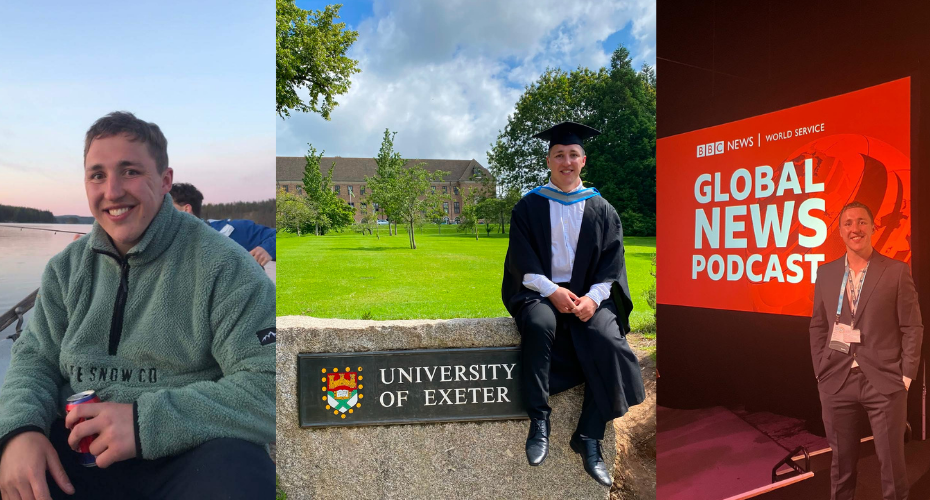
Narrowing down A-level choices can be tricky but it was alumnus Jacob Evans’ (Geography with European Study, 2021) decision to choose Geography that not only led to his studies at the University of Exeter but was a stepping stone to his working as a journalist at the BBC World Service. We caught up with Jacob to map out his career so far.
Jacob was drawn to Geography as it existed at the crossroads of his interests: science, people, cultures and global politics. So, how did the jump to journalism happen?
Growing up two of his favourite shows were Top Gear and Ross Kemp: Extreme World. Jacob shares, “I’ve always loved documentaries and travelling and meeting people from different places and I thought this would be a good career path for that.” This merged with what he enjoyed about Geography, “that we look out of a window or up at the sky and say, ‘why is that there?’ or ‘how did that happen’. I’ve always felt the same about other topics such as conflict or natural disasters: ‘Why? How? Who?’” Jacob’s constant quest for answering these questions (about pretty much anything he’s ever seen) led him to carve out his career path in the sector.
Plenty of tributaries also flowed together to create the direction that the river of his life has taken to date. Acting as reminder of how we’re all a sum of our choices, experiences and interests. For instance, his time at Exeter allowed Jacob to “be nerdy about the things [he] liked” and explore topics of interest critically with clear evidence and sourcing. He credits the academic rigour developed during this university chapter as integral to shaping his career since and recollects that the study of climate change played a huge role. Noting, “Not just what climate change is, but the consequences already facing communities around the world and solutions being drawn up.”
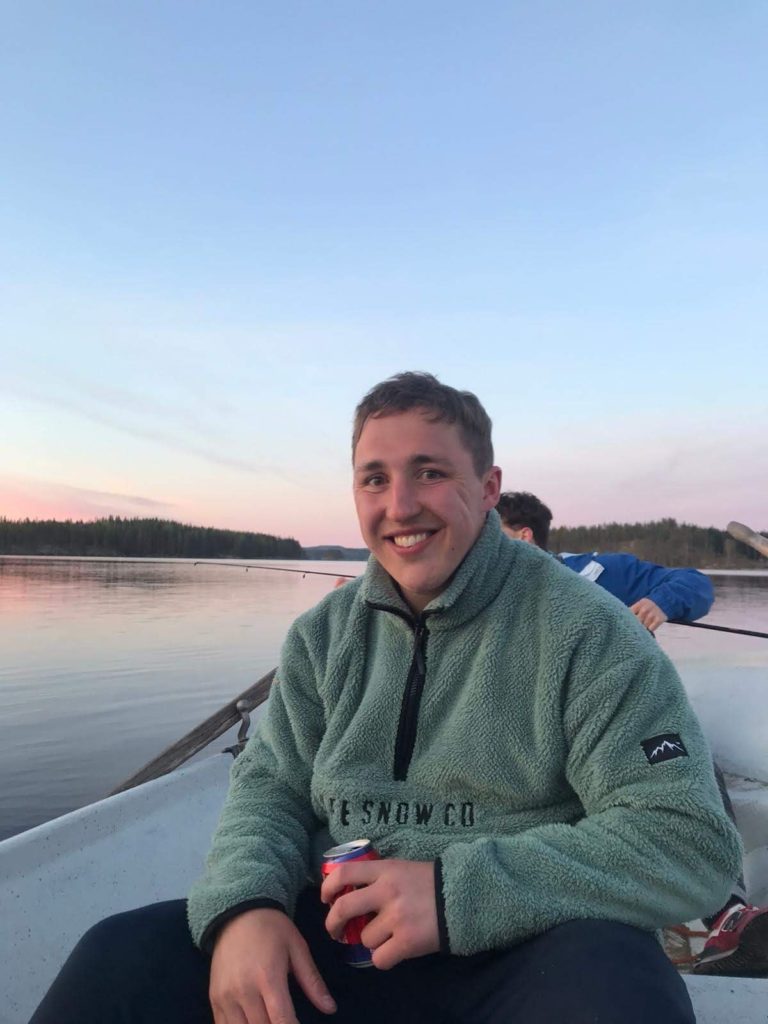
During his second year at Exeter, Jacob took part in a field trip to Brazil, and this along with his ERASMUS year at the University of Helsinki (pictured left) have had lasting impacts on him personally and in his career. These experiences have allowed him to flourish in several key parts of his work: travel, communicating with people from different parts of the globe, and being able to balance working both independently and in diverse groups. Jacob notes, “These are all vital skills I picked up on my year abroad and at Exeter too.”
After graduating from Exeter Jacob pursued a master’s in TV Journalism at City St George’s, University of London followed by a two-year graduate apprenticeship with the BBC before starting full time at the World Service as a journalist. A job which has seen him travel around the world seeking and sharing stories.
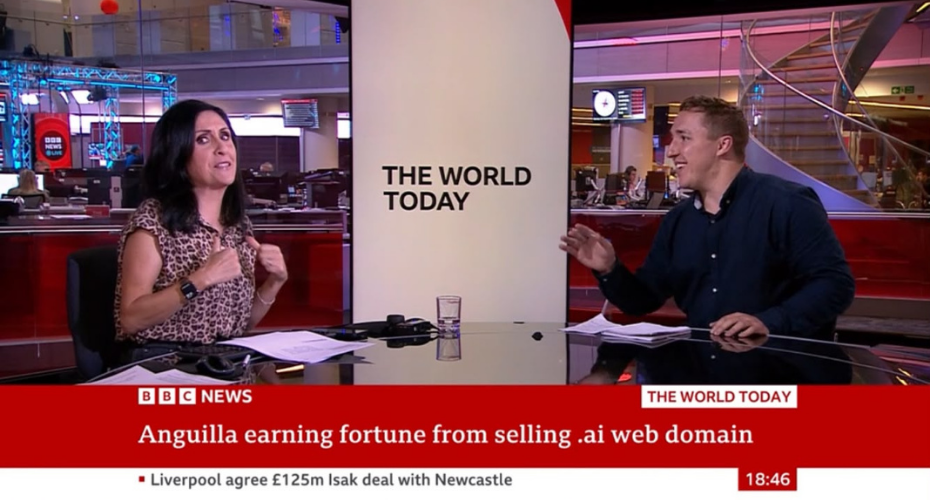
We could imagine trying sum up the highlights of his career so far could be a bit like trying to explain your favourite story to a friend in between tube stops so instead wanted to know what moments of his career made him feel surprised, inspired and hopeful.
For surprised Jacob recalls, “I did a story about surface flooding in London and fully dove into my Geography arsenal once. This story was called ‘Should London become a sponge city?’ and was all about why London floods so much when it rains and what can be done. My online article ended up on the BBC News homepage and was among the top ten stories of the day, with more than a million readers. On social media it gathered huge attention and I even did a package for the TV and radio news. I felt surprised by the interest both at the BBC and among the audience. It was satisfying to see an idea born straight from the library of Exeter translate so well. Additionally, the reaction to this idea has encouraged me to continue tackling questions like this, especially with a solutions-based approach.”
On being inspired he shares that being sent to Jerusalem for several weeks was the highlight of his career so far. Noting, “From a professional standpoint it was a testing opportunity to be at the forefront of a conflict and aim to help with our coverage. From a personal standpoint, having read and watched so much about the region, being able to see it for yourself was profound. The people I met and the stories I have covered have given me immense inspiration. Their courage and kindness left a lasting impact. I left feeling inspired to be a better journalist.”
With regards to feeling hopeful Jacob returns to his time on the BBC graduate scheme two years ago when he pitched the idea of going to the One Young World Summit in Montreal to produce some special podcast episodes. He remembers, “This was a big week-long summit featuring young leaders and change-makers from all over the World to showcase and discuss how young people are tackling some of our biggest contemporary issues. Hearing their testimonies, perseverance in the face of adversity and sheer drive to make a change to their community was unbelievably inspiring.”
Looking to the future we wondered what types of stories Jacob wants to tell next and where they will take him. He shared, “I really want to go everywhere. It is incredibly difficult to get access, but I would like to visit and report from the ongoing conflicts in Africa, such as the Democratic Republic of the Congo, Sudan, or in the Sahel. There are also a lot of climate-related stories I want to pursue in the Pacific. I have a big interest in refugees and migration routes and would like to investigate some of the lesser-known areas such as those trying to get to Mayotte or Yemen. A bit closer to home, I’m interested examining in the cost-of-living on young people including public transport costs and renting.”
Asked if he had any advice, for those feeling at a crossroads in life, current final-year students finding it hard to see the path ahead, or recent graduates feeling a bit lost, Jacob didn’t want to be prescriptive but did want to spotlight some learnings from his own story.
Particularly that he did an internship during his degree that was incredibly useful in knowing what he didn’t want to do as much as what he did. Adding, “I applied for all these schemes because all my friends were and I thought maybe I should. However, I really didn’t like it. I was bored. As soon as I realised that I would struggle massively doing something I didn’t care about. So, I took a risk. I realised what I liked and what I wanted to do and had to weigh up the pros and cons of the long journey to get there.”
“Do I regret it? No. Was there an easier way? From where I was sat, also no. I knew getting into this career was going to be hard and the first few years extremely challenging. Some of those challenges persist, of course, but I’m doing something I genuinely enjoy. I don’t wake up fearing the day and I am excited about the future. I also get to regularly do things which make me happy. It’s important to remember there’s no set trajectory you should compare yourself to. So, I would say pursue your interests and what gives you purpose. Know that you’re not alone and trust your instincts. Do something that engages and challenges you, as you might have to do it for at least another 40 years.”
We can’t wait to see where the years to come take Jacob, and if you’d like to keep up with the chapters ahead you can connect with him on LinkedIn as well as follow along on the journey via Instagram at @jacob_evansbbc.