
BioSpec
BioSpec
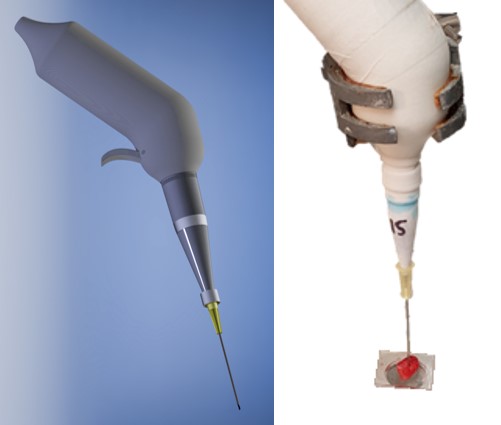
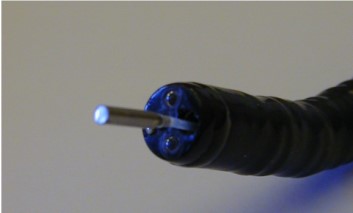
We have developed two medical Raman devices and tested them in vivo in humans: an endoscopic probe that fits down the endoscope’s instrument channel, and a needle probe for targeting swollen tissues through the skin.
A miniature confocal Raman probe has been designed to measure the surface of the oesophagus in vivo.
The has been trialled on 25 human patients undergoing routine Barret’s oesophagus screening at Gloucestershire Hospitals NHS Foundation Trust.
For further details, please visit: rapide-diagnostics.co.uk
We have safety tested our Raman needle probe on 15 patients at Gloucestershire Hospitals NHS Foundation Trust.
By fixing optical fibres inside a hypodermic needle, we can acquire Raman spectra of tissues inside the human body and avoid the current standard of invasive surgery to obtain a biopsy from the patient. This “optical biopsy” allows for faster recovery times and an instant diagnosis. Typically, conventional biopsies are taken during surgery and sent away for histopathological analysis, which can take time and add to patient anxiety. Scarring, nerve damage and infection from the surgery are also potential complications. The analysis of the stained, excised sections is performed by pathologists. They often struggle to identify early-stage tumours and results are subjective.
Raman spectroscopy has been shown to identify and distinguish between lymphomas and metastasises ex vitro, and we aim to develop a commercial probe to perform this in vivo.
For further details, please visit: dolphin-diagnostics.co.uk