
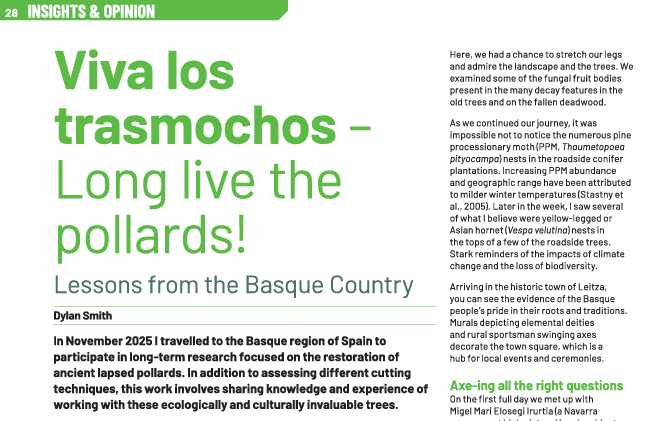
We are delighted to share that an article by one of our arborists, Dylan Smith, has recently been published in ARB Magazine (Issue 212, Spring 2026). The piece, titled Viva los Trasmochos – Long Live the Pollards! Lessons from the Basque Country, explores the ecological, cultural and practical importance of pollarded trees, drawing on Dylan’s hands‑on experience in northern Spain.
Learning from ancient traditions
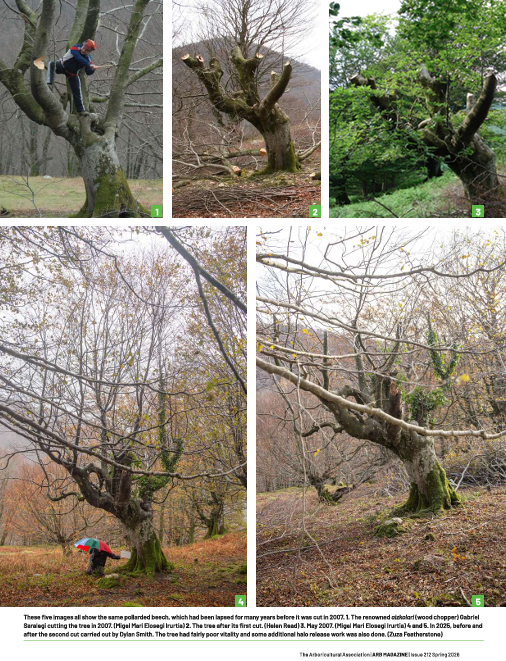
In November 2025, Dylan travelled to the Basque region as part of an international collaboration focused on the restoration of ancient lapsed pollards. Pollarding is a traditional tree‑management practice involving the repeated cutting of branches to produce sustainable supplies of timber, firewood or fodder, while also creating complex tree structures that support biodiversity. Although once widespread across Europe, the practice has been abandoned in many regions, placing veteran trees at risk through over‑extended limbs, decay and instability.
The Basque Country retains a remarkable living legacy of this tradition. Working alongside Spanish arborists, conservationists and researchers, Dylan and the wider team assessed historic beech and oak pollards, trialled different restoration techniques and shared expertise built up over decades of research and practice.
Combining science, skill and collaboration
A central theme of Dylan’s article is the balance between ancient practice and modern science. Restoration work needs to be carefully tailored to each tree’s condition, taking account of age, vitality, decay and response to past interventions. Techniques such as pole thinning, staged reduction and selective retention of branches are helping to stabilise trees while preserving their ecological value.
The project also highlighted the importance of collaboration. Knowledge was exchanged not only between UK and Spanish professionals, but also with local communities, government bodies and craftspeople. From discussions on fungal ecology and tree biomechanics to demonstrations of traditional axe‑work by renowned Basque wood‑choppers, the trip illustrated how cultural heritage and ecological conservation can reinforce one another.
Preparing the next generation of experts
Dylan’s involvement in this work is supported by his participation in the Ancient Tree Forum’s Experts of the Future programme. This initiative mentors and supports a small cohort of early‑career specialists, helping to build the knowledge and skills needed to care for ancient and veteran trees well into the future.
As Dylan reflects in his article, these experiences are invaluable – not only for advancing scientific understanding, but for fostering the collaboration, humility and long‑term thinking required to protect irreplaceable living monuments.
Why this matters
Ancient and veteran trees are reservoirs of biodiversity and tangible links to our cultural landscapes. Once lost, they cannot be replaced within a human lifetime. Work such as the Basque pollard restoration project shows what can be achieved when tradition, research and cooperation come together with a shared purpose.
We are proud to see Dylan’s work featured in ARB Magazine and to support initiatives that contribute to the protection of ancient trees both in the UK and internationally.
To find out more and help to protect ancient and veteran trees, please visit the Ancient Tree Forum:
https://www.ancienttreeforum.org.uk
The Arb Team are keen to contribute to research around trees and their ecology and they may be able to assist with research projects. Please contact them at grounds@exeter.ac.uk.