Guest Speaker (6 May): Mathieu Berger on Interactional Disruption in Participatory Assemblies
Evaluating Interactional Disruption in Participatory Assemblies: Infelicities, Havoc, Breaches
Mathieu Berger (UCLouvain-CriDIS & EHESS-CEMS)
12.15-13.45 Wednesday 6 May
Lecture Theatre 1, Institute of Arab and Islamic Studies Building, University of Exeter
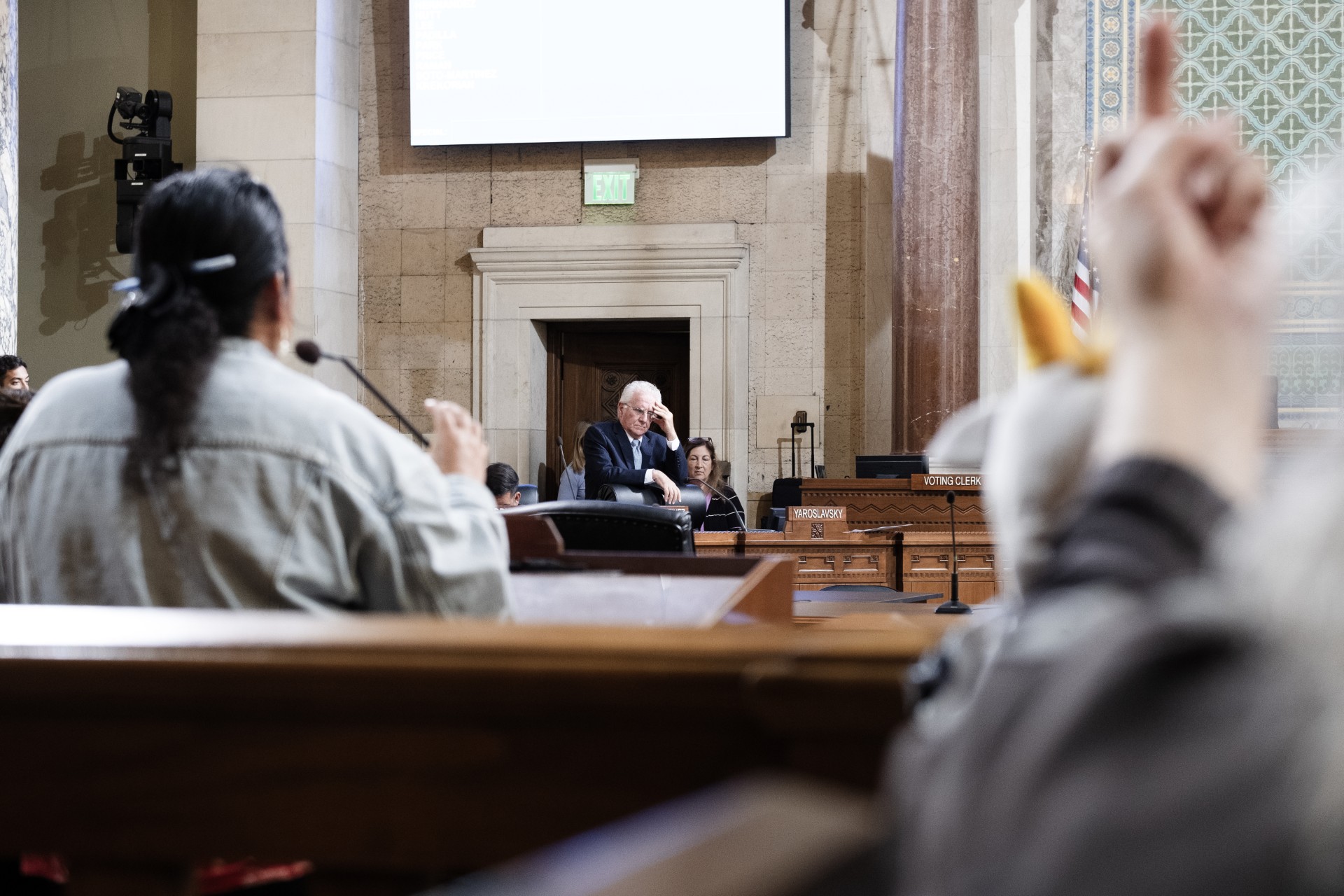
Featured Image: Typical scene at Los Angeles City Council (May 2024), Photo by Charles Paulicevich
Drawing on theoretical developments concerning the interaction order (Goffman, 1983; Rawls, 1987; Tavory & Fine, 2020), as well as on empirical investigations into civic practices in Western Europe and the United States, I will present different modes through which trouble is produced, by examining three forms taken by interactional disruption in participatory assemblies, before assessing their effects from a democratic perspective. The first, infelicities, produce more or less significant discontinuities in the flow of interaction and, depending on their severity, threaten the speaker’s face without necessarily undermining the situation as such. When they accumulate, however, they may dull democratic practice, erode the framework, and give rise to a diffuse negative experience (irritation, boredom, and other forms of disengagement). They may also become the object of repair, reworking, or small-scale inquiries aimed at problematizing the disturbance they generate, in order to restore or adjust the framework. The second, havoc (Goffman, 1969), stems from practices of interactional vandalism—deliberate forms of aggression against the interactional framework—and generate a much more intense negative experience, one that proves more resistant to treatment through discussion and inquiry. The third, breaches, refer to forms of conduct that break with the established frame, whether to explicitly call for an alternative frame or, more implicitly, to prefigure other possible horizons for democratic interaction. The aim will be to examine the specific productivity of these “disruptions of interaction” (infelicities), “disruptive interactions” (havoc), and “disruption for interaction” (breaches), while also considering the possible transitions and combinations between them.
Prof Mathieu Berger is a professor of sociology at UCLouvain, where he teaches urban sociology, theories of public space, social semiotics and qualitative research methods. He is a research fellow at CriDIS (Centre de recherches interdisciplinaires Démocratie, Institutions, Subjectivité) and a research affiliate at EHESS Paris (CEMS – Centre d’études des mouvements sociaux) and at EPFL Lausanne (LASUR – Laboratoire de sociologie urbaine). His research deals, on one hand, with democratic public spaces and political participation, and on the other, with social aspects of city planning and urban policies in Europe and the US. Mathieu is also the general coordinator of Metrolab (UCLouvain-ULB), a laboratory of applied urban research based in Brussels and funded by the European Regional Development Fund.
Professor Berger has been collaborating with colleagues at Exeter (Andrew Schaap, Bice Maiguashca and Katharine Tyler) in a project on The Labour of Civility: Practising Democracy on the Street, in the Hospital and around the University in London and Paris. This has included the organisation of a workshop at UCLouvain in Brussels in December 2025 on Street (in)civilities: International dialogue between urban researchers and practitioners: London, Paris, Brussels.