
Thursday, 5 November 2026, 14:00 – 16:00, Forum Seminar Room 6, University of Exeter
With comments from Kimberly Hutchings (Queen Mary), Matt Sleat (Sheffield), and Christopher Voparil (Lynn University).
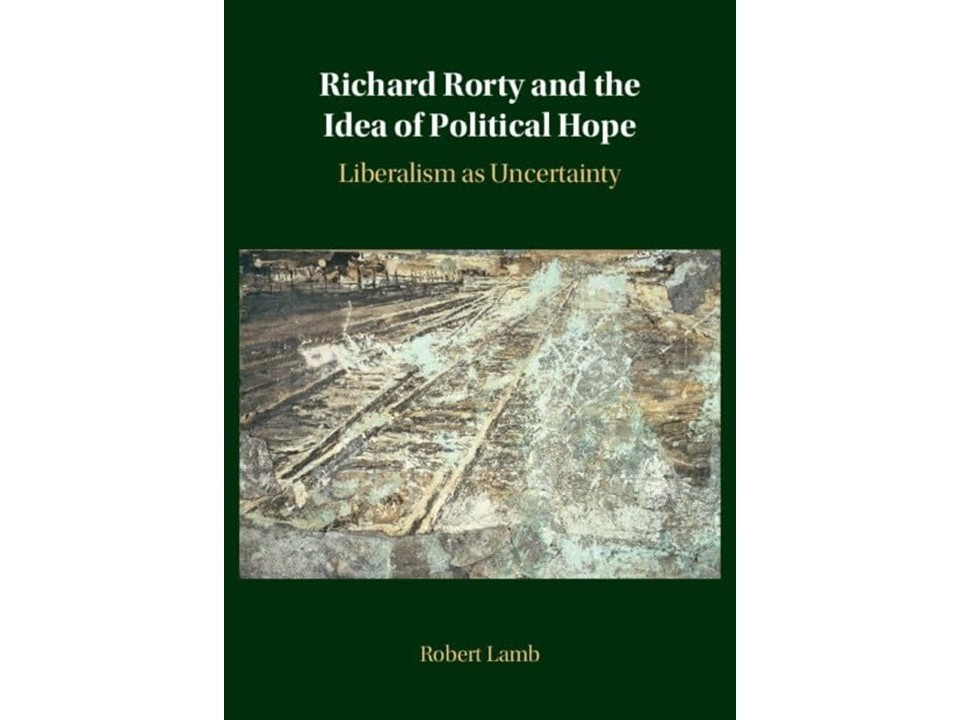
Richard Rorty and the Idea of Political Hope: Liberalism as Uncertainty, Cambridge University Press, July 2026
Hope is a vital force in politics, nourishing our visions of the future when things seem irredeemably bleak. Contemporary philosophy is trapped within a view of hope as an everyday desire empty of ethical and political content. Much political theory defers to philosophy and appears unable to appreciate the value of hope as a political attitude. Through an interpretive conversation with Richard Rorty, Robert Lamb shows how Rorty uses Hegel to develop a compelling, alternative understanding of hope as the yearning for a better future amidst a contingent social world and fragile political inheritance. Commitment to political hope – an enemy of despair, optimism, and certainty – invites a reorientation of philosophical reflection and involves a demanding civic ethos to sustain communities fragmented by pathological individualism. Rorty’s interpretations of John Rawls, feminism, and the redemptive potential of history show the relevance of hope for the urgent challenges facing twenty-first-century liberal democracy.
Professor Robert Lamb‘s research interests lie in the history of political ideas and contemporary political theory/philosophy. Most of his research has focused on the intellectual tradition of modern liberalism – construed very broadly, from the seventeenth century to the present – and its central political theorists, concepts, and normative (ethical and institutional) commitments. He brought these interests together in my first book, on the political thought of Thomas Paine. In other work, He has explored philosophical understandings of various moral and political ideas (such as human rights, property, equality, freedom, and impartiality) in the writing of historical and contemporary theorists, from John Locke and William Godwin to John Rawls and Richard Rorty. He has also written a bit on philosophical issues related to historical interpretation/methodology, as well as an introductory book on the concept of property in political theory.