
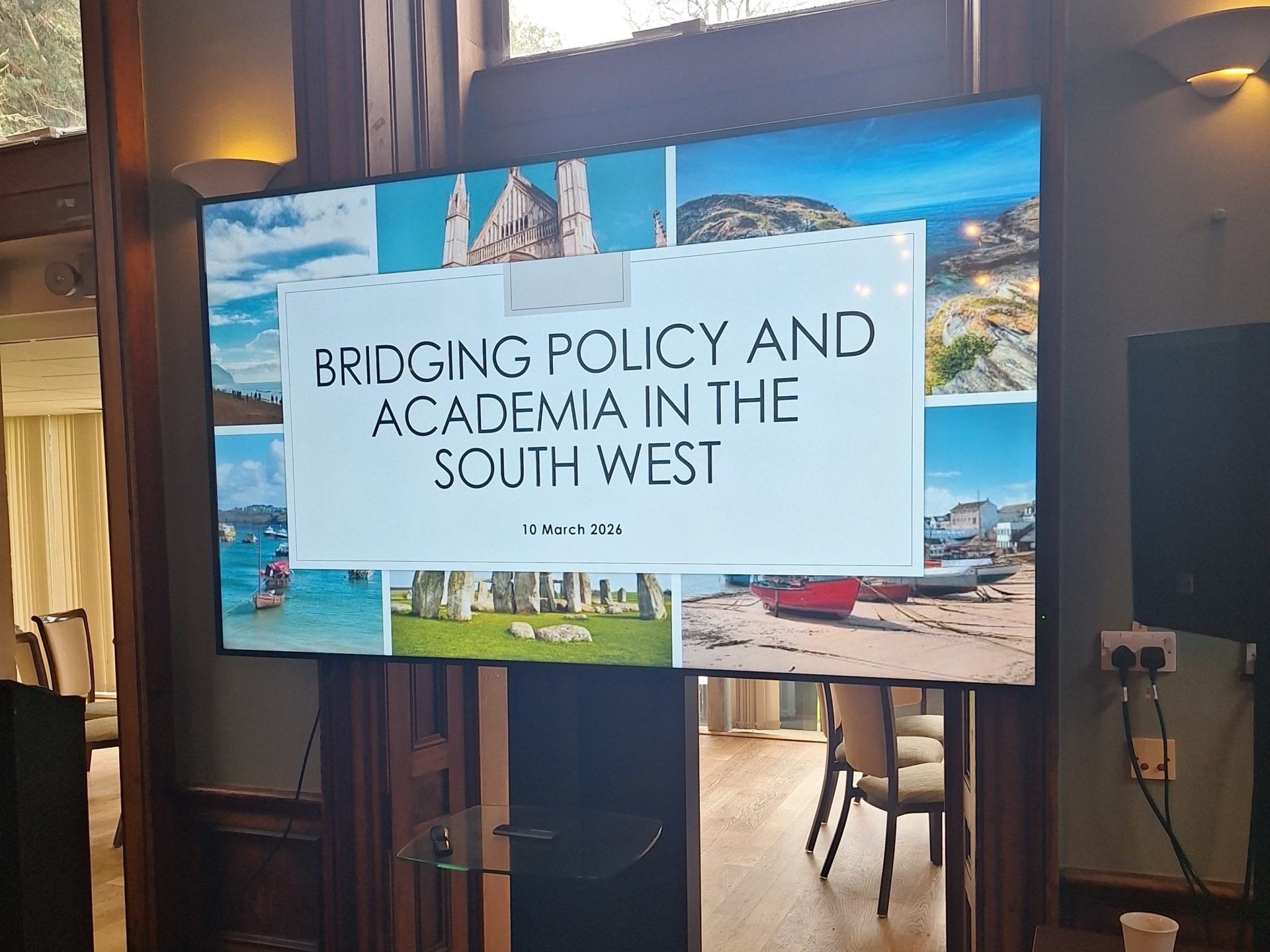
Earlier this month, researchers from universities across the region came together with policy professionals to share best practice and explore different perspectives on academic policy engagement. Representatives from the Universities of Bristol, Bath, Plymouth, and Exeter, and Bath Spa University were joined by policymakers from the Department for Environment, Food and Rural Affairs (DEFRA), the Office for National Statistics (ONS), and more.
What are the key steps for using research to generate impactful policy change through research? How can we facilitate connections between communities so we can better understand and benefit from one another’s knowledge? Can researchers do more to highlight the relevance of their work and bring this to the attention of policymakers? Can policymakers do more to communicate with researchers and implement evidence in practice?
Hosted by the South West Policy Network and Policy South West, the day-long event sought to answer these questions and more. Academics interested in policy engagement and knowledge mobilisation were invited to connect with local policy professionals to better understand both the challenges and opportunities involved in creating policy impact. Attendees were particularly keen to learn about current policy priorities and identify effective ways of collaborating to address them within the South West context.
Insights were shared by Civil Servants based in the South West, including staff from the ONS, the Ministry of Housing, Communities and Local Government, and DEFRA, which represents the largest government department presence in the region. Their presentation looked at place-based initiatives for developing policy presence outside of London, and the models that could be used to implement this.
Knowledge mobilisers from the universities within the Policy South West Network then shared their perspectives on supporting connections between academics and policymakers, while a representative from the Universities Policy Engagement Network (UPEN) highlighted the organisation’s ambitions for supporting the use of evidence in Government. The session highlighted the many ways that university policy professionals support researchers to engage with policy makers, through capacity building, funding schemes, communications, and intelligence gathering.
Policy professionals and researchers were later invited to share their perspectives in the form of a panel discussion. This drew on the policy development expertise of Dr Betheney Wills, marine biologist and knowledge broker for DEFRA, and Dr Joanna McLaughlin, clinical lecturer with the University of Bristol and the NHS. Professor Richard Thompson OBE FRS, Director of the Marine Institute at the University of Plymouth, and Professor David Strain, University of Exeter Associate Professor and Thematic Research Lead for the Parliamentary Office of Science and Technology (POST) shared their experiences as policy-engaged academics. Chaired by Professor Rob Anderson from the University of Exeter, the discussion invited panellists to reflect on their experiences working across policy and academia, and the challenges and opportunities this presents.
The final session of the day facilitated attendees to network, sharing their interest in subjects ranging from how to build an evidence basis, to future collaboration.
“The end of research is the start of the journey” as Professor Strain described it. Researchers and policy professionals have the skills and experience to help bring research evidence into regional and national policy. The South West is home to a wide range of expertise, hosting policy professionals from crucial government departments, and ground-breaking multidisciplinary research. Despite the different perspectives and languages of Higher Education versus policy settings, research and policy can inform one another through concerted collaboration, and a shared understanding of community needs. By bringing policy professionals and researchers together, it is hoped that a culture of communication and knowledge mobilisation can continue to grow and support policy development across the region.