
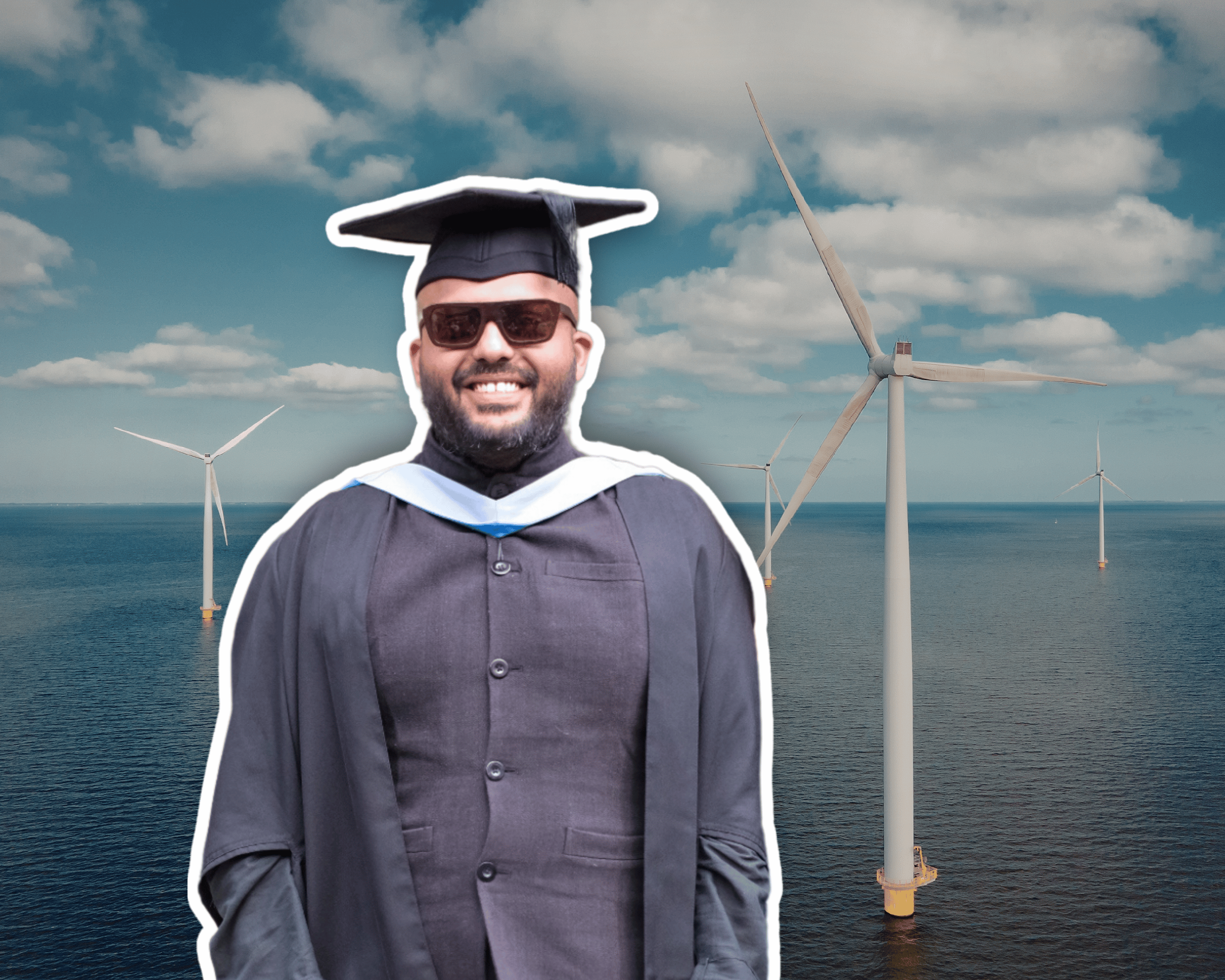
Wribhu Ghosh, MSc Renewable Energy Engineering (2020)
Data Analyst, Data Scientist and Machine Learning Engineer at Celtic Sea Power Ltd.
I spent 12 years working in the automobile industry before returning to academia. Over time, I began to feel that I was not using my engineering skills in any meaningful way in my day-to-day managerial role. There was a sense of boredom and, more importantly, a lack of real purpose in the work I was doing.
I desperately wanted to do something more meaningful, something that would allow me to reconnect with my technical background and apply my skills to real-world challenges. That was what eventually led me back to studying.

I applied to several universities and received offers from the University of Exeter and two others. Out of the three, Exeter was the highest ranked, and I was also offered a £5,000 scholarship, which made the decision much easier.
I accidentally landed in Cornwall. I came to Britain thinking I would be based in Exeter, so Cornwall was a surprise — but a very pleasant one. I thoroughly enjoyed the course and the environment. I felt inspired every day to learn something new, and the education system really suited me. Studying in Cornwall gave me the space, focus, and motivation to rediscover my interest in learning.
Coming from the Indian education system, I had mostly learned how to crack exams. It was often more of a memory test than a true learning experience. During my MSc at Exeter, at the age of 35, I learned for the first time how to teach myself something new without being spoon-fed. That has probably been the most valuable skill I took away from the course. It gave me the confidence to approach unfamiliar problems, learn independently, and build the skills I needed as I went along.

After finishing my MSc, I started as a Renewable Energy Design Engineer for a local Cornish company. My role involved the design and end-to-end project management of small-scale domestic renewable energy projects, mainly working with Solar PV, battery storage, and heat pumps. However, my sights were set on becoming part of the floating offshore wind revolution that is beginning to take shape in the Celtic Sea. So, when the opportunity came, I jumped ship and joined Celtic Sea Power Limited as a Data Analyst, Data Scientist, and Machine Learning Engineer.
Since then, I have been involved in several multi-million-pound environmental data campaigns. This began with the ERDF-funded Cornwall FLOW Accelerator project, where we deployed Floating LiDARs for metocean campaigns and delivered bank-grade models for resource assessment and Annual Energy Generation estimates. We also carried out a Digital Aerial Ornithological Survey and an airborne LiDAR campaign to measure avian flight height.
I am currently working on the Subsea Soundscape project, funded by The Crown Estate. As part of this project, we have deployed 21 monitoring stations across the Celtic Sea, each equipped with a broadband acoustic recorder, an F-POD, and a fish tag. We are delivering the project alongside the University of Exeter, and my role focuses on developing a deep learning-based convolutional neural network detector that can identify the presence of seals from the spectral signatures of their vocalisations.
Alongside this, I have also been involved in a range of other projects in different capacities, including the development of an underwater camera system for marine mammal monitoring in collaboration with Falmouth University.
What I enjoy most is the freedom my job gives me to learn, explore, and apply myself across a wide range of technical challenges. I have always enjoyed mathematics and problem-solving, and although I did not have formal qualifications or prior experience in some of the areas I now work in, I have been trusted and encouraged to get involved in some very important and exciting projects.
I chose this path because it allows me to keep learning while working on something that feels meaningful. The combination of renewable energy, environmental monitoring, data science, and machine learning gives me a sense of purpose that I did not have earlier in my career.
If you are young and have come straight onto the course from another degree, without much work experience, you may not immediately realise how valuable the opportunity is. Try not to take the path of least resistance. Stay curious.
One of our lecturers used to say that knowledge is cheap and easily available; it is skills that set you apart. I think that is very true. While you have the time and opportunity, try to build practical skills alongside your academic knowledge. Learn a programming language like Python or R, develop GIS skills, get comfortable working with data, and pick up tools that will make you useful in the real world.
The degree is important, but the skills you build around it are what will really shape your future.
Wribhu Ghosh, MSc Renewable Energy Engineering
Wribhu studied within the University of Exeter’s Graduate School of Environment and Sustainability, which brings together experts from across the spectrum of earth and life sciences, engineering, humanities, social sciences and business. Our programmes are all designed with a focus on developing solutions to global challenges and creating a better future for our planet and its people.
Follow us! 👇