
Posted by Laura Sangha
12 May 2026Jane Whittle, Wills Project Principal Investigator
The wills project has now successfully transcribed more than 30,000 early modern wills from the Prerogative Court of Canterbury, with at least 5000 from each of the sample periods evenly spaced between the 1540s and the 1780s. We also have a prototype database that allows us to search by type of bequest and testator. But what are the best ways of using these riches for academic research? At the end of March the wills project team went on a research retreat to Elton House in Bath – generously funded by the wonderful Landmark Trust Futures scheme. We each presented our research in progress for discussion, and it got me thinking about the main ways we’ve used the wills as a research resource: there seem to be three main approaches.
When I designed the project, I envisaged a quantitative survey showing change over time in types of bequests – and that is now possible, as I discuss below. But the availability of the searchable text of so many wills also opens up two other approaches that have been particularly exciting, both originating from basic wordsearches. These can be characterised as ‘chasing words’ and finding ‘needles in the haystack’. This blog discusses each of these approaches in turn.
Quantitative surveys
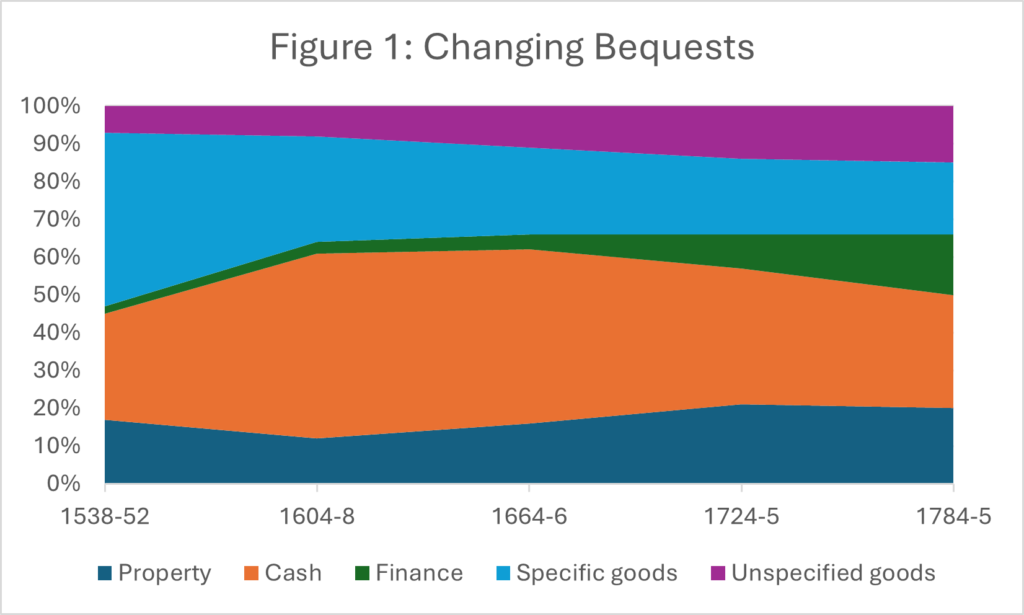
Figure 1 is an example of what a quantitative survey offers. Compiled from the database, it shows how bequests change over time across the five sample periods. The headlines are that that in the sixteenth century the most common bequests were specified goods (that is, individually itemized goods), a type of bequest that declined thereafter. In its place the proportion of cash bequests grew, as did the proportion of bequests of unspecified goods (‘goods and chattels’ or ‘household stuff and plate’ etc.). From the late seventeenth century – as we would expect from discussions of the ‘financial revolution’, bequests mentioning financial devices (annuities, rents, stocks) begin to increase. As well as this, bequests of real property form a steady background – a relatively small proportion of gifts, but much more significant in terms of value.
So, yes – our approach does allow changing testamentary behaviour to be tracked in a way that has never before been possible. We can generate graphs showing numbers of bequests, clusters of bequest-types, goods bequeathed, and varieties of financial devices used – all significant findings. But the transcriptions have also opened up other exciting avenues.
Chasing words
By chasing a word I mean the process of following how a particular word is used in wills across the whole sample. This approach has been much used by historians and literary scholars working with digitized printed texts. Large-scale transcriptions now make it possible for manuscript documents such as wills. It can be done just with a key word search with the transcriptions themselves, although the database makes it quicker, churning out all the phrases within wills that contain a particular word or phrase.
My favourite example so far is ‘stock’ – an unglamorous but multifaceted word. Stock is a word of many meanings, although at its core a stock is almost always something that has the ability to generate something else. If we set aside the placenames and surnames with ‘stock’ elements, and also items of clothing (stockings, nether stocks), searching for stock in wills turns up a variety of economic terms: livestock, farmstock, but also stock of trade, and of course, stocks and shares. In the sixteenth century stock was frequently used to refer to farm stock (livestock, stock of bees), but it also appears in bequests left to orphaned children in order to provide an income to support them, and in relation to charitable funds (parish stock). By the late eighteenth century farming assets had become less common in wills, as had charitable parish stocks. Instead stock now commonly referred to capital stock that generated an income (bank stocks, government stocks, stocks in trading companies), although ‘stock of trade’ of small businesses also appears frequently. Interestingly the idea of stock to support orphaned children continued across the whole period.
This is just one example, and members of the team have been chasing a whole range of words for different reasons. You can trace materials (pearls, calico), sentiments (friendship, remembrance), adjectives (wrought, workday), and concepts (heirloom) – all with fascinating results.
Needles in the haystack
But our favourite achievements have revolved around identifying the needles in the haystack – the interesting, detailed and revealing wills amongst the mass of often formulaic and repetitive documents. Some of these have been highlighted in Emily’s wonderful will of month blog posts. I’ve been looking for wills with detailed descriptions of textiles for the chapter I’m writing for our edited volume and now have a list of over a hundred interesting wills. Amongst them are the following: the 1547 will of Eme Beton, a widow who described herself as a ‘draper woman’ from St Ives in Huntingdonshire (the site of international fair in the medieval period) and who bequeathed textiles from her shop; Thomas Adams, a London lawyer, who in 1606 left provision of his niece’s education, hoping that she could be apprenticed to defend her against poverty and so that ‘she live not idly’. Elizabeth Peyto, a Warwickshire widow who in 1664 left a herbal to one daughter, and ‘my work box, silks and all my works’ to another. The will of Elizabeth Buckeridge, a spinster from Middlesex in 1725 left her niece Sarah ‘my India Japan Cabinet with the China upon it’.
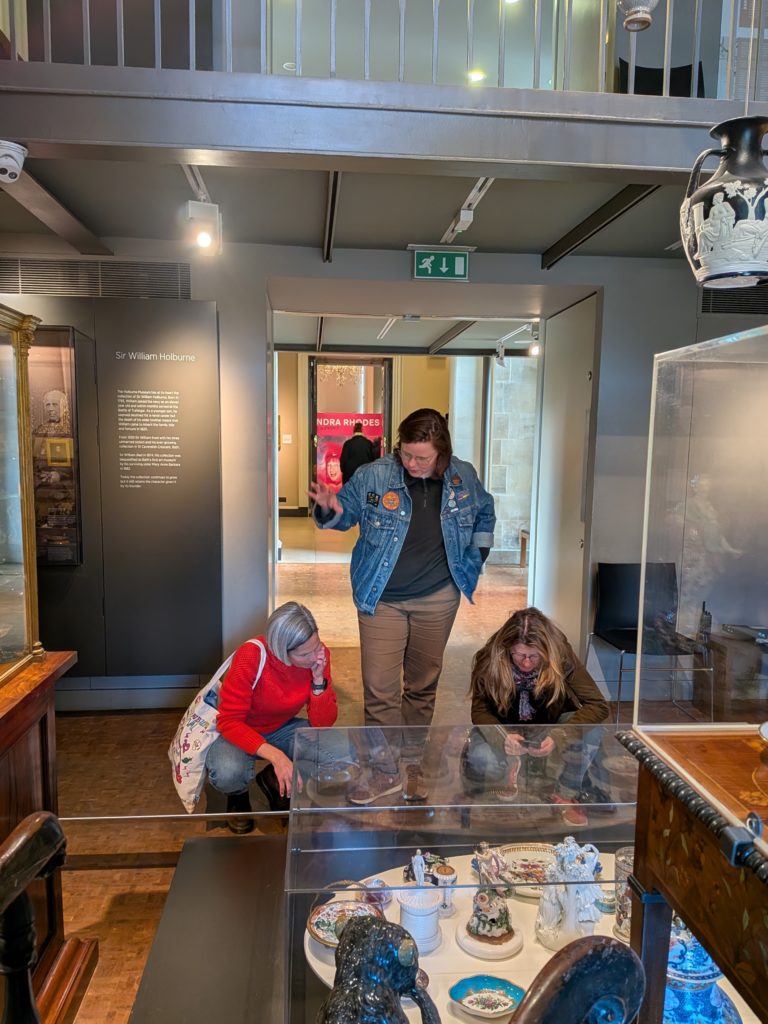
This last example opened up investigation into a fascinating family with strong connections to the East India Company and many Japan Cabinets. Elizabeth was also the sister of Bainbridge Buckeridge, the pioneering art historian who left many named works of art in his will. From our final period, Ann Ellington of Hotwells near Bristol left a 1785 will which described her self-made needlework, bequeathed her poetry papers and manuscripts, and also mentioned ‘my silver egg purchased with money saved at school by shopkeeping’.
I could go on, but the point is made: there a great riches in the archive – difficult to locate through conventional research methods, which having a great body of searchable transcribed wills now opens up.