
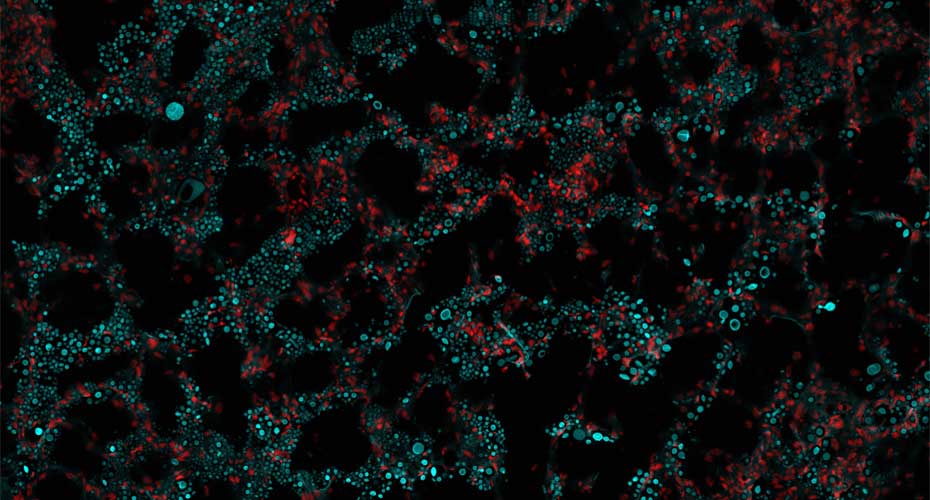
Researchers have uncovered the role of a previously overlooked fungal cell type that can cause serious disease, offering new insights into how dangerous fungal infections develop and spread. The study has been published in PLOS Biology, and focuses on Cryptococcus neoformans, a fungus that causes 200,000 deaths each year and can result in life-threatening infections, particularly in people with weakened immune systems. When it grows in the lung it can take on a wide range of sizes, but how it does this and the impact these cells have on infections remains unknown. In this project, an interdisciplinary team of scientists at the MRC Centre for Medical Mycology, University of Exeter, identified the tiny ‘titanide’ cell type and used bespoke microscopy techniques to reveal its previously unknown role in the lifecycle of the fungus.
Measuring just two to four micrometres across, titanides were once thought to be small versions of ordinary fungal cells. The new research shows they are in fact a distinct cell type with specialised features that help the fungus adapt to challenging conditions.
Led by Abigail Potton, a PhD candidate in the Ballou Group, the team used advanced microscopy, microfluidics and live-cell imaging to investigate how titanides form and behave. They discovered that titanides form from typical C. neoformans cells when the fungus encounters conditions similar to those found in the lung. Although newly produced titanides enter a temporary dormant-like state, they can quickly return to active growth when conditions become favourable.
The researchers also found that titanides have unique characteristics. The team discovered titanide cells will swell and divide in the right conditions. Despite their small size and thin cell walls, they are highly resilient, showing increased resistance to some environmental stresses and have a distinctive cell membrane structure.
Importantly, experiments showed that titanides can cause disease and infections identical to other types of C. neoformans cells. The study also identified differences in how titanides respond to antifungal drugs. While they were better able to withstand certain stresses, they were more sensitive to amphotericin B, a key treatment used for severe fungal infections. Studying these differences could help researchers better understand how fungal populations survive treatment.
Abigail Potton said: “Cryptococcus has a fascinating cell biology that allows it to generate several cell types within the course of one infection, and these cell types directly underpin disease progression. By recognising and characterising the titanide, we’re adding one more piece to the puzzle in understanding how C. neoformans adapts its growth form to survive.”
Dr Elizabeth Ballou said:
“Our findings add to growing evidence that C. neoformans can exist in multiple forms, helping it respond to different environments during infection. We hope that understanding these changes will ultimately support the development of improved approaches to diagnosing and treating fungal disease.”
Paper
Potton AM, Kalinina I, Brown GD, Makarova M, Catania S, Corzo-Leon DE et al. (2026). The Cryptococcus neoformans titanide is a pathogenic cell type that arises from typical yeast cells in response to host conditions. PLOS Biology.