
Posted by Anne Gwatkin
5 May 2026For our first non-publicity-related entry of term, we’re thrilled to introduce Anne Gwatkin, a PhD student in Archaeology and History, and to offer another entry in our ‘Just Visiting’ series, in which we take a look at sites of medieval interest in the south-west. This week, Anne takes us to the neighbouring county of Dorset, and shows us that not all late-medieval carvings are as well-known as one might expect.
One of the great things about being a part-time PGR is the opportunity to go down rabbit holes when particularly interesting ones present themselves. It’s dangerous to the progress of the whole project if done too frequently, but sometimes it can provide an enjoyable diversion, and send the researcher back to the main project invigorated.
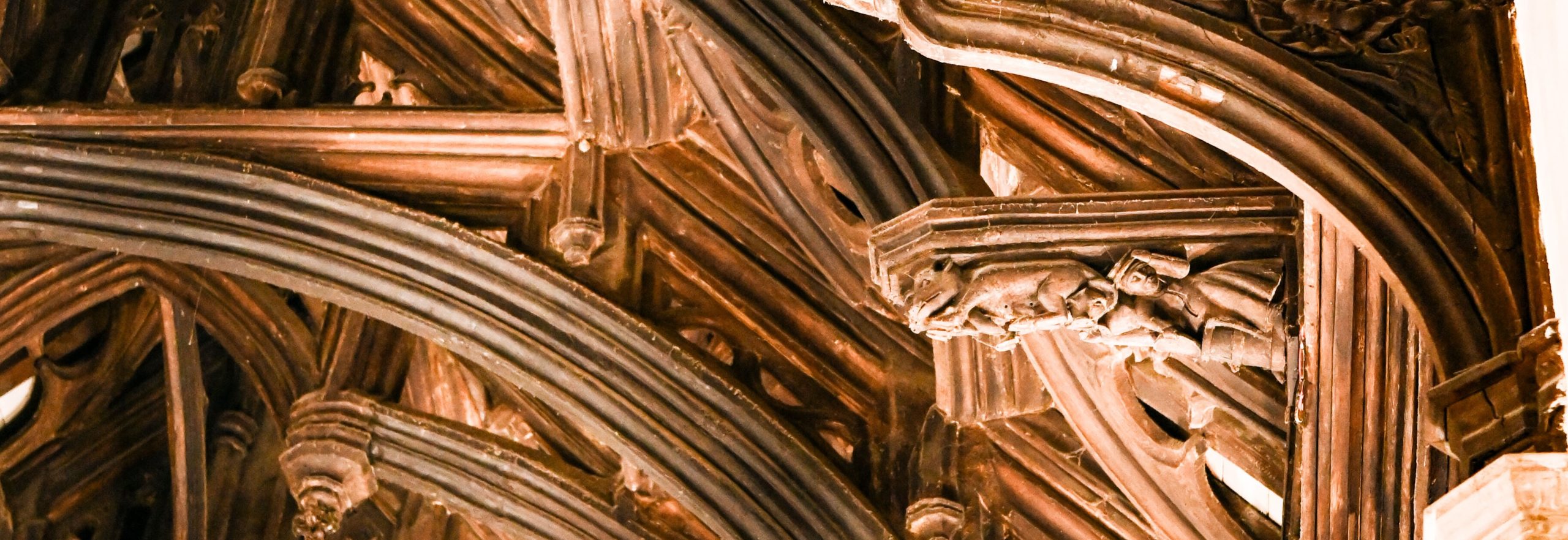
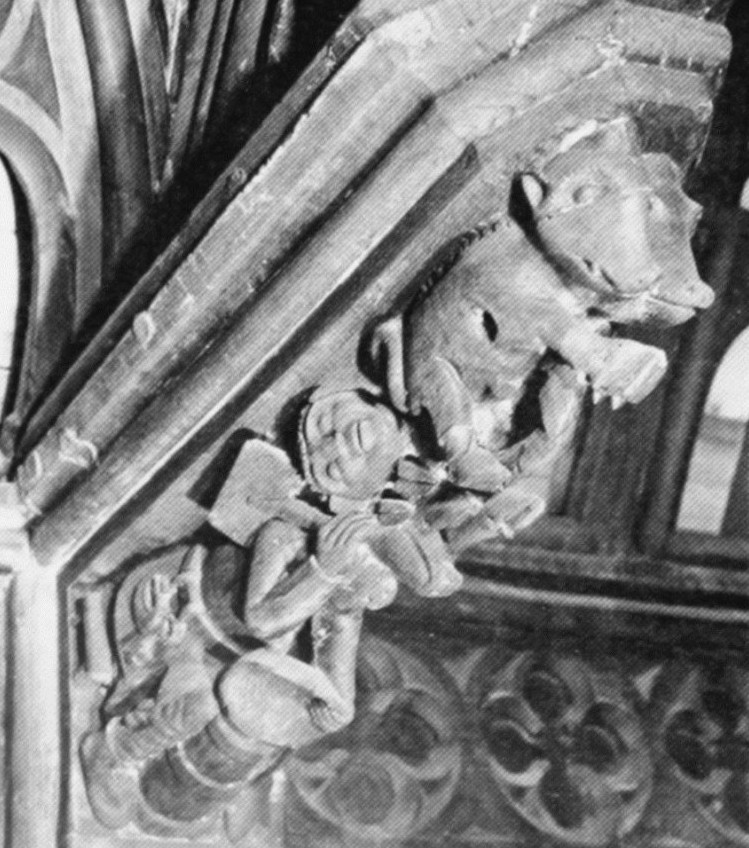
My main topic is how monastic foundations in medieval Dorset patronised parish churches, so the Great Hall at Milton Abbey, built by Abbot William Middleton in 1498, is already one step away, and the carvings on the roof of said hall another still. But what carvings! The roof is a magnificent oak hammer-beam roof, and between each of the main, bracketed, hammer beams are trusses with unsupported hammer beams. Each of these beams has carvings underneath, where the support would be. Some are animals of various types; goats, dogs, sheep, and one I think is a cat, and some have people, playing instruments or doing farm work.
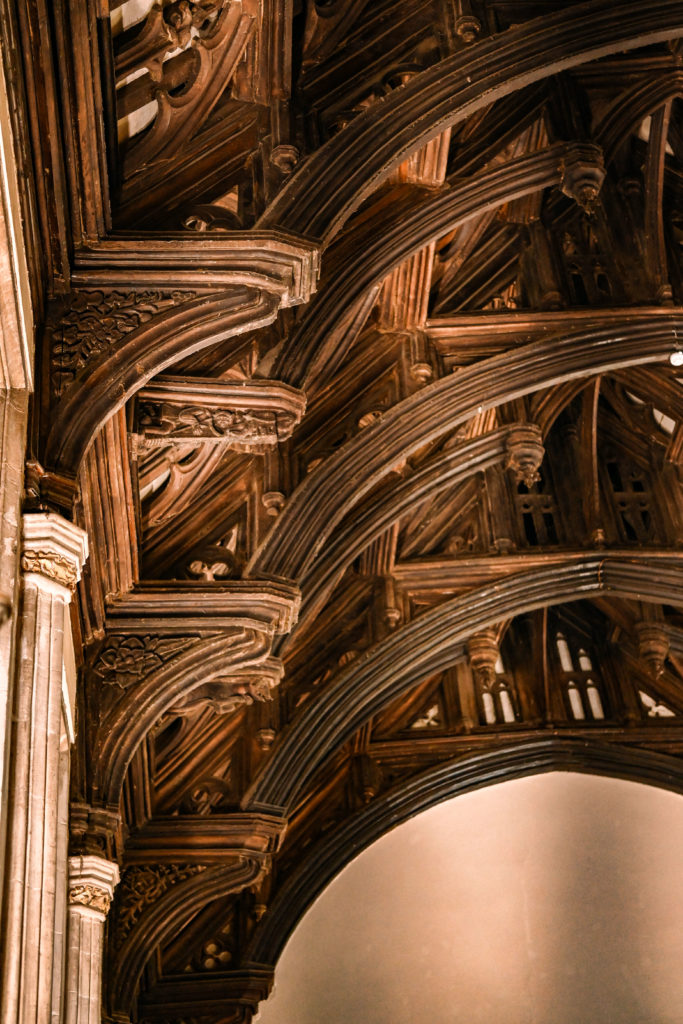
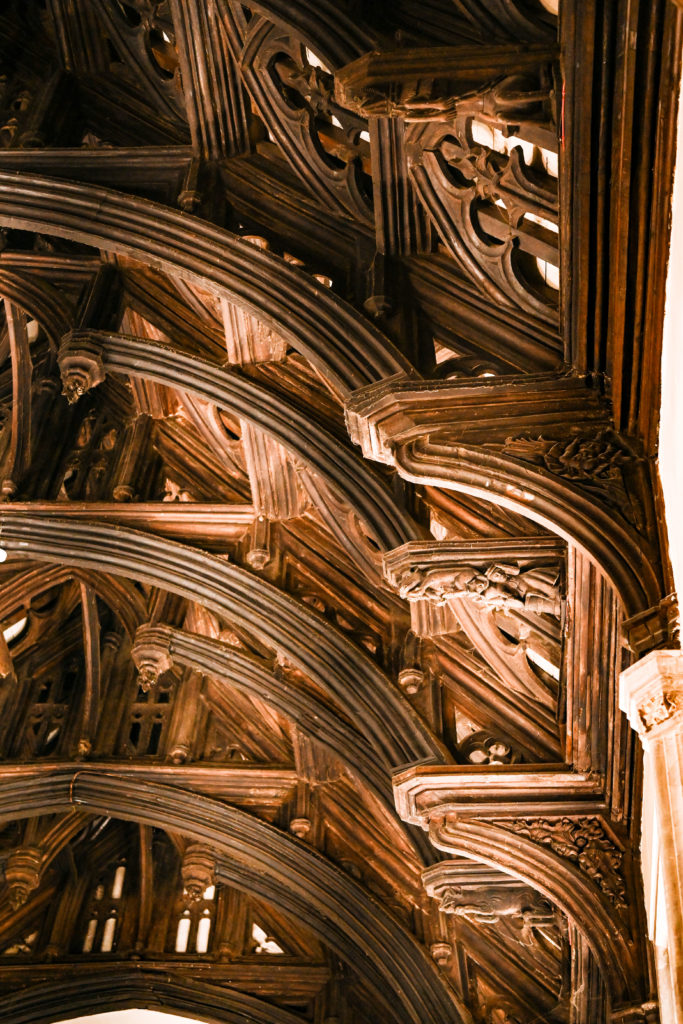
The angle and height makes it very hard to take a good picture of the carvings themselves, while the hall itself is now part of the estates of Milton Abbey School, and not open to the general public: taken together, these factors may explain why these carvings are perhaps less well-known than they might be. I’m very grateful to Anne Litchfield, Archivist at the school, for allowing me access, and for being very generous with her time and help.
It is very hard to know what to compare the beasts themselves with. Perhaps the Dacre beasts, now in the V&A, though they are on a larger scale, and are obviously heraldic in subject, whereas the Milton Abbey subjects are animals and people drawn from everyday life. It is as though the carver of the abbey misericords (if there were any, that is: the abbey stalls do not survive) gave free rein to his or her imagination on the slightly larger space provided by the roof beams.
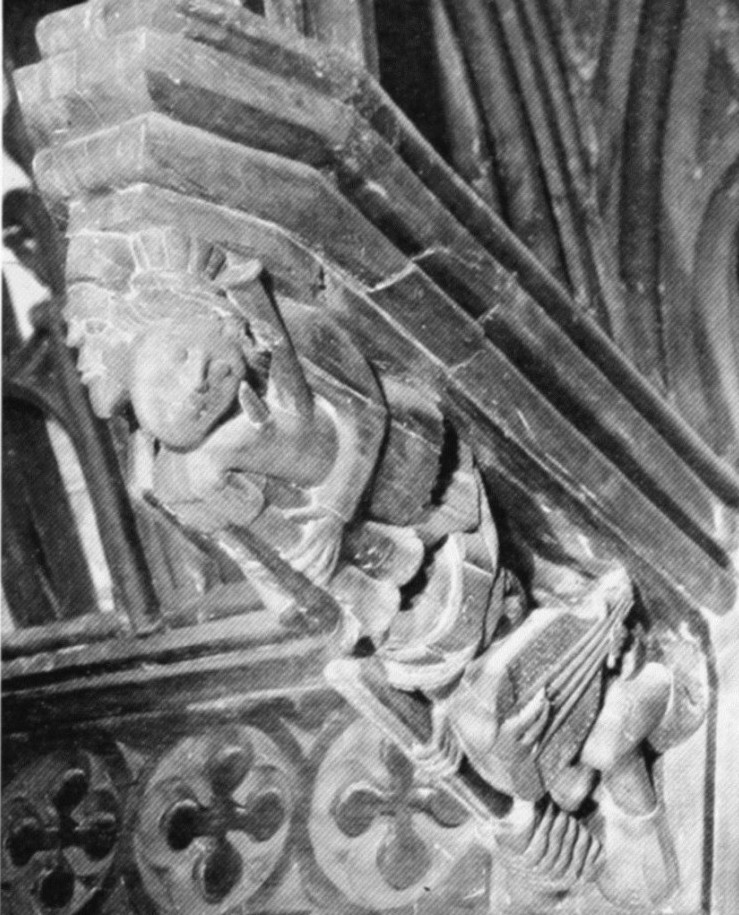
The two carvings involving people are fascinatingly intricate. One carving shows no less than four musicians, two facing north and two south, playing a bagpipe, a lute, a harp, and something that might be a violin, given its position under the chin of the player. The organisation of this much detail into the available space gives a kind of cubist appearance to the carving; reality is suppressed into its essential but contracted forms. It could be compared with Picasso’s oil painting of 1921, Three Musicians (now in the New York Museum of Modern Art); heads face outwards at impossible angles, and bodies are suggested by their salient features, not necessarily arranged in the right order.
The second carving of people is a scene of farm labour; there is a milkmaid, signified by a bucket, and a labourer with a spade, but also, on top of these two, a cow, and, given the placement of the udders, I think there is a pig. Again, the organisation of space is seriously compressed, though somehow the animals are less squashed than the people in this cubist dance. It is the quality of the carving that makes the subject clear and also gives it an element of humour, a playful quality; the milkmaid is almost being sat upon, and the cow and pig have sweet, slightly childlike expressions. They all look as though they are playing a game of sardines. The artistry required to invent this design and visualise and carve it into one block of oak must have been quite remarkable. It would be amazing to be able to take these down from the roof, or to put scaffolding up to be able to properly examine them, and some day in the future perhaps that will happen.
The hall itself is often known as the Abbot’s Hall (including in its Historic England entry), and was a public monastic space, displaying the shields of bishops, abbeys and local landowners that the abbey had relationships with. The magnificence of the room was clearly designed to enhance Milton Abbey’s prestige, and the woodwork in the room is a glorious survival, after five hundred years of use as a country house, and latterly a school.
These sculptures suggest the ingenuity and ability of the craftsmen at work in Dorset in the late fifteenth century. They hint at the cultural richness of that time, reminding us that that artistry did not stop at portraying religious or aristocratic subjects. If they were located somewhere else, perhaps in the Netherlands or Italy, or even just a more public space in England, they would be classified as ‘significant artworks’, and would be much better-known today. As it stands, though, the students at Milton Abbey School have been gifted with a truly fantastic dining-hall.