Posted by Clementine Pursey
8 June 2026In our final blog post for the 2025-26 academic year, Clementine Pursey crosses the Atlantic as they look back on a research trip to the USA.
If you grew up in the UK in the early 2000s, America felt more like an abstraction than a real place, with equal parts old Hollywood glamour and over-accessorized Disney Channel teenagers. Going there for the first time a few weeks ago, as part of my PhD research, didn’t quite feel real, but once the novelty of being on a plane with a television wore off, I sleepwalked through JFK airport, slightly delirious but excited. During my trip, I had two missions: learn as much as I could about my primary manuscript, and present at one of the world’s biggest medieval conferences. As it turned out, I’d get the best of both worlds.
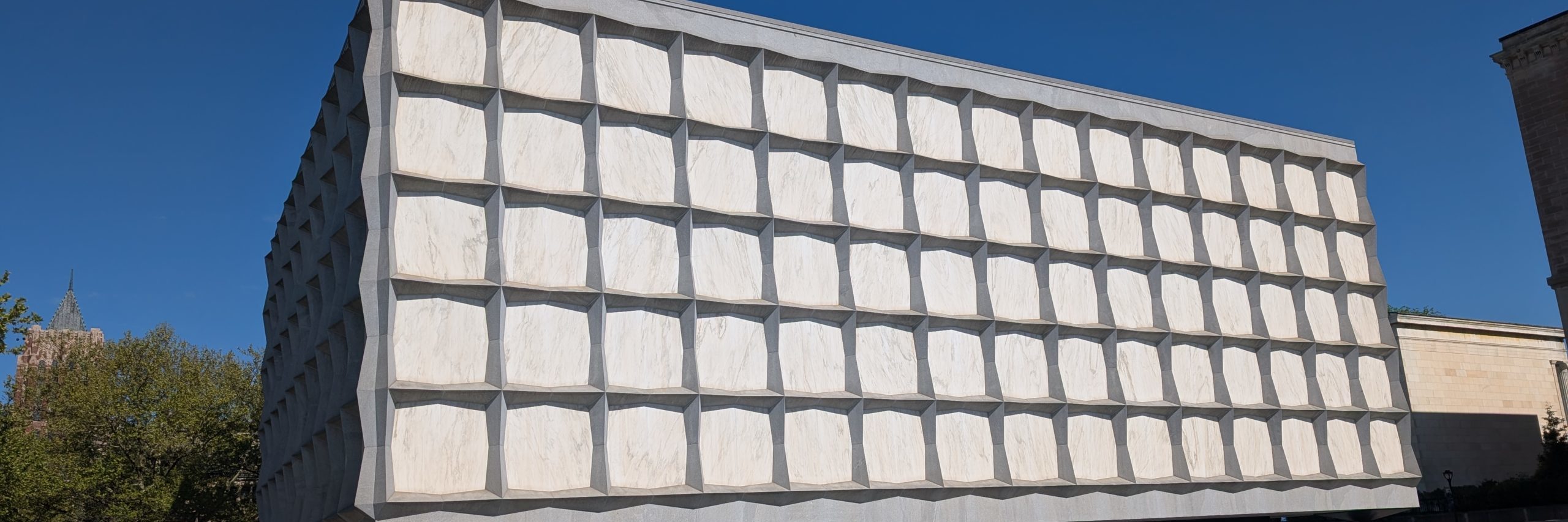
First up on my agenda was a few days in the Beinecke Library, where I’d be coming face-to-face with the manuscript that’s at the heart of my PhD thesis. Yale’s Old Campus sits at odds with an otherwise typically New England town, with tree‑lined streets and tall spires in a suspicious shade of Cambridge yellow. If you’d told me a lost college had drifted down the Cam and reattached itself in Connecticut, I might have believed you. On my first attempt to find the Beinecke Library, which was ostensibly somewhere in the middle of all this, I walked straight past it. After eighteen months imagining the home of my manuscript as a fortress of pomp and ceremony, I found a cuboid spaceship.
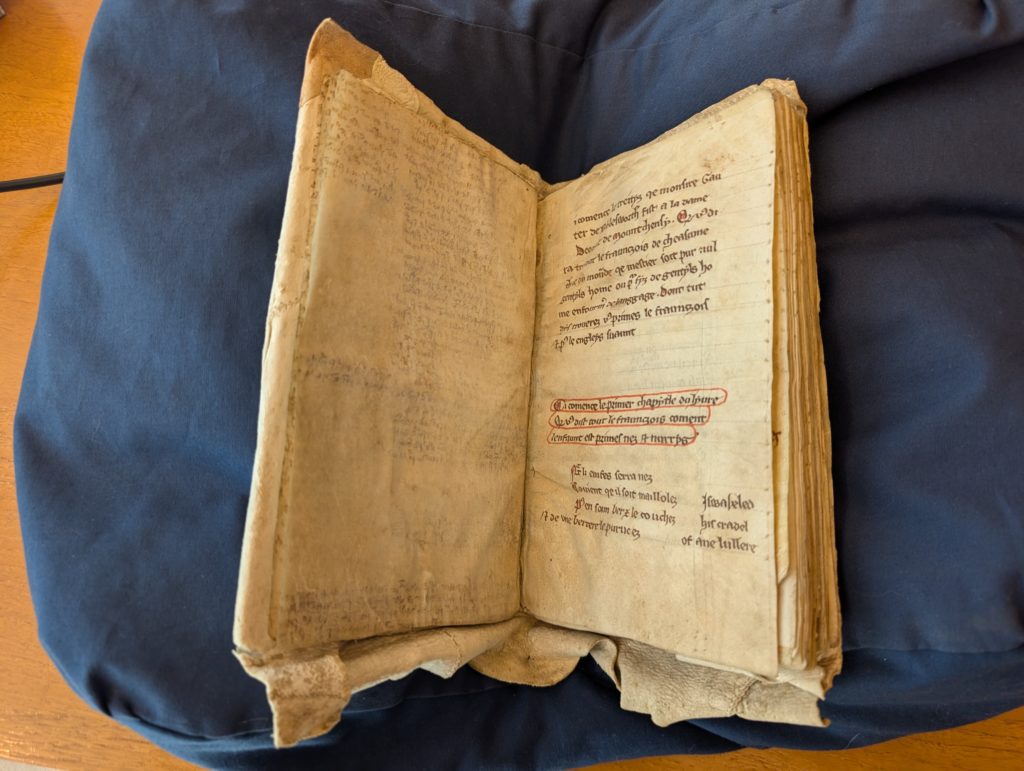
In the reading room, after carefully selecting my conversion plugs, a box was placed before me bearing the shelfmark that had become so familiar: Osborn a56. The digital facsimile, for all its hours of company, paled beside the little codex in front of me. Yet I felt an odd kinship with this stack of wood, leather, and parchment. Leafing through its pages, I found everything I was looking for as if it was the thousandth time I had touched it, not the first. Saladin, Lady Pride, and talking weasels of the volume’s later texts were all accounted for, as were the glosses to Walter de Bibbesworth’s Tretiz and Henry Sharington’s multiple attempts at writing his name to his own satisfaction.
The second half of my trip was a different beast entirely. Gone was my air-conditioned hotel room, replaced by the monastic dorms of West Michigan University and the International Congress on Medieval Studies, where I was presenting as part of a panel on ‘Policing Identity in the Fourteenth Century’.
Kalamazoo is often described as medievalist Disneyland. This does not do it justice. It was fourteenth-century freshers’ week, complete with feasting (a quick lunch between sessions), jousting (heated Q&A exchanges), and dancing (the infamous Kalamazoo disco). The days blurred together in a fog of textile reconstruction, queer cannibal romances, and mystery‑play staging. It was serious, sincere, and delightfully kitsch, with the love I feel for the field reflected back at me in unexpected ways.
Where I had expected to be intimidated as a postgraduate, I instead found camaraderie and encouragement. As I packed my bags and enjoyed my final plate of vegan breakfast sausages, I felt almost reluctant to leave. Now I return to Exeter to pick up where Osborn a56 and I left off, powered by the momentum of laybrothers speaking Latin at bus stops and a midnight macarena.
Featured image: the Beinecke Library, New Haven.