
Posted by Clementine Pursey
2 February 2026Clementine Pursey, PhD researcher on the ‘Learning Anglo-French’ project, shares the experience of going behind-the-scenes at the National Trust for doctoral work.
In mid-December, I made my second visit to Lacock Abbey and my first as a researcher. When I first wandered through the thirteenth-century monastery last autumn, one of the best preserved in England, it was full of wand-swishing Harry Potter cosplayers. This time, it was tinged with tinsel. The bells of Lacock’s Christmas event rang every half hour as a new gaggle of small children cheered inside.
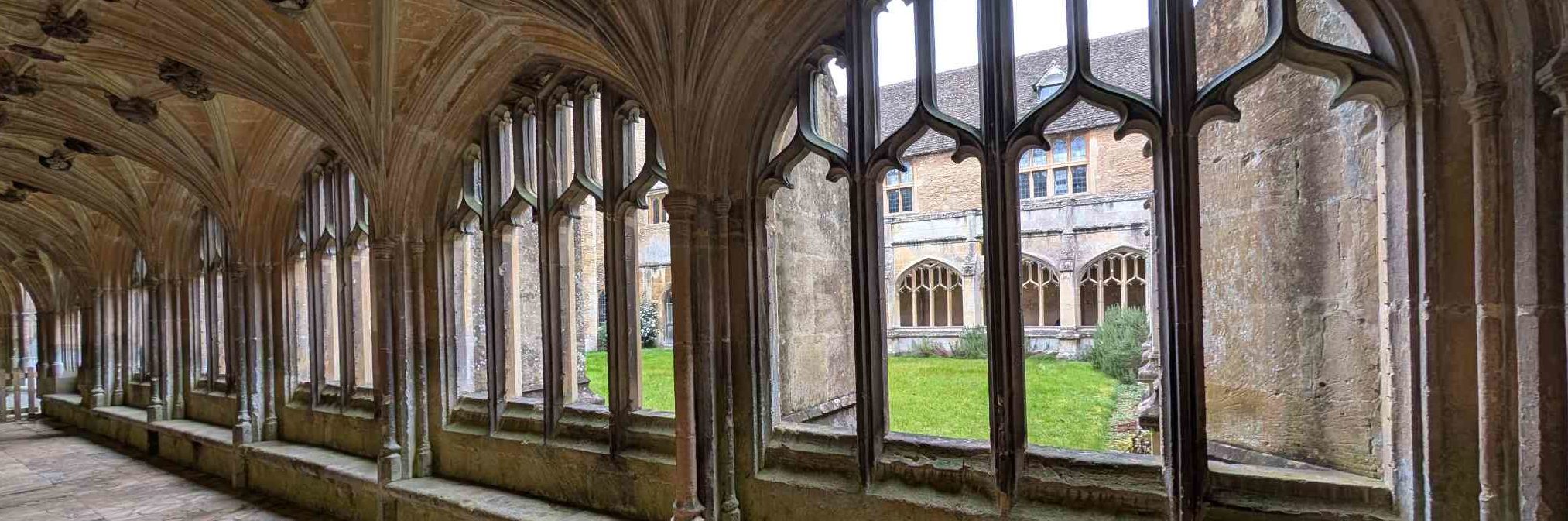
I was kindly hosted by Emma Zadeh, Lacock’s Collections Manager, who guided me to a room above the cloister. The space was converted by William Sharington after his Dissolution purchase of the monastery. Fortunately for medievalists, Sharington left the cloister walk and its surrounding rooms intact, choosing instead to demolish only part of the complex. The result is the charming, if slightly uncanny clash of a medieval abbey wrapped inside a later stately home. A single family occupied the site from the Dissolution until 2011, when the final descendant of Henry Sharington, Lacock’s second owner, vacated the premises.
This visit had been a quiet fantasy of mine ever since I stumbled upon a Latin Bible dictionary in a glass display cabinet during my first visit, having previously lamented on its untraceability. Known as the Brito Book, the manuscript is a copy of William Brito’s twelfth-century Expositiones Vocabulorum Biblie, a monolingual dictionary that explains difficult biblical vocabulary.
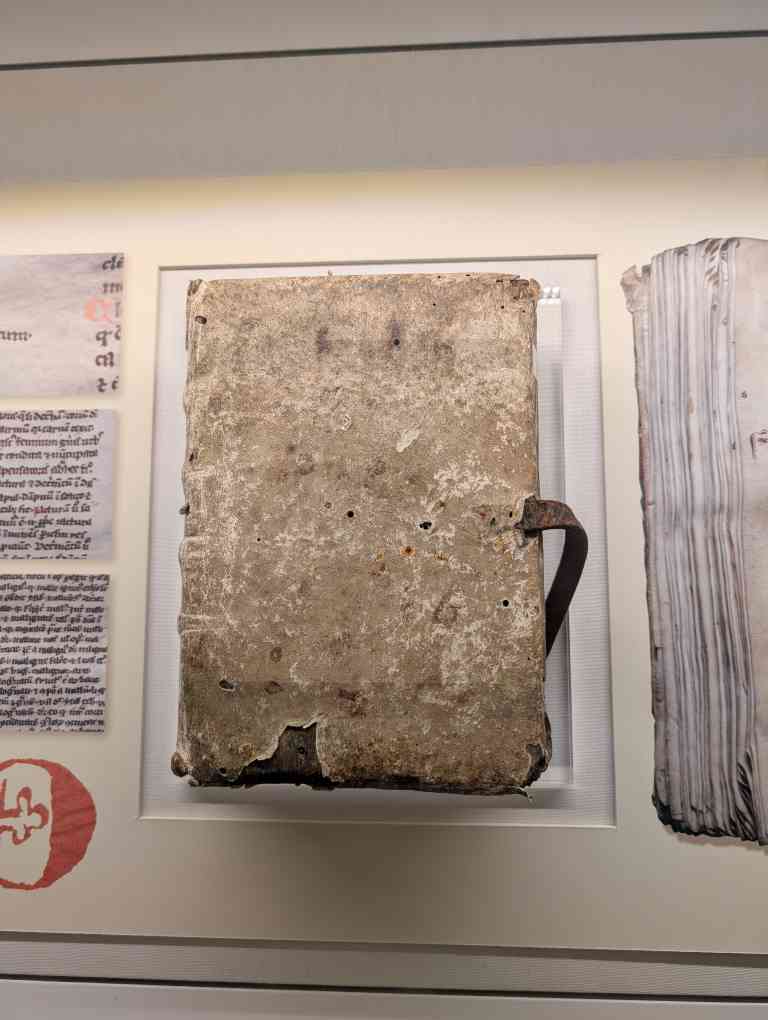
As a non-Latinist, the prospect of examining it closely was daunting. Armed with a 1970s edition of a similar manuscript and a three-hour time limit, I settled in. While my original intention had been to find French glosses, what I found instead was just as exciting: dozens of later elaborations on definitions, letter form practice, small faces illustrated between entries, and even a list of declensions.
If my suspicions are correct that the Brito Book was indeed used by nuns, it may represent a key piece in the puzzle of female latinity in later medieval England. It is not difficult to imagine the sisters of Lacock poring over the chained dictionary during their devotional reading, using it not only to deepen their comprehension of the liturgy but their capacity to contemplate it.
These discoveries offer a small window into the linguistic life of Lacock’s community, hinting at a richer story that I look forward to pursuing in my thesis.
Featured image: the cloister walk at Lacock. Through the windows, you can see the later additions to the house.