
Posted by Edward Mills
18 May 2026This week sees the return of our ‘Just Visiting’ series, where Centre members explore medieval sites of interest from around the South West. After Anne Gwatkin’s tour of Milton Abbey a few weeks ago, our post this week takes us to Dorset, where Edward Mills (and his son) went castle-hunting earlier this year.
As any medievalist will tell you, it’s impossible to resist the lure, even when not ‘working’, of a good premodern visitor attraction. So when, last March, I decided to use my non-working day to take my child on a short train trip to the sleepy town of Sherborne, it was almost an inevitability that we’d visit the Old Castle. I’m using the term ‘Old Castle’ with some care here, because — as the name suggests — there’s a certain amount of castellological confusion in this part of Dorset: essentially, depending on your preferred definition, Sherborne has either no castles, one castle, or two.
The complex where my one-year-old and I found ourselves on that unseasonably warm March afternoon os the older of the two, and if you showed it to most non-specialists, they wouldn’t hesitate in calling it a ‘castle’. It owes its existence to Roger, Bishop of Salisbury from 1107, for whom it was built as a residence, with the first wave of construction possibly finishing as late as 1137 (a mere two years before Roger himself was unceremoniously removed from office). Roger was certainly known as a prolific builder, as William of Malmesbury’s Historia Novella makes clear:
Rogerius qui edifitiorum constructione magnanimum se uideri uellet, plura. Apud Scireburnam et apud Diuisas multum terrarum edifitiis amplexus, turritas moles erexerat.
Roger, who wished to be thought of as a great builder, had built several castles. At Sherborne and at Devizes, encircling a wide expanse of ground, he had made ranges of buildings surmounted by great towers.
William of Malmesbury, Historia Novella: The Contemporary History, ed. by Edmund King, Oxford Medieval Texts (1998), p. 44
William of Malmesbury does not, however, use the term ‘castle’ at this point in the text. In many respects, the construction was really more of a fortified palace complex than an easily defensible retreat, and while its strategic location overlooking the town certainly gives it the impression of a sturdy stronghold, its defences were never tested in any meaningful sense until much later. Its history following the downfall of Roger in 1139 is a mish-mash of royal, seigneurial, and ecclesiastical ownership, before the site ultimately ended up in the hands (from 1592) of none other than Sir Walter Raleigh. Despite initial efforts to rebuild the castle, Raleigh ultimately settled upon building a new seat in what was the ‘old’ castle’s deer park, which survives today as the larger — and somewhat better-known — ‘new’ castle.
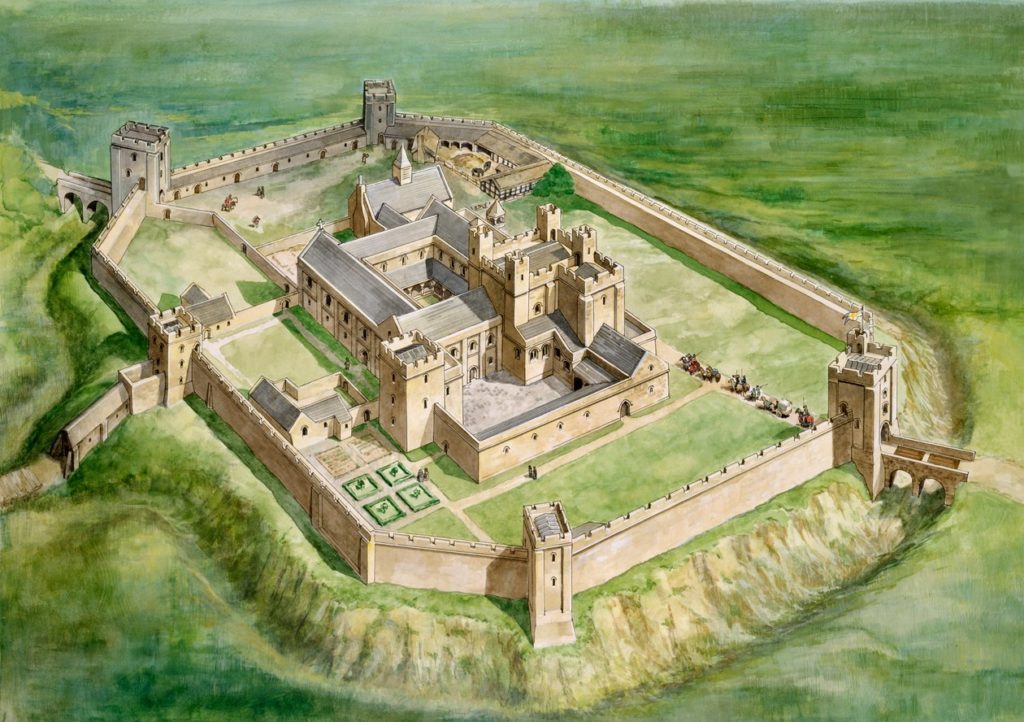
Looking out from the medieval ruins, which had finally faced siege (and suffered from it) during the English Civil War, it’s hard not to feel a stab of envy towards the newer foundation, which stares up the hill at its younger sibling as it flaunts its Capability Brown-designed gardens, magnificent house, and vineyard. By contrast, the only other visitors to the ‘old’ castle at the time of our visit were another parent and their child, a sadly small audience for what was a very evocative and well-presented site. English Heritage have worked hard, through well-designed and informative signage, to indicate what each surviving building would have been used for, from the imposing great tower to the kitchen and service yard, leaving the complex feeling surprisingly alive in spite of its centuries of disuse.
All this certainly made the not-insignificant walk from central Sherborne, weighed down with the accoutrements of new fatherhood, well worth it — and, if nothing else, I’ve ensured that my child’s seen their first castle. (I think I’ll save debates about nomenclature for a few years yet.)
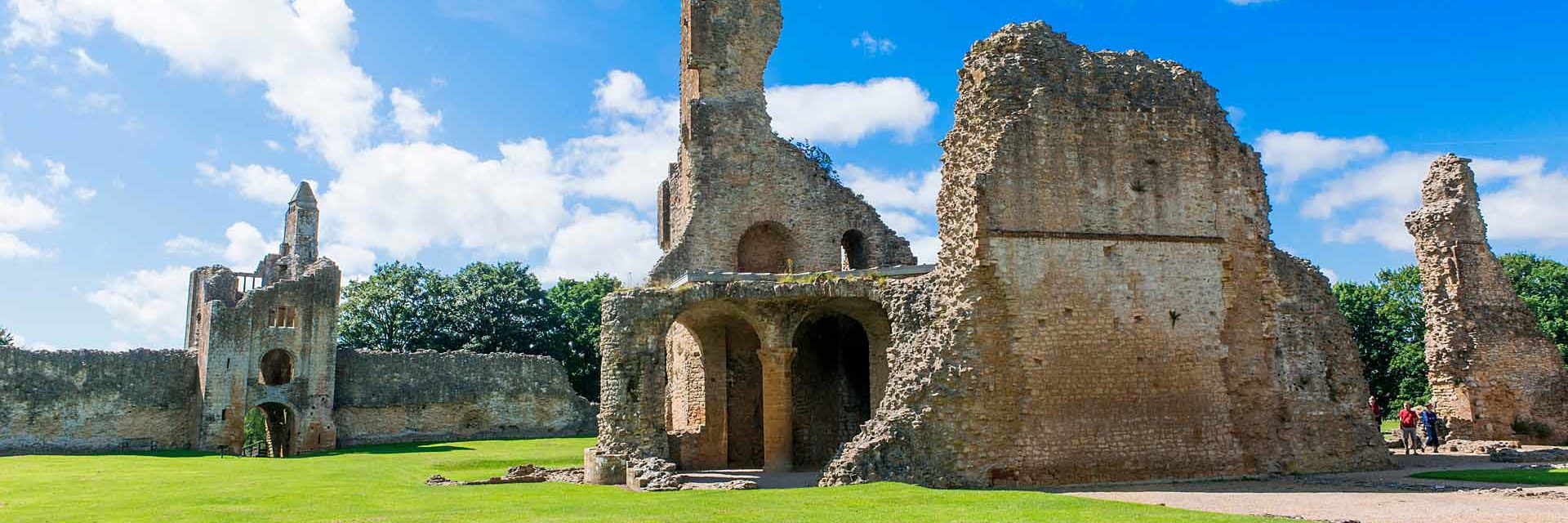
Header image: the castle interior as it appears today (source: English Heritage). Information on the history of the complex was adapted from Peter White and Alan Cook, ‘Sherborne Old Castle, Dorset: Archaeological Investigations 1930-90 (London: Society of Antiquaries of London, 2015).