We would love to hear from anyone who would like to write a blog for us. Please contact l.carmichael@exeter.ac.uk
July 2026
Balancing a PhD or early-career research is a notoriously tough journey. But imagine navigating that intense academic pressure while managing parenting and caring responsibilities. For mature students and researchers with families, time is a luxury, exhaustion is a constant companion, and the risk of isolation is incredibly high. Unfortunately, this resilient demographic is too often overlooked. That is why the Parent and Family Support (PAFS) group at the University of Exeter stepped up to create a much-needed space for connection, communication, and joy.
On July 11, Lyndsay Carmichael and the PAFS leadership team hosted their biggest event yet! Thanks to generous funding from various University of Exeter faculties, over 20 postgraduate and mature students, alongside their families, enjoyed a fully funded day trip to the iconic Eden Project. An air-conditioned coach picked up all 58 excited attendees from both the Streatham and St Luke’s campuses for a day to remember.
Together, the families explored the three massive biomes, shared a lovely group walk and lunch, and built lasting peer networks. For these busy researchers, it was not just a sightseeing trip; it was a rare, invaluable lifeline to socialise, breathe, and share experiences with others walking the same demanding path.
What Our PAFS Community Said:
The day was a resounding success, giving children a wonderful opportunity to play while their parents found solidarity. However, transformative events like this cannot happen without institutional backing.
PAFS extends its deepest gratitude to the generous university departments that made this trip possible. To ensure our student-parents and mature scholars have the community care they need to complete their studies smoothly, ongoing funding and support are vital. Let’s keep investing in the wellbeing of the researchers who carry it all.
Dr Tamara Al Khalili (on behalf on the PAFS team)
July 2026
Behind every research paper or grant application is a person with a life beyond academia. For many Postgraduate Researchers (PGRs) and Early Career Researchers (ECRs), that life includes intense parenting and caring responsibilities. Too often, these challenges remain invisible, leaving student-parents exhausted and isolated.
As a PAFS group lead, I wanted to change that. I am thrilled to share that I secured a grant from the University of Exeter’s Researcher Development and Research Culture Team to launch a new researcher-led initiative entitled “Bridging the Gap: Supporting the Wellbeing and Resilience of Researchers with parenting or caring responsibilities.” I designed this transformative, three-phase project specifically to boost the wellbeing, connection, and resilience of our academic caregivers.
Here is a snapshot of our journey:
Phase 1: Sharing Stories and The Power of Art
We kicked off by breaking the silence around academic caregiving. Four inspiring speakers, Alison Pearson, Rachel Griffiths, Martina Egedusevic, and Lyndsey Carmichael, shared raw, honest stories about balancing PhDs, newborns, and community advocacy.
Following these moving talks, arts educator Ludmila Centurión led a creative collage workshop. Surrounded by calming music, participants stepped away from productivity metrics to explore their identities through art, answering powerful prompts like “Why do I matter?”
Phase 2: Creating Space to Rest
Rest is not a luxury; it is a necessity. We took our researchers to the breathtaking Southcombe Barn at Dartmoor for a much-needed wellbeing retreat. Facilitated by Rosanna Elliott, the day focused on the Eight Pillars of Rest. From restorative yoga and journaling to a sauna, river plunge, and nature walks, our busy parents finally had the rare chance to pause, breathe, and remember you matter too.
Phase 3: Telling Our Stories Through a Collective Zine
In our final phase, participants collaborated with arts educators Ludmila Centurión and Katie Scott-Hamilton to co-create a collective zine. Filled with poetry, drawings, and personal narratives, this zine celebrates our diverse voices. Beautifully, it will also serve as the centrepiece for a co-authored research paper, allowing researchers to share their experiences creatively while helping shape future university policy on inclusion!
Looking Ahead
Resilience is not just about enduring a heavy workload. It is about having the community support to thrive. Thank you to everyone who made this project a success. Let us keep building an academic culture that truly sees, hears, and supports our researcher-parents!
Dr Tamara Al Khalili (on behalf on the PAFS team)
An interview response from ChatGPT, curated by Lyndsey Carmichael, June 23, 2026.
If I were looking across the higher education sector, I would say the issue is bigger than simply asking whether student parents need more support. The deeper issue is that many universities are still designed around an imagined student who is young, mobile, financially flexible, and able to organise their life around the institution.
Student parents often do not fit that model. They are not only students. They are also managing childcare, school routines, family finances, paid work, health appointments, emotional labour, commuting, and sometimes complex caring responsibilities. This means the problem is not only a lack of support services. It is a mismatch between university systems and the realities of students with children.
In recent years, student parents have become more visible in higher education policy. The Office for Students recognises students with parental responsibility as a group that may face risks to equality of opportunity. This is significant because it moves student parents beyond a narrow wellbeing discussion and places them within wider questions of access, continuation, attainment and progression.
However, recognition is only the starting point. The sector has begun to name student parents, but it has not yet fully redesigned university systems around them.
One of the first changes universities could make is to identify student parents earlier and more sensitively. Many student parents only become visible when something has gone wrong. This might be poor attendance, missed deadlines, financial difficulty, interruption of study, or withdrawal.
A better approach would be to offer students a voluntary and non intrusive way to disclose parenting responsibilities at application, enrolment, induction and progression points. This should not be about labelling students as a problem. It should be about making sure they receive the right information early enough to make informed decisions.
Universities could provide clear guidance at the points where student parents are most likely to need it: before starting their course, when choosing modules, when planning placements, when returning after maternity or parental leave, and when considering postgraduate study.
The message should be simple: we know that students with children may face specific barriers, and we have designed support with that in mind.
Childcare is often treated as something separate from academic life. But for student parents, childcare shapes almost every part of their university experience. It affects whether they can attend teaching, complete placements, participate in group work, travel to campus, use the library, attend events, or continue to the next level of study.
If childcare breaks down, academic participation breaks down with it.
This means childcare should be understood as an access and participation issue, not only a personal responsibility. Universities should do more than signpost national schemes. They should also consider emergency childcare support, childcare hardship funds, clearer guidance on entitlements, and practical advice for students whose study patterns do not fit standard childcare arrangements.
This is particularly important for postgraduate students, part time students, commuter students, placement students and international student parents. These groups can fall through gaps because many support systems were not designed with their circumstances in mind.
One of the most practical ways universities can support student parents is through better timetabling.
Late timetable release, sudden room changes, evening teaching, unpredictable placements and compulsory attendance at awkward times can create serious barriers. These issues may seem administrative, but for a student parent they can affect childcare bookings, school pick ups, paid work, travel costs and family routines.
Universities cannot remove every difficulty, but they can reduce unnecessary uncertainty. Earlier timetable release, core hour teaching where possible, fewer last minute changes, recorded teaching, structured catch up materials and more flexible attendance policies would make a real difference.
This does not mean lowering academic standards. It means recognising that predictability is part of fairness.
For student parents, uncertainty itself becomes a barrier.
Many universities offer hardship funds, emergency loans or cost of living support. These can be important, but they are often reactive. They usually appear once a student is already in financial difficulty. The sector needs to move from emergency rescue to prevention.Student parents need clear financial information before they reach crisis point. This includes guidance on childcare costs, benefits, bursaries, postgraduate funding, placement costs, travel, family accommodation and the financial implications of interruption or reduced study intensity.
Financial advice should also recognise that student parents often make decisions not just for themselves, but for their whole family. A funding delay or an unexpected cost can affect rent, childcare, food, transport and children’s activities. Support needs to be timely, visible and practical.
Many university spaces still quietly communicate that children do not belong there. This can leave student parents feeling out of place, embarrassed or unwelcome.
Family friendly campuses would include family study rooms, child friendly library areas, baby changing facilities, feeding spaces, safe waiting areas and clear guidance about bringing children onto campus. This does not mean turning universities into childcare providers. It means recognising that students with children are part of the university community.
The physical environment matters. If a student parent cannot safely bring a child onto campus for a short period, attend a meeting during school holidays, or find a suitable space to study while managing family responsibilities, their sense of belonging is weakened.
Belonging is not only emotional. It is also built through spaces, policies and everyday practices.
A strong sector response also needs to recognise difference within the student parent population.
A single parent, an international postgraduate parent, a mature undergraduate, a doctoral student with a baby, a commuter parent, and a student on a professional placement may all face different challenges. Some may have family support nearby. Others may be isolated. Some may be financially secure. Others may be managing debt, housing insecurity or benefit rules. Some may be studying online. Others may need to attend campus or placements at fixed times.
Universities should avoid a generic model of student parent support. Parenting intersects with gender, class, race, disability, immigration status, age, study level and mode of study. Support needs to be flexible enough to recognise those differences.
Student parent communities can be extremely powerful. They create belonging, reduce isolation, share practical knowledge and help students feel less alone. They can also help universities understand where the real barriers are.However, universities should not rely on unpaid student labour to solve institutional problems. If student parent communities are helping universities improve policy, support and student voice, they should be properly resourced.This could include funded networks, paid student parent ambassadors, consultation payments, staff support, family friendly events, and formal routes into student voice and governance structures.
Student parent communities should not become a low cost substitute for institutional responsibility.
If I had to summarise the sector challenge, I would say this: higher education needs to move from supporting individual student parents in difficulty to redesigning university systems around caring responsibilities.
This means student parents should be considered in admissions, induction, timetabling, attendance, assessment, placements, finance, campus spaces, postgraduate progression, student voice and equality planning. The cultural shift is just as important as the practical one. Universities need to stop seeing parenting as an exception to the student experience. For many students, parenting is part of the student experience. Until that is fully recognised, support for student parents will remain fragmented, reactive and too dependent on individual staff goodwill.
A more inclusive higher education sector would not ask student parents to constantly prove that they are struggling. It would design systems that recognise their responsibilities from the start.
OpenAI. (2026). ChatGPT (GPT-5.5 Thinking, 23 June version) [Large language model]. https://chat.openai.com/
The Importance of Community Events for Student Parents
Thursday 14th May 2026 by Dr Tamara Al-Khalili
Student-parents often experience a sense of disconnection within university life, particularly those balancing academic work with caregiving responsibilities. A recent report prepared by the PAFS founder Lyndsey Carmicheal and core team leads (Carmicheal et al., 2026) highlighted that many student-parents at the university of Exeter feel socially isolated from the wider student body, largely due to competing responsibilities and limited opportunities to engage fully in campus life. In response, the PAFS group aims to strengthen participants’ sense of belonging and connection.
As part of this effort, members were invited to two events this term, organised by Dr Tamara Al Khalili, an early career researcher and a PAFs Lead, who was awarded funding for a researcher-led initiative by the Researcher Development and Research Culture team supporting the wellbeing and connectivity of PGRs and ECRs with parenting and caring responsibilities for children with special educational needs and disabilities.
The first event was a collage workshop at the Multifaith Centre at Streatham campus facilitated by the talented art educator Ludmila Centurion, and the second was a retreat and wellbeing day held at Southcombe Barn, Dartmoor led by Rosanna Elliott. Thanks, to Exeter Students’ Guild who kindly supported the PAFS’ members transportation for the retreat at Dartmoor.
Both events created valuable space for student-parents, PGRs and ECRs from this community to connect with one another, prioritise their wellbeing, and temporarily step away from daily pressures.
Student-parents remain an often overlooked and marginalised group within higher education. There is a clear need for more sustained and targeted support to ensure they can thrive academically while managing their caregiving roles, ultimately enabling them to succeed and achieve their goals.
By Dr Tamara Al Khalili (Lecturer and researcher in Education Policy; PAFS Lead)
Carmichael, L., Norman, E., Pearson, W. and Egedusevic, M. (2026) Student-parents: Barriers to progression report. University of Exeter. Available at: https://ore.exeter.ac.uk/articles/report/Student-parents_Barriers_to_progression_report/31827955/1
Supporting Student Parents: Our New Collaboration with Tops Day Nurseries
Thursday 5th March 2026 by Dr Tamara Al-Khalili
We are delighted to share some exciting news with our Student and Families Support Group, our new collaboration with Tops Day Nurseries (Exeter Branch).
For student parents, juggling lectures, deadlines, placements, and research alongside childcare responsibilities can feel overwhelming. That is why strong, trusted partnerships between nurseries and university support networks matter so much. When childcare is reliable, safe, and genuinely supportive, student parents can focus on their studies, progress, and thrive without the constant worry of “what if something goes wrong?” Collaboration also means better communication and smoother support when challenges arise, helping families feel reassured and included, not isolated.
This partnership with Tops Exeter Day Nursery is about more than convenience. It is about building a supportive environment where student parents feel confident that their children are cared for by a professional team in a setting that values learning, wellbeing, and community.
We were delighted to join Tops Exeter’s official opening event on Saturday 24 January and to celebrate the beginning of this relationship together. The event was a truly lovely occasion- warm, welcoming, and full of positive energy. There was catering inspired by their award-winning menus, plenty of fun activities for children and families, and a great opportunity to meet local parents and members of the wider community. It was also a chance to see first-hand the environment Tops is creating: friendly, engaging, and thoughtfully designed for young children to learn and enjoy their day.
Most importantly, this opening marked the start of what we believe will be a meaningful collaboration. As we begin working more closely together, our goal is to strengthen the support available to student parents and reduce the pressure that often comes with managing family responsibilities alongside academic life.
We are also pleased to share that this collaboration offers very good rates and affordable options, supporting both home and international students. We know affordability is a major factor especially with rising living costs and we want student parents to have access to childcare that feels financially realistic, not out of reach.
Over the coming weeks, we will share more details about how student parents can benefit from this partnership, including how to express interest, ask questions, and explore the options available.
For now, we want to say a big thank you to Tops Day Nursery for the warm welcome, and to our student parents, who inspire us every day with your determination, resilience, and commitment to both your studies and your families.
In a statement from TOPS:
“Tops Day Nurseries, based on our University campus, is offering our international students a 5% subsidy when we reserve a space with them. You will only need to pay your deposit with your first invoice, so there are no upfront payments – making it as easy as possible to arrange your childcare and giving you one less thing to worry about (T&Cs apply).”

We are excited about what lies ahead, and we are proud to be building this support together
A Joyful Close to the Summer Term – PAFS BBQ Outing 2025
By Dr Tamara Al-Khalili
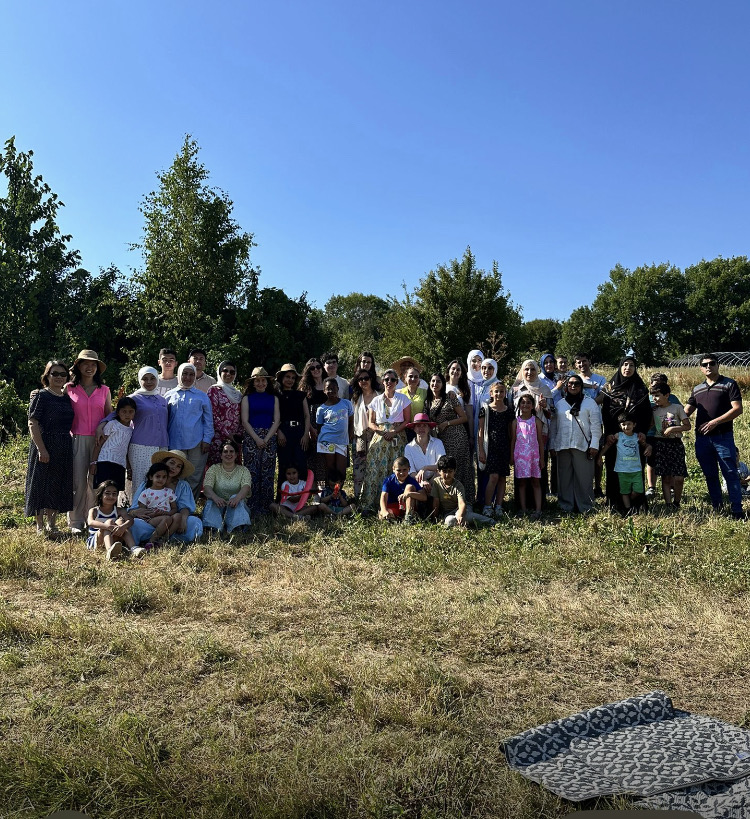
On Saturday 12th July, we wrapped up our summer term events with a joyful BBQ trip to Shillingford Organic Farm School. As the current lead of the PAFS group, I was thrilled to organise this special day, which brought together around 60 student parents and their families from across various departments at the university. It was a wonderful day out in nature, marking the end of another busy and often demanding academic term.
I chose Shillingford Organic Farm not only for its stunning green space and welcoming, family-friendly atmosphere, but also because it’s run by one of our valued members, Fatma Sabet. Fatma always greets us with warmth and generously invites us to her workshops and events. Visiting her farm is more than just a relaxing day out. It is an enriching, sensory experience. Children had the freedom to run, play, and connect with nature, while their parents could unwind, socialise, and simply breathe.
For many of our members, especially those living far from their home countries, the farm offers a comforting sense of grounding and belonging. One child summed it up beautifully, joyfully asking, “When is the next trip? I can’t wait, it’s so much fun!” Moments like these remind us exactly why this community matters so deeply, and why these gatherings are worth every bit of the effort and time it takes to organise them. All the planning and logistics fade into the background when we see the smiles, hear the laughter, and feel the gratitude from everyone who joins us.
This outing was also deeply meaningful because we celebrated one of our inspiring leads, Silvia, who successfully completed her PhD this year and is graduating this summer. Congratulations, Dr Silvia Nassar! You did it with three children. It was a lovely moment to reflect on her journey and to thank her for the energy and care she has brought to our group.
We also took time to honour the roots of our community by recognising the unwavering efforts of Lyndsey Carmicheal, the founder of PAFS. Alongside Ibhade Akpede and myself, we have worked through many challenges to keep this group going strong. It is this shared resilience and care that makes our community what it is a space of support, friendship, and understanding.
Our BBQ outing was the perfect way to unwind, connect, and celebrate all that we have achieved this term. While transportation can often be a barrier for members who do not drive, we were incredibly grateful to the Students’ Guild for their support in providing transport for the day. Their help made the event more accessible and inclusive for everyone.
Here’s to many more beautiful gatherings and the continued support that keeps our community strong and open to more students’ parents.
I’ll leave you with a few photos that capture the joy, laughter, and special moments we shared—true reflections of the spirit of the day 😊!
A special thanks to Jessica Eades from the Student Guild and supporting this even through community funding.
Tamara Al Khalili
PAFS Lead