
The Past Harvests Project
The Past Harvests Project
Posted by es970
11 August 2026The Past Harvests project is studying the archives of several great landed estates across a period of five hundred years. The records from the early modern period that these estates hold are exceptional. These include a rich seam of accounting information, detailed field-by-field surveys encompassing many years, wonderfully detailed maps and much other invaluable material.
For the medieval researcher the material that survives, even in such rich archives, can be much more problematic. Where records have survived at all, the level of detail can fall well short of what is needed to construct a full picture of farming activity across the manors of each estate. Ideally we would wish to understand how each tenant farmed their land. However, there is almost no surviving material that would provide the necessary information. The farming unit that does feature in the medieval records is that of the lords’ demesnes (what we might describe rather loosely as the home farm of the manor). The demesne was a commercially-oriented enterprise with much of the produce sold to local markets and consumers
For our project the ideal combination of records for a manorial demesne would comprise several sets of consecutive years of accounts by the reeve or bailiff. The reeve was an important official elected from among the tenantry; one of his key responsibilities was to produce an annual account for the lord. The bailiff was an official of the manorial court and could have broad administrative responsibilities within the manor, including the production of accounts. The perfect accompaniment to any surviving accounts would be a survey or extent, providing details of the make-up of the demesne. The best such extents give the acreages of arable, pasture, meadow and woodland on the demesne, together with their values. They also list the tenantry, giving the sizes and values of their holdings and their obligations to do bonded service. Taken together these records can help greatly in understanding the position, composition and scale of a manor. However it is only with surveys produced in the early modern period, together with written perambulations of its boundaries that the definite outline of the manor can be discerned.
Where detailed accounts produced by the reeve survive, they include information on the crops grown, on items produced such as cheese, eggs, fruit etc. as well as the number and ages of livestock. We do have a selection of such accounts such as those for the manor of Exminster, part of the estate of the earls of Devon who now resides at Powderham – in the middle ages the earl was resident at Tiverton while a cadet branch of the family were at Powderham:
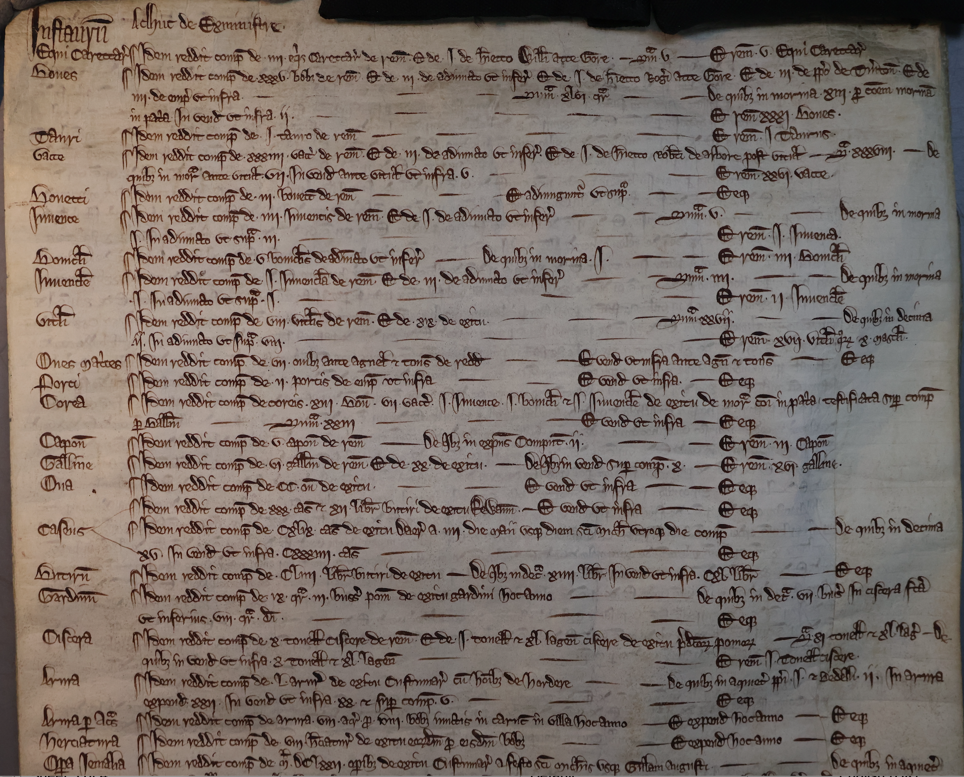
The National Archives, item SC 6/827/39. Part of the reeve’s account for the manor of Exminster, Devon for the period 1285–1287. Here we see the stock list beginning with the numbers of cart-horses, oxen, bulls and cows.
Another example comes from Holkham Hall in Norfolk where the account for the manor of Beeston near Dereham survives for the year 1287:
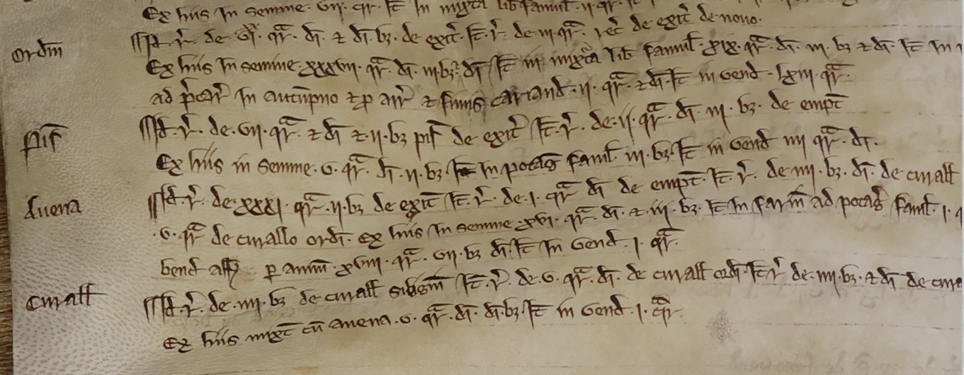
Holkham Hall Archives DTR/6. An extract from the reeve’s account for the manor of Beeston, Norfolk in year 1287. This image shows the quantities of various crops grown such as barley, peas, oats and rye.
Such detailed accounts are needed to complete the entries for the Global Farm Metrics (GFM) model. The GFM is the work of globalfarmmetric.org and is a framework designed to explain, measure and improve whole-farm sustainability. It is the model adopted by our project.
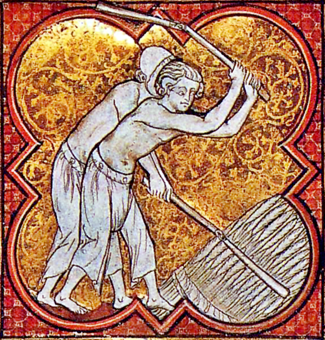
Bibliothèque nationale de France, département des Manuscrits, Latin 12834, fol. 64v. – Calendrier-martyrologue de l’abbaye de Saint-Germain-des-Prés, France (Paris), date 1270. Two men are using hand flails to thresh the corn.
All too often, however, there are no such detailed accounts or extents or surveys surviving from the medieval period for our chosen estates. We therefore have to be resourceful in finding and making use of sources from elsewhere. For example, to supplement the accounts for the Powderham estate, we have used detailed accounts from similar manors nearby such as that of Tiverton. The Tiverton account for 1285–1287 is a splendid one, listing the crops grown and their amounts such as mixed grain, rye and oats (both large and small). It also includes a comprehensive list of stock and their produce such as wool, skins, butter and cheese etc.
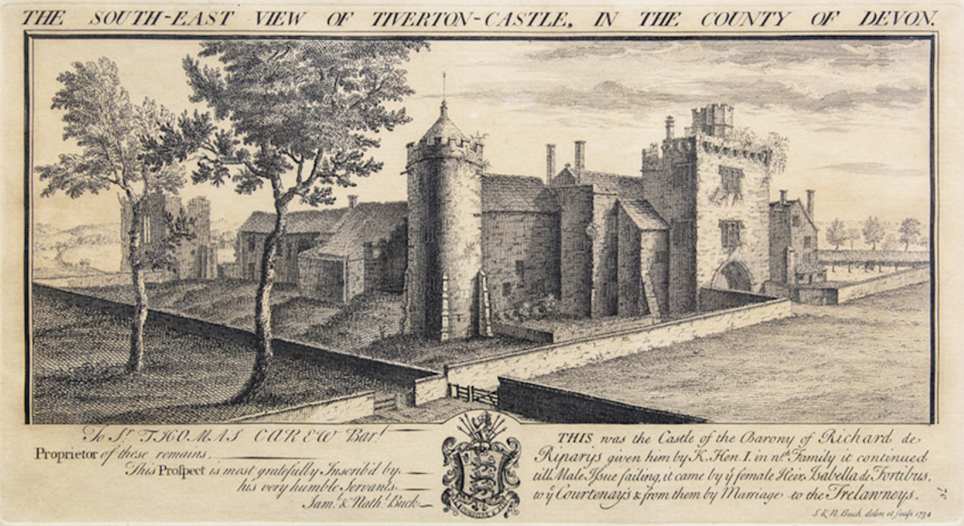
South-East View Tiverton Castle in the County of Devon drawn and engraved by Samuel and Nathaniel Buck in 1734. From the University of Exeter Fine Art Collection.
Where no detailed accounts or exents exist for our chosen manors or for similar manors nearby then other approaches have to be considered. Regional and national summaries of medieval farming practice have been published by scholars such as Bruce Campbell and are widely available. Recent authors have also produced some detailed models of how medieval agriculture was carried out. They have, for example, calculated the physical size of livestock (they were much smaller in the middle ages!) and modelled the amount of manure they would have produced under different regimes of care. The medieval researcher can seize on these to populate a framework such as the GFM model.
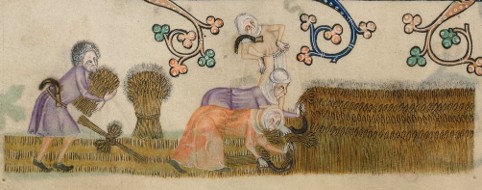
Another scene from the Luttrell Psalter (fol. 172v). Here women are reaping the corn with their sickles while the men gather, bind and carry away the sheathes.
Medieval authors such as Walter of Henley and others were concerned with what we might describe as best practice in agriculture. They produced various guides on how to farm effectively and profitably. We know that such treatises were widely read and circulated in the thirteenth, fourteenth and fifteenth centuries. We can therefore draw on those writings to envisage how farming was carried out on our manorial demesnes. For example, Walter advises that stubble should not be sold or removed from the ground unless needed for thatching. Another anonymous author advises that each cow ought to yield seven stone of cheese and one stone of butter in a year. An old edition of these works is freely available online: Walter of Henley et al.
In conclusion the medieval researcher must be prepared to toil like the peasant at harvest time. They must comb through the whole crop, extracting what information they can, always looking out for additional ways to supplement their findings. With persistence, ingenuity and imagination they would hope to do justice to the hard work of the medieval people they study.
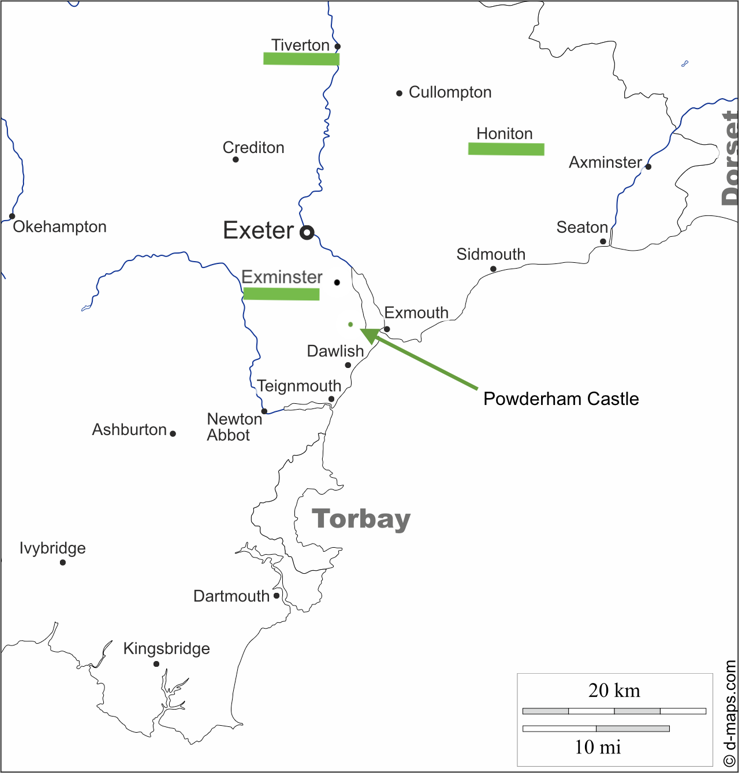
Outline map of south-east Devon highlighting some of the locations mentioned.
This blog was provided by Dr Des Atkinson, Postdoctoral Research Associate at the University of Exeter on the Past Harvests project.