
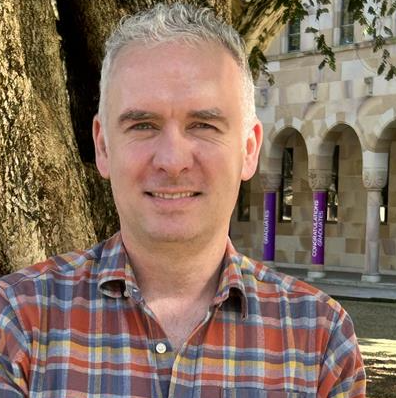
Dr Tony Barnett is a Research Fellow in the School of Psychology at The University of Queensland in Brisbane, Australia. Tony’s work explores the social and cultural contexts of alcohol and other drug use, treatment (including novel therapeutic interventions) and policy change. His work draws on critical social science methods to provide in-depth accounts of consumers, carers and clinicians’ experiences of addiction treatment, care and recovery. He is currently focussing on a new program of work entitled “The psychedelic revival in addiction research and practice: A social and policy analysis in Australia and the UK” (funded by an Australian Research Council, Discovery Early Career Researcher Award 2025 to 2028). His trip to the University of Exeter is supported by a “QUEX Workshop Grant” (with Associate Prof. Farrimond and Prof. Hauskeller), which opens the opportunity for discussions and collaborations between The University of Queensland and Exeter on psychedelic topics. On that note, he would love to hear about any research people at Exeter are conducting on psychedelics, hence please feel free to get in touch with him before or after the talk!
Colloquium Presentation: 16 January 2026, 3:30-5pm (Room G17, Mood Disorder Centre, Sir Henry Wellcome Building)
Psychedelics in addiction research and treatment: Social and policy implications in the Australian context
Abstract
Addiction researchers have long been searching for biomedical treatments to address difficult to treat addiction problems. Psychedelic therapies have been labelled as a potential breakthrough treatment for alcohol and other drug addiction. Contemporary clinical trials aim to extend a historical, scientific focus on psychedelics to treat what are framed as treatment refractory addictions (e.g., psilocybin for alcohol use disorder). Although Australia has (controversially) moved to fast track the translation of psychedelics to clinical practice for depression and PTSD, concerns have been raised about how psychedelic treatments might be translated to treat addiction, with resultant benefits or harms impacting different groups in society affected by addiction. People seeking addiction treatment have been targeted by dubious for profit clinics promoting psychedelic “cures” to their addictions at significant personal costs and harm with little evidence of their efficacy and limited regulatory oversight. Addressing these concerns, Tony’s work explores the policy and social implications of psychedelics in addiction research and treatment, including equitable access to clinical trials and treatment in contemporary society. Guided by a responsible research and innovation framework, he argues that there is an urgent need to ensure that the translation of psychedelics to practice is conducted in an ethical way, that promotes the wellbeing of a large cohort of Australians seeking addiction treatment. Discussion will be invited from attendees to unpack these concepts further.