
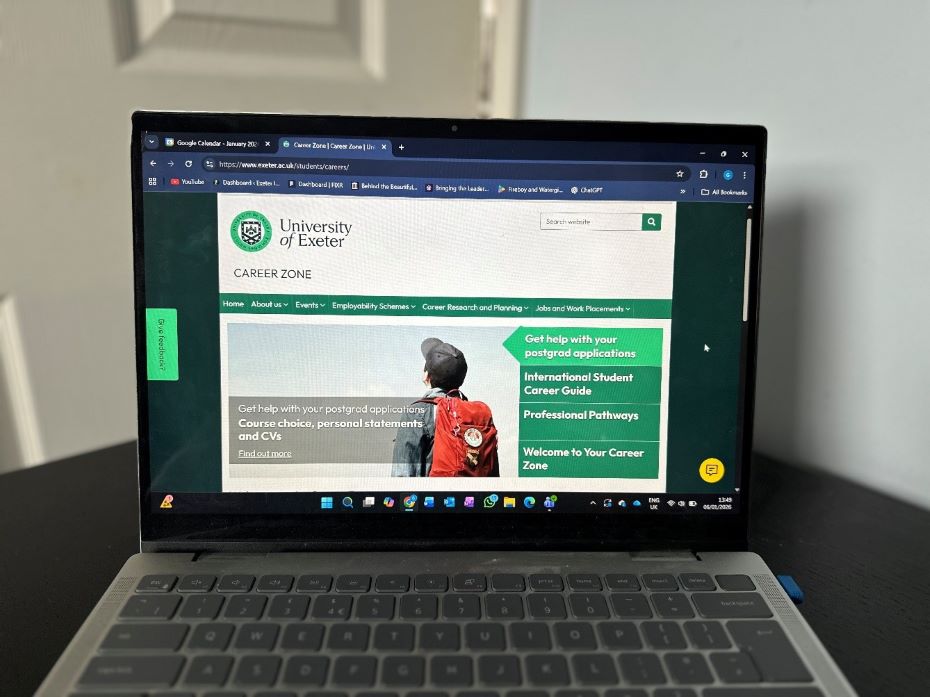
Hello there! I’m George, I’m originally from Kent, south-east England, and I’m currently in my third year studying BA International Relations with Proficiency in Spanish. When I first joined Exeter, I didn’t know the exact career I wanted, what job I’d be best suited to, or how to get there. I now know the answers to all these questions, thanks to Exeter. The employability and careers opportunities I have pursued at Exeter have been instrumentally important in helping me find answers to these important questions. I’m going to talk about all the opportunities, support, and activities available in this space and how they’ve helped me!
Exeter is a fabulous base to launch your career from. Gaining practical skills and experience to help your employability is part of student life at Exeter, and it is certainly a key reason why I chose to study here. In my opinion, students at Exeter are very career orientated, a reflection of this core mission of the University. This atmosphere is noticeable on campus and students often talk amongst themselves about what they’re up to in this space. Careers and employability can be a daunting topic for some, but what I like about Exeter is the positive and supportive vibes the University and its students create in this area. This gives students the confidence to pursue their passions and enhance their personal development. I’ve personally explored many of the avenues available to enhance my skills, and I now feel much more confident about my employability prospects in comparison to when I first started at Exeter. I’m going to tell you a bit about all the exciting, and incredibly useful employability and careers opportunities, support, and activities available to all students at the University of Exeter!
Exeter’s Approach
I think the famous phrase ‘Rome wasn’t built in a day’ reflects Exeter’s attitude towards careers and employability. Landing your first graduate role is a great and important achievement, Exeter knows this doesn’t happen easily, but through persistent effort and dedication. This is why Exeter encourages its students to start thinking about careers right from day 1, and why it offers a plethora of ways to build up relevant skills, knowledge, and experience. I remember attending an employability lecture very early on during the first term of my first year where I was pleasantly surprised by the dedication the University shows towards developing students’ employability. From that lecture, it was clear to me that Exeter’s employability support was an opportunity to not be missed. Looking back at what I’ve done in this space, I’m so glad I took on the opportunities Exeter has provided me.
Career Zone

The first thing to flag is definitely the Career Zone. This is the University’s dedicated hub for everything employability related. Located in the main Forum building, it is a vital cog in the Exeter machine and it’s accessible to everyone who studies at Exeter. The goal of the Career Zone is simple – to help prepare Exeter students for life after university; it does this in many ways. Arranging free-to-attend careers events, fairs, talks and workshops is one of them. In October this year I attended the Public Policy and Government careers week where I had the chance to speak to professionals in this sector, undertake skills workshops, and hear from those that know this sector inside out. I found this incredibly useful and I know my friends and peers who attended different careers weeks and fairs for other sectors found them very useful too. You can also tap into the Career Zone for CV and application form advice, 1:1 appointments, advice on finding work experience, internships, graduate jobs, or post-graduate study, and guidance for interviews and assessment centres. The Career Zone can help you identify what career you would like to pursue and help you land your first role in your chosen sector. Importantly, Exeter graduates can still seek support from the Career Zone for up to three years after graduation!
Don’t just take it from me, however. According to Student Crowd, in 2025 Exeter was ranked the 3rd best university for its career services in the whole of the UK! It said that Exeter ‘goes above and beyond to help students with their onward study or placement/graduate jobs.’ As someone who has lived and breathed what Exeter has to offer in this space, I believe this achievement is well-deserved and a true reflection of the high-quality careers and employability support offered by Exeter.
Career-Orientated and Flexible Degrees
Degrees at Exeter are not just academic, they’re career orientated. There are dedicated employability modules in all degrees. These are not generic but instead are discipline-tailored in order to provide the most effective support, advice, and skill development. Moreover, modules at Exeter are assessed with employability in mind. Alongside standard essays, I have been assessed on my ability to give presentations, put together analytical reports, write policy briefs and more. These skills will provide me with great advantages as I aim to enter an international relations related career.
Exeter degrees are very flexible, especially as students can become proficient in a skill or subject outside of their degree discipline which can be added to their degree title. This can be arranged once students start at Exeter. There are opportunities to be proficient in Languages, Management, Sustainability, Law and more. In fact, this aspect was a main reason I chose Exeter. During an open day, I spoke to a lovely lady from the Language Centre who told me that I could learn a language alongside my other studies and it would be put next to international relations in my degree title. I’ve subsequently pursued Spanish for all three years of my time at Exeter! More often than not, there is a language section in job application forms and so Exeter has given me another string to my bow. Studying modules from outside of your degree discipline is a great way to broaden your knowledge and convey inter-disciplinarity to employers.
Development Beyond Curriculum
Other opportunities for students to enhance their employability alongside their studies include part-time jobs, internships, and society positions. If you would like to sign up for it, there is a dedicated internship bulletin emailed out every Friday with a list of the available university-based internships as well as internships available in the wider area. Some of my housemate’s study neuroscience and they have completed neuroscience-related internships at the university for example. For me, I am currently serving as President of Exeter’s International Relations Society, I was Publicity Secretary previously, and I also have a freelance position as a Student Content Creator. This year I landed my first internship with an international non-profit organisation, and I know the positions I have pursued at Exeter assisted in my successful application to this internship.
If you would like to designate a big chunk of your degree to employability specifically, you can choose to pursue a work placement. This opportunity is fantastic to gain some full-time experience and I personally know of many cases where students who completed a placement year with an employer are subsequently offered a graduate position. If they aren’t, students still have an entire year of relevant experience which gives them a huge employability advantage. There is also a great study abroad option for students seeking international experience or language development to advance their employability.
Exeter offers a career mentor scheme whereby students can be paired with a professional in their desired career sector who is available for specific guidance and advice. There is a dedicated employability award called the Exeter Award students can achieve. Importantly, in June every year there is something called the Grand Challenges, This is a project week in which students can work in interdisciplinary groups with other students to create and present innovative solutions to real-world challenges. I completed this project week at the end of my first year where I participated in the Complex Global Security path and I thoroughly enjoyed the experience. This experience further developed my teamwork, communication, critical thinking, and interpersonal skills. This project now has a designated section on my CV.
Future Ready Graduates: The Exeter Advantage
I believe that anyone who attends the University of Exeter is giving themselves a career and employability advantage instantly. The Exeter approach to employability is unique and clearly pays off in the highly skilled graduates it produces. Exeter graduates rank in the UK’s top 10 for the most targeted by leading employers, a reflection of the effort this University puts into making its graduates future ready.
I should mention that the whole atmosphere around employability and careers at Exeter is very positive and welcoming. It isn’t a competition; people aren’t made to feel bad if they don’t know where to start when thinking about careers. The University of Exeter is very understanding of everyone’s situation and is extremely supportive of everyone’s circumstances. I came to Exeter not knowing where to begin on the careers front, and I will be leaving in July 2026 well-equipped for the future I want. This journey began when I applied to the University of Exeter. An offer to study at Exeter isn’t just about academics, it’s an employability and career advantage. I know I chose the perfect university for me in terms of careers and employability, and I hope you do too!
George 😊