

Hi, I’m Prisha, a third year Zoology student studying at the University of Exeter’s Penryn campus. I’m going to talk about a topic that isn’t talked about enough surrounding university life: money. We always hear ‘budget wisely’ or ‘there’s support available’ but that doesn’t actually help when you’re not confident asking for real financial support. Money can even be a deterrent for some applying to uni, if they feel like they can’t afford it.
This blog isn’t going to be me pretending that being a student is cheap, or that money worries magically disappear once you arrive at uni. They don’t. But I can talk about how studying at Penryn campus supports students financially in real, practical ways, from free food to part time jobs and wellbeing support. It’s also a simple fact that living in Cornwall is very different (and often cheaper) than living in a big city like London.
The Success for All Hardship Support fund
Money problems at university don’t always come from bad budgeting. Sometimes things change unexpectedly, a job falls through, rent goes up, or an essential cost pops up out of nowhere. When that happens, the University of Exeter’s ‘Success for All Fund’ is there as a safety net.
The fund offers extra financial support to students who are experiencing unexpected hardship that’s starting to affect their ability to study. In simpler terms, it means your essential costs (like rent, food or travel to campus) are higher than your income. It’s not designed to be a main source of funding or to cover non-essential spending, but it can really help if something unexpected happens.
Before applying, the University expects that you’ve explored other options, such as taking out the Student Loans you’re entitled to and using any significant savings you may have. The fund is there to support you when you’ve done what you can and things still don’t add up.
The application process is online, and you’ll be asked to upload evidence, but support is available. Students at Penryn can get help from the Falmouth & Exeter Students’ Union, and you can also email SuccessForAll@exeter.ac.uk if you have questions. It’s there to help when you need it, not to judge.

Falmouth & Exeter Student’s Union
The student union is not just about societies or events – it’s a big part of how students are supported day-to-day, for example, when money is tight.
One of the most talked about (and loved) SU initiatives is Free Soup Fridays. Every Friday from 1-3pm, the SU provides free vegan soup for students on campus. It sounds small, but it’s not. It’s a guaranteed hot meal at the end of the week, no questions asked. You don’t have to prove anything, you don’t have to sign up, and no one makes it awkward. You just turn up, grab a bowl and enjoy some soup with your friends. For some people, it’s a nice bonus but for others, it genuinely helps stretch their food budget just a little bit further. And for everyone, it creates a sense of community, which is just as warming as the food itself.
The SU also holds a community pantry which students can freely pick up any food essentials if they are struggling, and a ‘Hygiene Station’ offering things like soaps and sanitary products that everyone needs on a daily basis. This can be a real relief and help cover the basics during more expensive weeks.
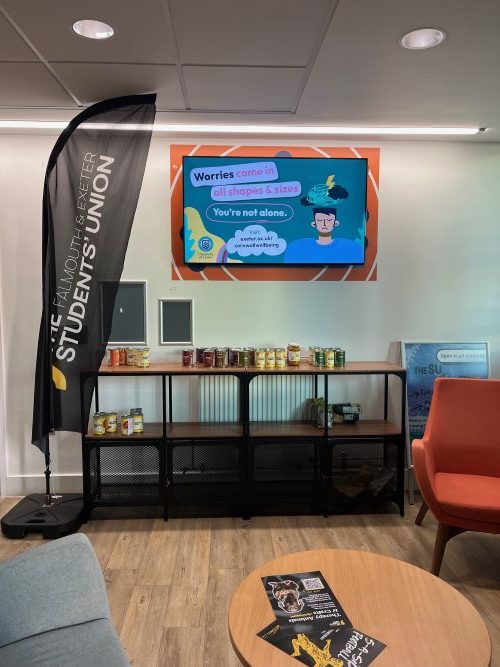
Occasionally, budgeting skills workshops are held, they are truly useful and not someone juts telling you to ‘stop buying coffee’! These sessions are practical and realistic, covering things like:
- How to plan a student budget that reflects real costs
- Managing rent, food and social spending
- What to do if money suddenly becomes tight
- Where to get help if you’re struggling financially.
These workshops are meant for everyone, including those that aren’t struggling with their money, as it informs students how to keep on top of finances and where to look for help if it does become a problem. They are never judgemental, and are understanding that everyone’s situation is different. Some students are living off loans alone, some have part-time jobs to help, some get family support and some don’t. The advice reflects that.
Beyond specific initiatives, the SU is also just…there. If you’re stressed about anything; money, housing, work or anything else, there are people you can talk to who will point you out in the right direction.
ResLife’s Crafternoons and days out
Another underrated source of support is the ResLife team, made up of students from the University of Exeter and Falmouth University. Some of them may have even been in your position before, understanding your financial situation. Their main aim to help you feel settled and make the most of university life, without costing a fortune.
ResLife works closely with the Student’s Union and events teams to run an amazing trips, activities and events throughout the year. So even if you may be having a hard time with finances, you don’t have to miss out on uni experiences. Every Monday, from 4pm-6pm, they hold a Crafternoon, where the ticket includes all the materials to make your own craft, ranging from embroidery to pumpkin carving at Halloween. Some people even go just for the free drink that’s included at Koofi, one the cafes on Penryn Campus! Whatever the reason, it’s such a fun way of spending your Monday evening, either by dragging your friends along, or making new friends at the event itself.

Every now and then, ResLife also organise trips all around Cornwall, for a fraction of the standard prices. They even meet at the campus bus stops so you can all travel together without a fuss. In the past, students have been able to visit Bodmin jail, the Tate in St Ives and even ice skating at the Eden Project! I remember in my first year, not having a car with me, I would go on these trips all the time, my weekends would be filled with activities, and I definitely saved a lot of money by going with ResLife. You can find out what they’re up to on their Instagram @fxreslife.
The Career Zone
One of the biggest ways students support themselves financially is through part time work, and that’s where the Career Zone come in, located just on the ground floor of The Exchange. They regularly advertise part-time roles that are suitable for students including: on-campus jobs; local jobs in Penryn and Falmouth; flexible hours that fit around lectures and deadlines; and short-term/seasonal work. This is especially useful if you’re new to the area and don’t know where to start looking. Instead of endlessly scrolling job sites, you’ve got a central place that understands student availability and academic commitments.

But their support goes beyond just job listings. They also help with CV writing, cover letters and interview preparation. If you’ve never had a job before, this support can make the process so much less intimidating. And if you have worked before, it still helps refine things so you’re putting your best foot forward. I definitely know that – being in my final year here – I’ll be looking to finesse my CV and confidence with interview practice before I venture out into the job market!
My tip would be to think of university as investing in your future, with it being more than just a degree. All the transferable skills I have accumulated through my course and societies such as critical thinking, good communication and teamwork have made me feel prepared to venture into applying for master’s programmes and even the job market.
Wellbeing services
Something that in my opinion that doesn’t get talked about enough is how closely financial stress and wellbeing are linked. With your wellbeing being so crucial to good sleep, concentration, metal health and overall enjoyment of uni life, we all need to take care of ourselves.
If you’re struggling with anxiety, stress or low mood because of financial worries, there is wellbeing support available on campus. Students can firstly book an appointment with The SU Advice Service. They give advice on all things student loans, grants and bursaries, taxes, welfare benefits, debt problems and budgeting. The important thing is that money worries are taken seriously. They’re not dismissed as something everyone just has to deal with. If finances are impacting your wellbeing, you’re encouraged to seek support. I’ve been very lucky where a combination of part time jobs, loans and help from parents have meant that I haven’t had to worry too much about not having the essentials to keep me going. But if I was ever put into that situation, I would wholeheartedly be confident that the university can help me in so many ways, including just having a chat with someone to tell them about my worries as a reminder that you are not alone and people are always willing to help.
What’s good about the support at Penryn is that each point of help does not exist on its own. Wellbeing services, the SU and other support teams work together, meaning you’re not passed around endlessly or made to repeat your situation over and over. That approach makes it much easier to actually get help when you need it.
Final remarks – You are not alone!
University is expensive. There’s no point in pretending that it’s not. But studying at the University of Exeter’s Penryn Campus means you’re not navigating anything alone. The support is personal, grounded in what students actually need. Whether it’s a bowl of soup on a Friday, help finding part-time work, or someone to talk to when money stress gets overwhelming, there are systems in place that really help. So if you’re questioning whether studying here in Cornwall is for you, it’s reassuring to know that there’s a bit of help everywhere to make student life here feel more manageable, financially or otherwise.