
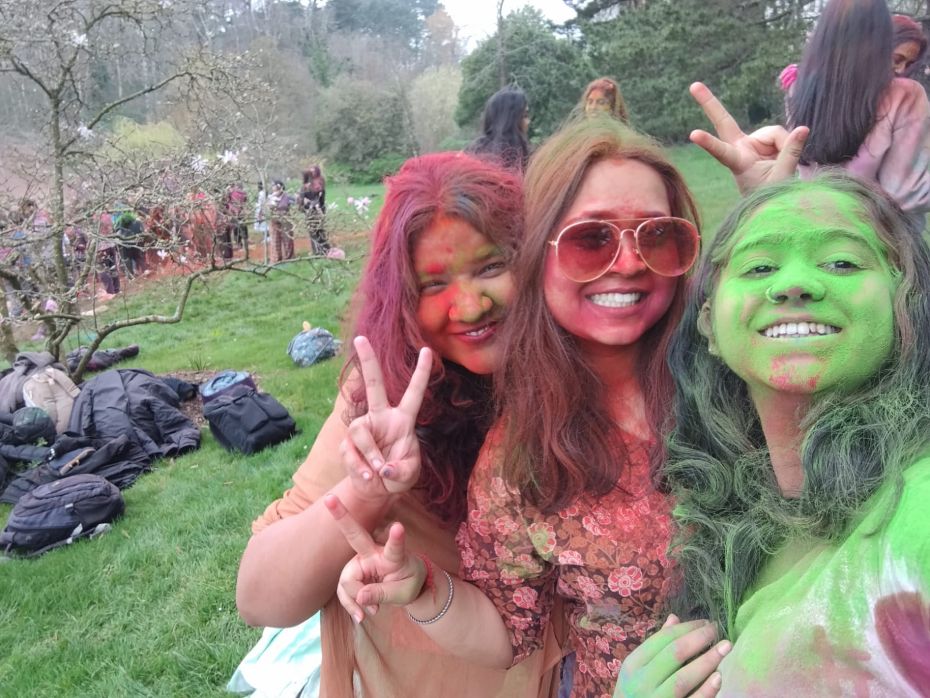
Hello everyone, my name is Suproja, and I am a postgraduate student studying for an MA in English Literature at the University of Exeter. I am from India, and I grew up surrounded by the stories and traditions of festivals like Holi, the vibrant celebration that marks the arrival of spring. Yet this year was particularly special for me, as I experienced Holi in a completely new way here on campus in Exeter – celebrating with friends from across the world and sharing the moment with my father, who had come to visit me. What began as a simple gathering soon transformed into something unforgettable.
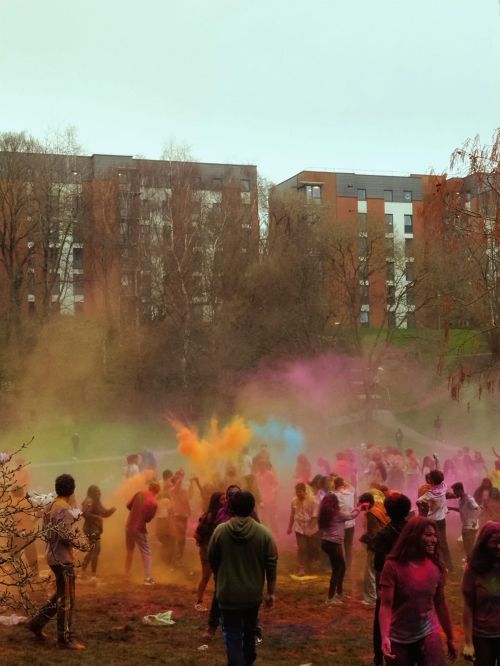
For a moment, the sky above Exeter stopped being ordinary. The pale English afternoon suddenly filled with drifting clouds of pink, yellow, and blue, as if someone had gently shaken a box of powdered rainbows into the air. Laughter travelled across the open field, music pulsed somewhere in the background, and strangers’ faces, slowly transforming into bright canvases of colour, began dancing beneath a sky that felt almost unreal. It felt less like a festival and more like stepping inside a dream. And somewhere in that floating haze of colour and music, when I realised that it was the time for the festival of colours – HOLI.
Holi had always existed somewhere on the edge of my life. Growing up in India, it was impossible not to know about it. Every year, the festival would arrive with stories of colour-filled streets, laughter echoing through neighbourhoods, and music drifting through the warm spring air. I knew the mythology behind it, the rituals, the joy people associated with it. Yet strangely enough, I had never truly stepped into the celebration myself. Sometimes festivals surround us without quite including us. They exist around us like familiar seasons, recognised, anticipated, but never fully experienced. Holi was always like that for me: something I knew about, but never quite belonged to.
Perhaps that is why celebrating it this year, thousands of miles away from home at the University of Exeter, felt almost surreal. It was as if something I had always known suddenly revealed its true colours to me for the first time. And strangely, it took distance to make that discovery possible.
As the celebration unfolded on the open field near the XFI building, with music playing and clouds of colour rising into the pale spring sky, it was impossible not to reflect on what this festival represents. Holi, often known as the festival of colours, celebrates the arrival of spring and symbolises the triumph of good over evil through the ancient legend of Prahlad and Holika. But that afternoon in Exeter, the meaning of the festival felt even broader.
The University of Exeter has long been a welcoming space for students from around the world, and for many Indian students like me, celebrating Holi on campus felt incredibly special. What is normally experienced in the streets and courtyards of India was recreated here in a university field, bringing together students from different countries, cultures, and backgrounds. It was a reminder of how much importance the university places on its international community, creating spaces where traditions from across the world can be shared, celebrated, and experienced together. In Bengal, where I come from, Holi begins a little differently. Before the brighter chaos of the festival arrives, there is Doljatra, a celebration that carries a softer, more lyrical mood. Doljatra feels a poetic ritual of worshiping nature, as if spring itself has been translated into music. People dress in shades of yellow and saffron, the colours of blooming mustard flowers and sunlight. Songs fill the air, often Rabindra Sangeet, the music composed by Rabindranath Tagore, whose poetry so often captures the delicate beauty of seasons and human emotions.
One of the most magical places to witness this celebration is Shantiniketan, the university town founded by Tagore himself. In Shantiniketan, Doljatra transforms into what is known as Basanta Utsav- the festival of spring. Students dressed in flowing yellow garments gather beneath open skies, singing Tagore’s songs while welcoming the season. Gentle clouds of coloured powder drift into the air, but the celebration feels less like a chaotic festival and more like a carefully choreographed performance. There is dance, poetry, music, and a quiet sense of grace that fills the campus. It is almost theatrical, as though spring itself has stepped onto a stage and begun to perform. Tagore believed deeply in the connection between nature, art, and education, and Basanta Utsav reflects that philosophy beautifully. It is not merely a festival of colour, but a celebration of beauty, creativity, and the renewal of life.
Another place where Holi takes on an almost legendary dimension is Vrindavan, the sacred town associated with the childhood stories of Krishna. Here the festival feels expansive and mythic, unfolding across temple courtyards and narrow streets filled with music and devotion. The mythology behind this celebration is rooted in the playful love between Krishna and Radha. According to legend, Krishna once mischievously coloured Radha’s face, and that playful act eventually became a symbol of affection, joy, and equality. Even today, people recreate that moment during Holi, throwing colour at one another with laughter and affection. In Vrindavan and nearby towns like Barsana, the celebrations can last for days. Temples echo with devotional songs, and waves of colour rise into the sky like living rainbows.
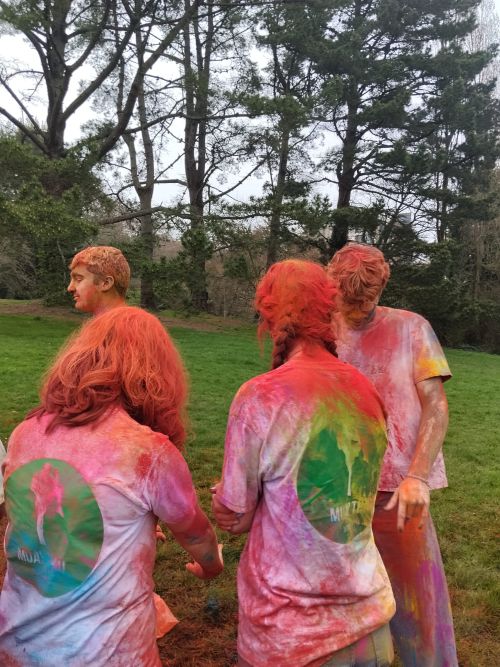
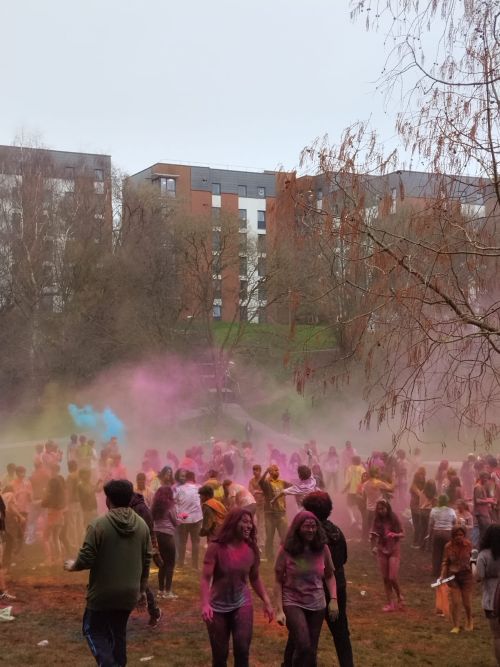
Standing in Exeter that afternoon, it struck me how remarkable it is that a festival rooted in such specific places, Vrindavan’s ancient temples, Shantiniketan’s poetic campus, the towns and villages of India, can travel so far across the world. Festivals are not confined to geography. They move with people, carried quietly in memory and tradition. Students bring them across continents, recreating them wherever they gather. And so, for a few hours, a small field near the XFI building at the University of Exeter became its own little universe of colour.
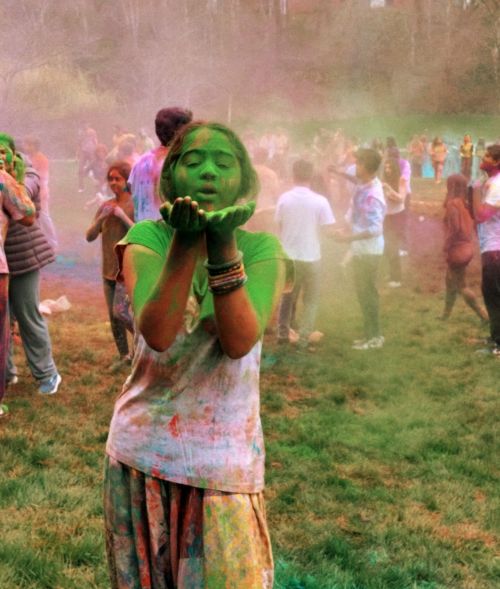
At first, the space looked completely ordinary. A few groups of students stood chatting, some holding small packets of coloured powder, others adjusting the speakers that would soon fill the air with music. The sky above was calm and pale, the kind of sky that belongs to early English spring. But slowly the transformation began. Someone opened a packet of gulal (coloured powder traditionally used during Holi celebrations) and tossed a handful into the air. A faint cloud of pink drifted upward and dissolved into the sunlight. Another burst of yellow followed. Soon there were streaks of blue, flashes of green, and laughter echoing across the field.
Within minutes, the entire space felt alive.
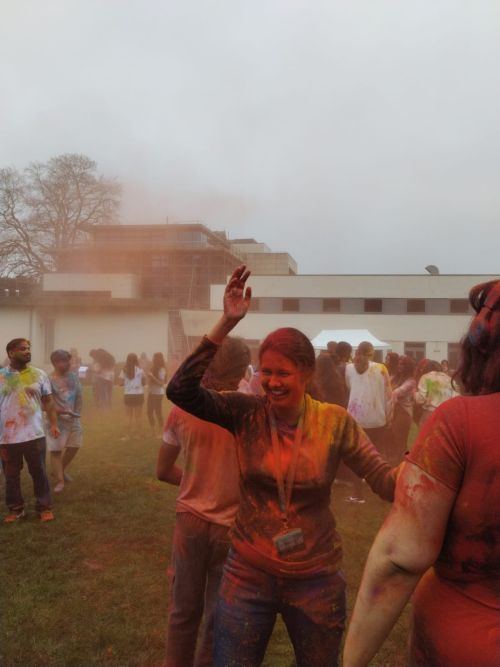
Bollywood music began to pulse through the air, those familiar rhythms that seem almost impossible to resist. Groups formed naturally, friends dancing together, strangers laughing as they were pulled into the celebration. Faces began to change as colours spread across cheeks and foreheads. Hair turned pink, shirts became canvases of bright powder. The careful distinctions people usually maintain – their appearance, their neat clothes, their sense of order – slowly dissolved into joyful chaos.
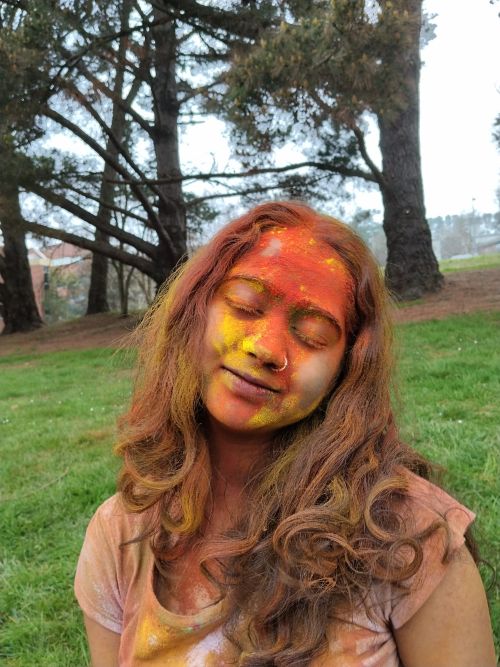
What felt most magical was how quickly the celebration became inclusive. Of course, there were many Indian students there, carrying their traditions with them across oceans. But the crowd was far more diverse than that. Students from all over the world had gathered, some curious, some excited, some experiencing Holi for the very first time, just like me. Some passersby stopped and asked what was happening. Others simply joined when someone handed them a packet of colour and invited them into the moment.
Holi has a beautiful way of dissolving hesitation. Once someone throws colour at you, you automatically become part of the celebration. Within minutes, everyone looked the same, faces streaked with bright pinks and yellows, laughter replacing uncertainty.
At one point, someone began counting down loudly, gathering people into a loose circle. Hands filled with colour lifted toward the sky. Three. Two. One. Suddenly, dozens of hands threw powder upward at the same time. The sky above us turned briefly into a swirling cloud of pink, purple, yellow, and blue. For a moment, it looked almost unreal, like a fragment of a painting suspended in the wind.
And yet the most meaningful part of this Holi had nothing to do with the colours themselves.
It had to do with who stood beside me.
My father had come to visit me in Exeter.
Living abroad creates a strange emotional geography. You carry home with you everywhere, but you also feel its absence more sharply during certain moments, birthdays, quiet evenings, and festivals that are usually filled with family traditions. But that afternoon, as colour drifted through the air and music echoed across the field, my father was there with me.
For the first time in my life, I played Holi with him.
It is difficult to explain how special that moment felt. Festivals are often about crowds and celebrations, but sometimes their true meaning lies in small personal moments hidden inside the larger celebration. Throwing colour at friends was joyful. Dancing beneath the spring sky was exhilarating. But the memory that will remain with me longest is the quiet happiness of sharing that festival with my father, thousands of miles away from home.
The afternoon unfolded almost like a dream. People danced, sang along to familiar songs, and posed for photographs with faces completely transformed by colour. Some passersby stopped to watch, curious about the celebration. Others joined in spontaneously, laughing as they were welcomed with streaks of pink or yellow across their cheeks.
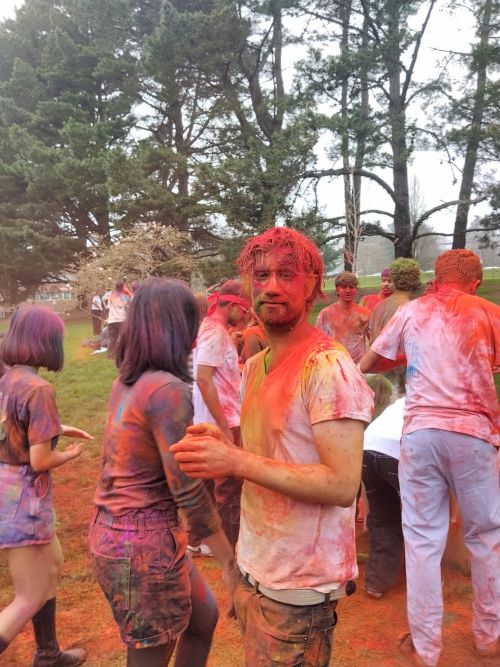
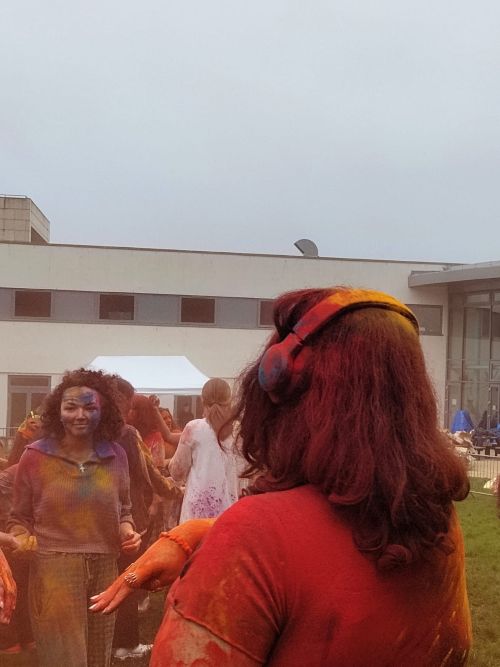
And yet the celebration never lost its sense of care and responsibility. Even in the middle of all that laughter and colour, people were mindful of the space around them. The festival remained within the designated area near the XFI building, and everyone tried to keep the campus environment clean and respectful. Joy did not turn into chaos. Instead, it felt like a shared understanding that celebrations can be vibrant and exuberant while still caring for the space that hosts them.
Eventually, the music softened, and the clouds of colour began to thin. People slowly drifted away, brushing powder from their sleeves, still laughing, still taking photographs of their brightly coloured faces. But something lingered in the air long after the celebration ended.
Perhaps it was the realisation that festivals are living things. They change and grow wherever people carry them. Holi began with ancient myths, sacred fires, and stories of devotion. It blossomed in places like Vrindavan and Shantiniketan, each shaping it in its own way. And now, in a quiet university city in England, it had become something new again.
When I returned to my room later that evening, faint traces of colour still clung to my clothes. I realised then that the festival I had always known from a distance had finally become part of my own story. Not in the streets of India where it was born, but here in Exeter, beneath a soft spring sky that for a brief and magical afternoon had turned into a floating world of colour.