
What Is Worth Waiting For? Continuity of Care at a Crossroads
Group practices spread. The St Leonard’s doctors asked what the relationship itself does for patients. They turned to literature, adding up the hours a relationship builds over the years, and in 1995 looked at the patients who keep missing their own doctor: they were more often depressed, poorer and facing family problems, and may be a vulnerable group. Continuity came to be seen as a stand-in for the doctor-patient relationship, and the relationship as part of the treatment.
What this era added. Continuity as a measure of the relationship, and a first look at who loses out when it breaks.
The community thread. Inequality: the patients who kept missing their own doctor were more often poorer, and GPs learned about hardship by visiting homes.
On the wall in this era: 13 exhibits (1 large poster, 4 posters and 8 cards). The posters explain the main studies; the cards are the shorter pieces, mostly letters. Every entry links to the original.
Gale Memorial Lecture, Journal of the Royal College of General Practitioners
Argued that GPs cannot be generalists and specialists at once: dividing work between partners conflicts with personal and continuing care.
Source: Pereira Gray D. Just a GP. J R Coll Gen Pract 1980;30(213):231-9. Read the original
Summary based on the full text.
Article, BMJ
A practical guide to prevention in which personal lists are ’emerging as an aid’, helping patients follow advice and doctors take pride in their own immunisation rates.
Source: Pereira Gray D. Organising preventive medicine. Br Med J (Clin Res Ed) 1982;284(6317):709-11. Read the original
Summary based on part of the text.
Journal of the Royal College of General Practitioners, 1982 · Professor Sir Denis Pereira Gray on A Fortunate Man (1967) by John Berger and Jean Mohr
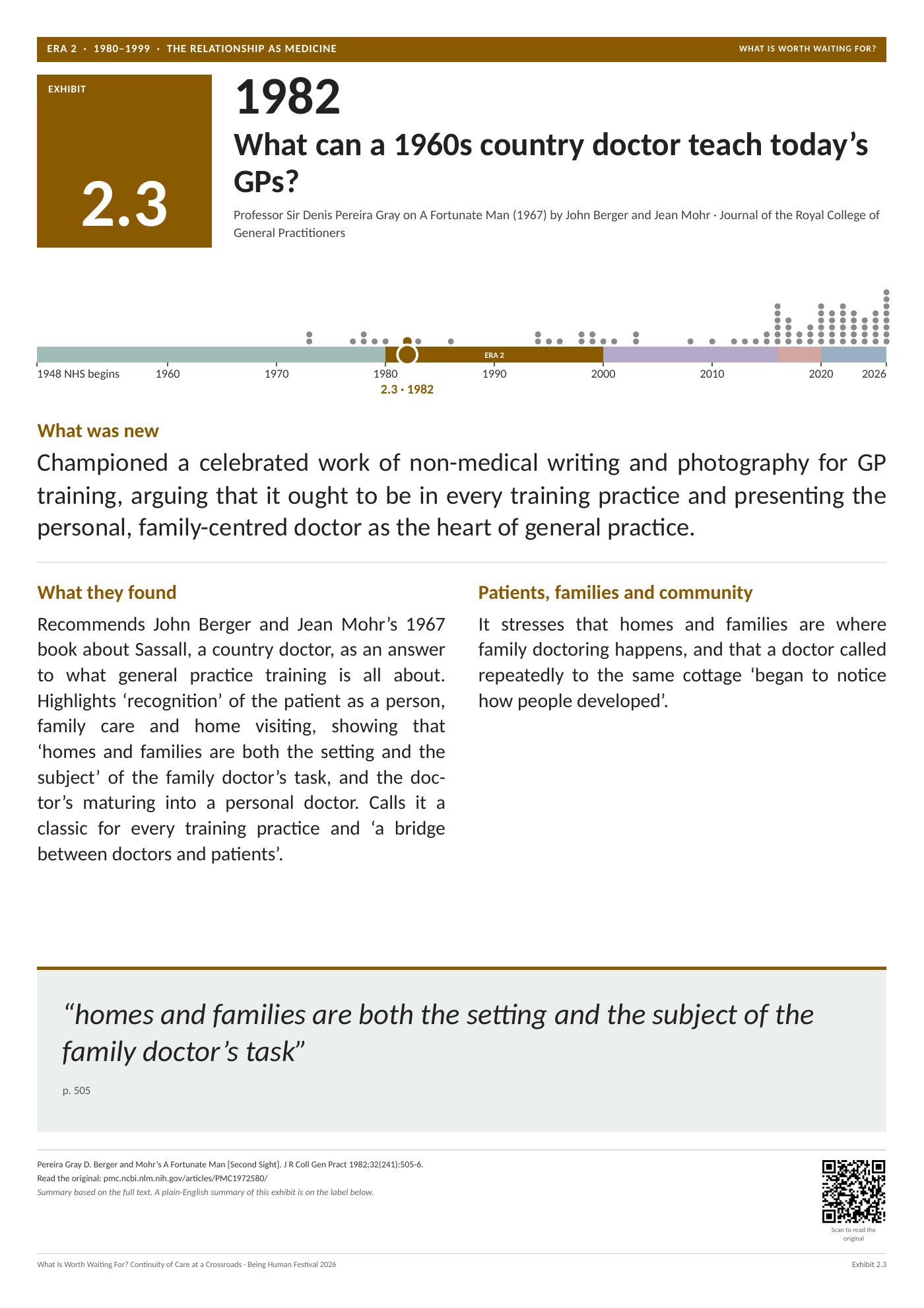
In plain English. In 1982 Professor Sir Denis Pereira Gray revisited ‘A Fortunate Man’, a 1967 book by John Berger and Jean Mohr about Sassall, a country doctor; half its pages are photographs. He argued that no other book showed more clearly what personal doctoring means: caring for people rather than just illnesses, in their homes and families, and growing over the years into a personal doctor. Because it was made by two non-doctors, he called it ‘a bridge between doctors and patients’.
Why it is on the wall. A humanities bridge in its own right: a GP turning to a writer and a photographer’s portrait of one doctor in one community to show trainees why knowing people over time is the heart of the job.
What was new. Championed a celebrated work of non-medical writing and photography for GP training, arguing that it ought to be in every training practice and presenting the personal, family-centred doctor as the heart of general practice.
What they found. Recommends John Berger and Jean Mohr’s 1967 book about Sassall, a country doctor, as an answer to what general practice training is all about. Highlights ‘recognition’ of the patient as a person, family care and home visiting, showing that ‘homes and families are both the setting and the subject’ of the family doctor’s task, and the doctor’s maturing into a personal doctor. Calls it a classic for every training practice and ‘a bridge between doctors and patients’.
Patients, families and community. It stresses that homes and families are where family doctoring happens, and that a doctor called repeatedly to the same cottage ‘began to notice how people developed’.
Source: Pereira Gray D. Berger and Mohr’s A Fortunate Man [Second Sight]. J R Coll Gen Pract 1982;32(241):505-6. Read the original
Summary based on the full text.
Editorial, Australian Family Physician
Took the message to Australia, where group practice had grown faster than in Britain but patients made the same criticism: a lack of continuity of care.
Source: Pereira Gray D. Continuity counts [editorial]. Aust Fam Physician 1983;12(7):552-3. Read the original
Summary based on the abstract.
Letter, Journal of the Royal College of General Practitioners
Three partners called themselves ‘enthusiasts’ for personal lists, while admitting there was not yet controlled evidence that patients prefer a personal doctor.
Source: Pereira Gray D, Buxton A, Steele R. Personal lists [letter]. J R Coll Gen Pract 1986;36(285):177-8. Read the original
Summary based on the full text.
Editorial, BMJ, 1994 · Professor Sir Denis Pereira Gray, Russell Steele, Kieran Sweeney and Philip Evans
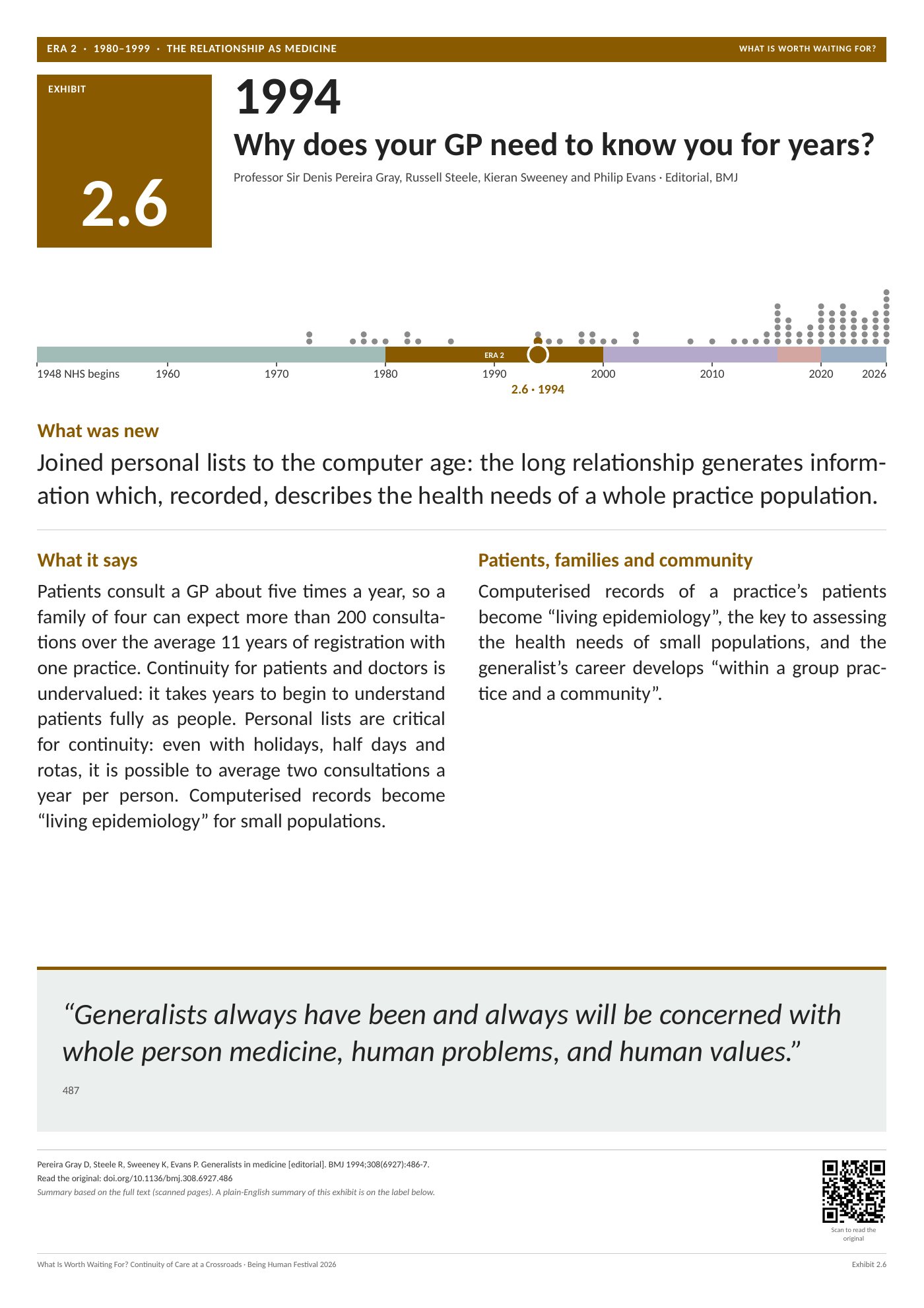
In plain English. In 1994 four doctors from the same Exeter practice wrote that general practice is “medicine with a human face”. A family of four might see their GP more than 200 times over the years, and it takes years to begin to understand someone fully as a person, so the practice encouraged patients to see and get to know the same doctor as far as possible. They also described how computer records could build a living picture of the health needs of the small population a practice serves.
Why it is on the wall. The subtitle says it: “General practice is medicine with a human face”. It ends with whole person medicine, human problems and human values.
What was new. Joined personal lists to the computer age: the long relationship generates information which, recorded, describes the health needs of a whole practice population.
What it says. Patients consult a GP about five times a year, so a family of four can expect more than 200 consultations over the average 11 years of registration with one practice. Continuity for patients and doctors is undervalued: it takes years to begin to understand patients fully as people. Personal lists are critical for continuity: even with holidays, half days and rotas, it is possible to average two consultations a year per person. Computerised records become “living epidemiology” for small populations.
Patients, families and community. Computerised records of a practice’s patients become “living epidemiology”, the key to assessing the health needs of small populations, and the generalist’s career develops “within a group practice and a community”.
Source: Pereira Gray D, Steele R, Sweeney K, Evans P. Generalists in medicine [editorial]. BMJ 1994;308(6927):486-7. Read the original
Summary based on the full text (scanned pages).
Letter, The Lancet
Four Exeter GPs backed a Lancet editorial on medical education: students should learn from primary care teams caring for patients in their homes and communities, and the importance of the family is best taught ‘by those who care for whole family groups simultaneously’.
Source: Pereira Gray D, Steel R, Sweeney K, Evans P. Community-bespoke doctoring [letter]. Lancet 1994;343(8907):1228. Read the original
Summary based on the full text.
Research paper, British Journal of General Practice, 1995 · Kieran Sweeney and Professor Sir Denis Pereira Gray
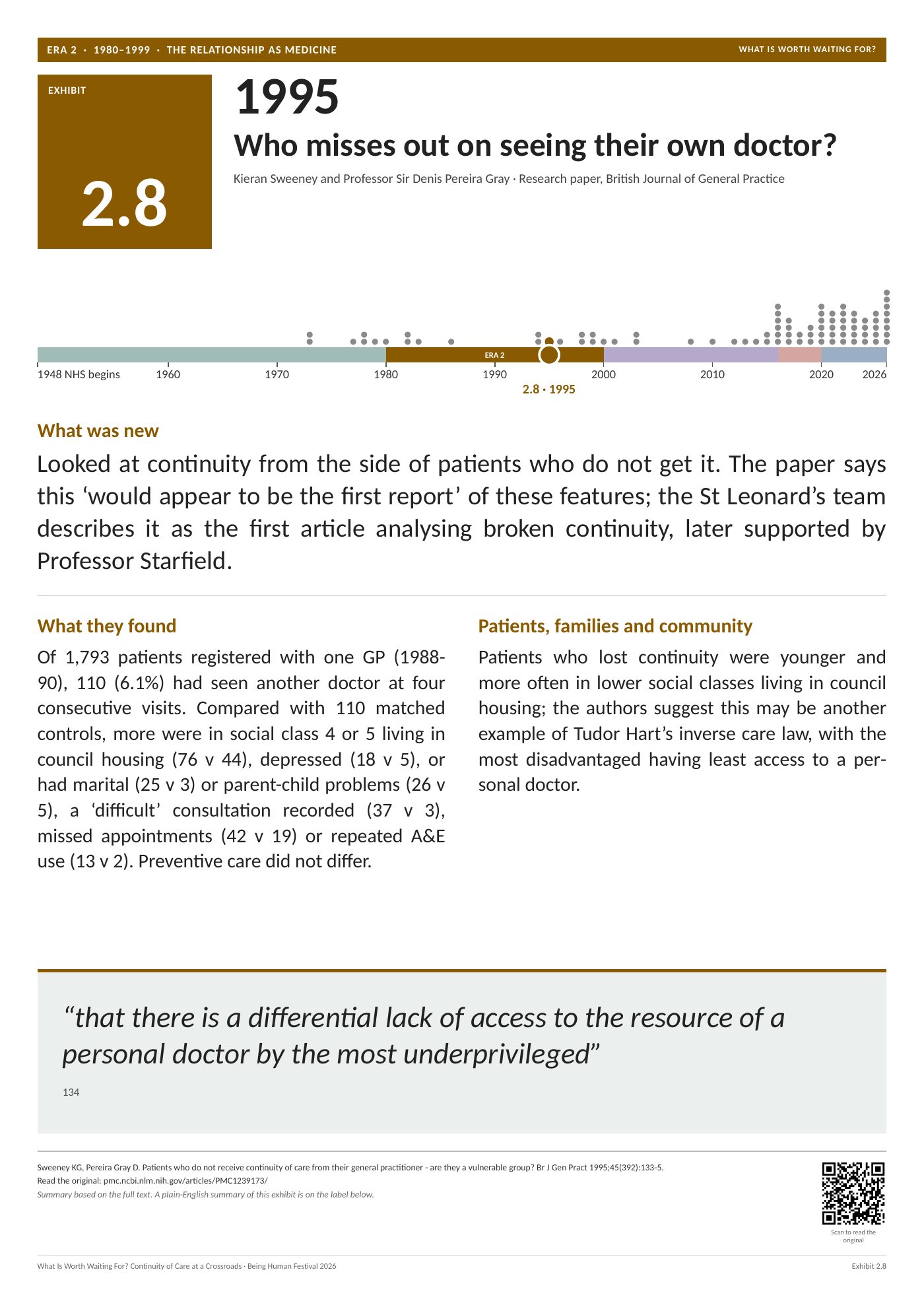
In plain English. In a practice where every patient had a named doctor, researchers looked at 110 people who had seen a different doctor four times in a row and compared them with 110 similar patients. Those who kept missing their own doctor were more often depressed, living with family or marriage problems, missing appointments and going to A&E repeatedly. They were also more often from poorer backgrounds. The study suggested that people who lose a steady relationship with their doctor may be among the most vulnerable.
Why it is on the wall. The patients who drift between doctors, often the most disadvantaged, may be the ones who most need a doctor who knows them. When services choose between quick access and continuity, this study asks who bears the cost.
What was new. Looked at continuity from the side of patients who do not get it. The paper says this ‘would appear to be the first report’ of these features; the St Leonard’s team describes it as the first article analysing broken continuity, later supported by Professor Starfield.
What they found. Of 1,793 patients registered with one GP (1988-90), 110 (6.1%) had seen another doctor at four consecutive visits. Compared with 110 matched controls, more were in social class 4 or 5 living in council housing (76 v 44), depressed (18 v 5), or had marital (25 v 3) or parent-child problems (26 v 5), a ‘difficult’ consultation recorded (37 v 3), missed appointments (42 v 19) or repeated A&E use (13 v 2). Preventive care did not differ.
Patients, families and community. Patients who lost continuity were younger and more often in lower social classes living in council housing; the authors suggest this may be another example of Tudor Hart’s inverse care law, with the most disadvantaged having least access to a personal doctor.
Source: Sweeney KG, Pereira Gray D. Patients who do not receive continuity of care from their general practitioner – are they a vulnerable group? Br J Gen Pract 1995;45(392):133-5. Read the original
Summary based on the full text.
Letter, Journal of Epidemiology and Community Health
Argued that GPs understand inequality first hand, by repeatedly visiting homes and listening face to face, day and night.
Source: Pereira Gray D. Public health medicine and primary care [letter]. J Epidemiol Community Health 1996;50(1):108. Read the original
Summary based on the full text.
Essay, The Lancet, 1998 · Kieran Sweeney, Domhnall MacAuley and Professor Sir Denis Pereira Gray
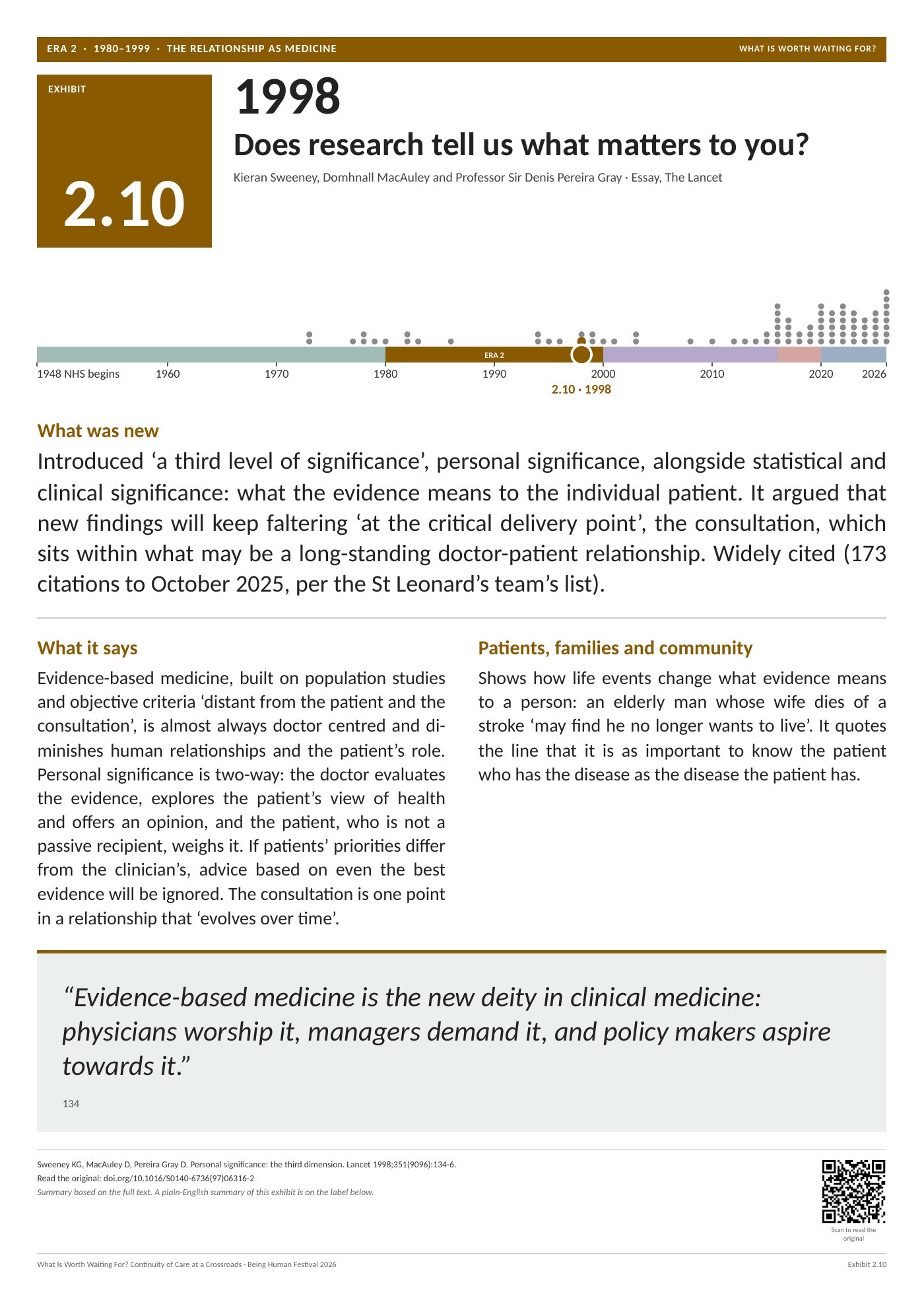
In plain English. In 1998 three GPs wrote an essay in The Lancet about evidence-based medicine, which uses studies of large groups of people to guide treatment. Research usually asks two questions: is a result statistically significant, and is it clinically important? They added a third: what does it mean to this patient? Advice will be ignored if it clashes with what matters to the person, and each consultation is one point in what may be a long-standing relationship. As they put it, ‘Personal significance is the key.’
Why it is on the wall. At a crossroads between medicine by statistics and medicine by relationship, the essay asks whose significance counts: results that ‘relate to what happens in groups of people, rather than in an individual’, or the one person in the consulting room.
What was new. Introduced ‘a third level of significance’, personal significance, alongside statistical and clinical significance: what the evidence means to the individual patient. It argued that new findings will keep faltering ‘at the critical delivery point’, the consultation, which sits within what may be a long-standing doctor-patient relationship. Widely cited (173 citations to October 2025, per the St Leonard’s team’s list).
What it says. Evidence-based medicine, built on population studies and objective criteria ‘distant from the patient and the consultation’, is almost always doctor centred and diminishes human relationships and the patient’s role. Personal significance is two-way: the doctor evaluates the evidence, explores the patient’s view of health and offers an opinion, and the patient, who is not a passive recipient, weighs it. If patients’ priorities differ from the clinician’s, advice based on even the best evidence will be ignored. The consultation is one point in a relationship that ‘evolves over time’.
Patients, families and community. Shows how life events change what evidence means to a person: an elderly man whose wife dies of a stroke ‘may find he no longer wants to live’. It quotes the line that it is as important to know the patient who has the disease as the disease the patient has.
Source: Sweeney KG, MacAuley D, Pereira Gray D. Personal significance: the third dimension. Lancet 1998;351(9096):134-6. Read the original
Summary based on the full text.
Editorial, British Journal of General Practice, 1998 · Professor Sir Denis Pereira Gray, then President of the Royal College of General Practitioners
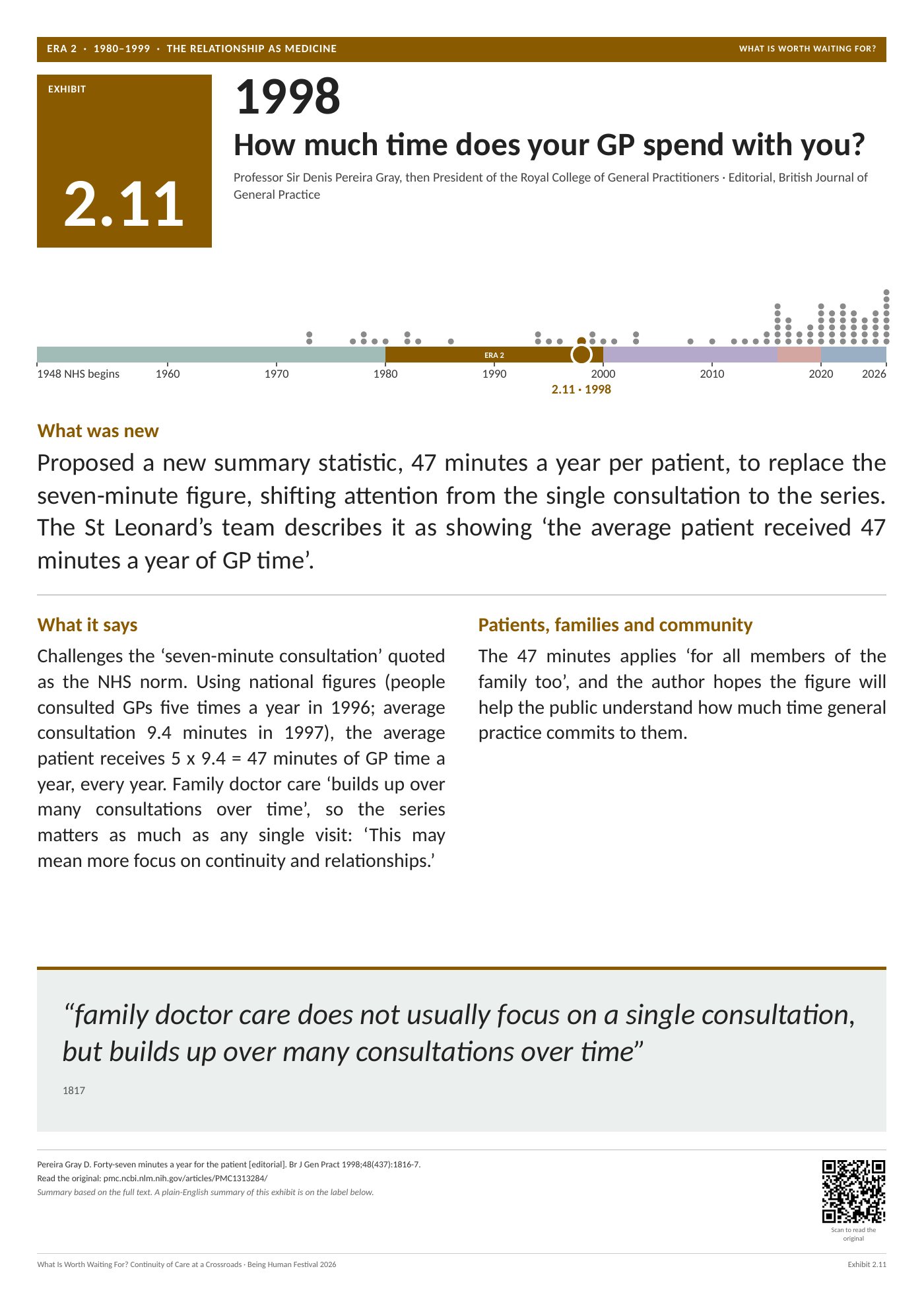
In plain English. People often said a GP appointment lasted only seven minutes. In 1998 Professor Sir Denis Pereira Gray, then President of the Royal College of General Practitioners, did a different sum. On average people saw a GP five times a year and each appointment lasted 9.4 minutes, so each person had about 47 minutes a year, every year. Family doctor care, he argued, is not one short meeting but builds up over many meetings, so we should value and study the whole series.
Why it is on the wall. Short appointments can look like a poor deal; Pereira Gray’s sum shows what builds up when you return over years. A crossroads for patients and planners: count minutes per visit, or value care that builds up, 47 minutes a year, over many years?
What was new. Proposed a new summary statistic, 47 minutes a year per patient, to replace the seven-minute figure, shifting attention from the single consultation to the series. The St Leonard’s team describes it as showing ‘the average patient received 47 minutes a year of GP time’.
What it says. Challenges the ‘seven-minute consultation’ quoted as the NHS norm. Using national figures (people consulted GPs five times a year in 1996; average consultation 9.4 minutes in 1997), the average patient receives 5 x 9.4 = 47 minutes of GP time a year, every year. Family doctor care ‘builds up over many consultations over time’, so the series matters as much as any single visit: ‘This may mean more focus on continuity and relationships.’
Patients, families and community. The 47 minutes applies ‘for all members of the family too’, and the author hopes the figure will help the public understand how much time general practice commits to them.
Source: Pereira Gray D. Forty-seven minutes a year for the patient [editorial]. Br J Gen Pract 1998;48(437):1816-7. Read the original
Summary based on the full text.
Article, British Journal of General Practice
Argued that the doctor-patient relationship can itself help people heal. Patients value continuity, and research suggested satisfaction is higher in practices with personal lists.
Source: Dixon DM, Sweeney KG, Pereira Gray D. The physician healer: ancient magic or modern science? Br J Gen Pract 1999;49(441):309-12. Read the original
Summary based on the full text.
Editorial, European Journal of General Practice
With Philip Evans, argued that seeing patients in physical, psychological and social terms lets GPs relate to them ‘over longer periods of time’, and asked why so few GPs were now writing about the social side of patients’ lives.
Source: Evans PH, Pereira Gray D. Three dimensional care? [editorial]. Eur J Gen Pract 1999;5(4):135-6. Read the original
Summary based on the full text.
← Era 1: Naming the personal doctor · All five eras · Era 3: Trust, theory and evidence →