
What Is Worth Waiting For? Continuity of Care at a Crossroads
As pressure on general practice grew, the St Leonard’s team, now a research practice working with medical students, showed that some patients had stayed with one practice for 50 years or more. In 2018 they published a systematic review: in 18 of 22 studies from nine countries, more continuity went with lower death rates. In 2019 they published the St Leonard’s Index of Continuity of Care, a simple monthly measure any practice with personal lists can use.
What this era added. The link with mortality, and a practical measure for everyday use.
The community thread. Long belonging: patients registered with one practice for half a century, and surgeries within walking distance of most homes.
On the wall in this era: 15 exhibits (3 large posters, 2 posters and 10 cards). The posters explain the main studies; the cards are the shorter pieces, mostly letters. Every entry links to the original.
Research paper, Family Practice, 2016 · Eleanor White, then a medical student, with Professor Sir Denis Pereira Gray, Peter Langley and Philip Evans
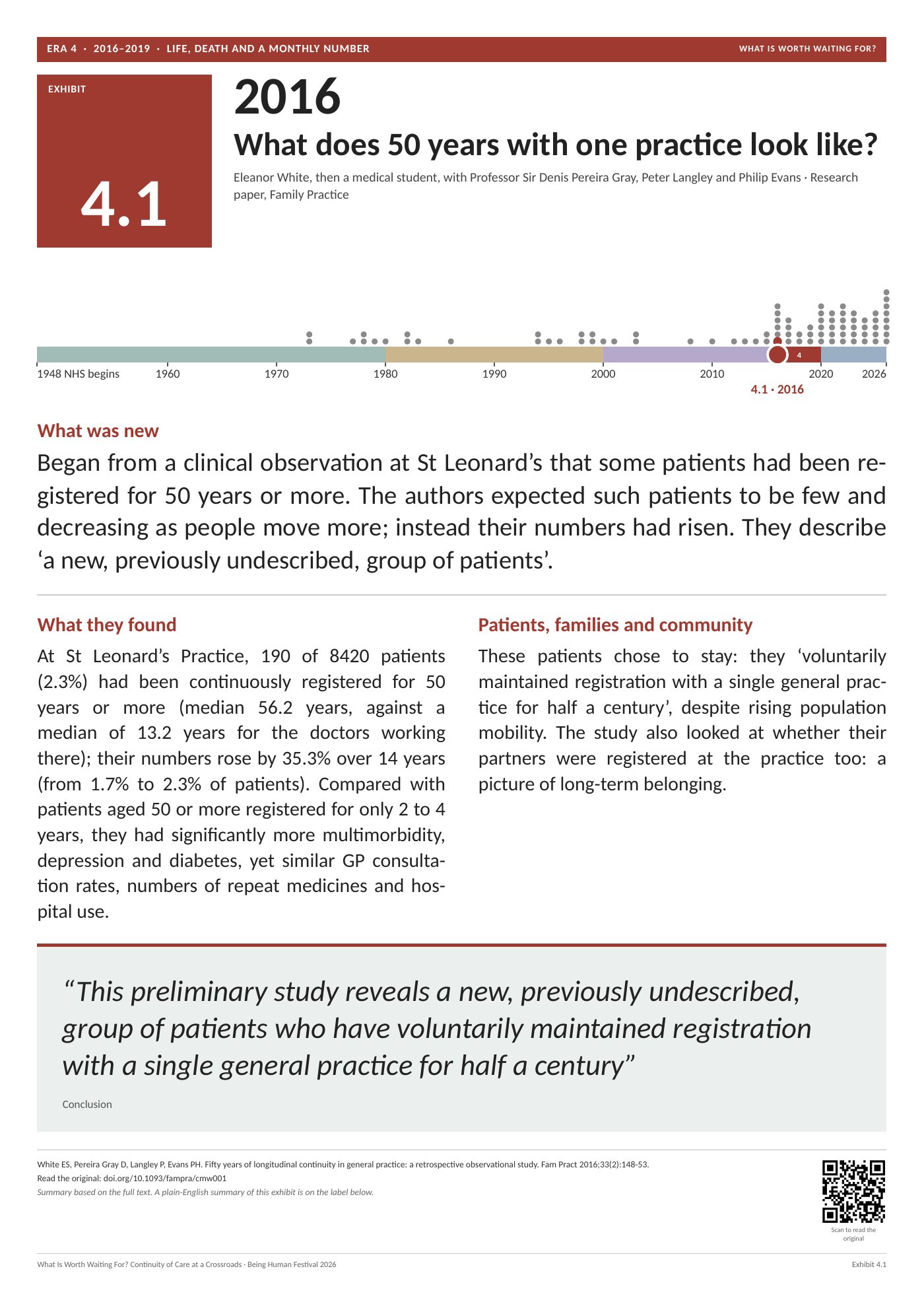
In plain English. Some patients stay with the same GP practice for a lifetime. At St Leonard’s Practice in Exeter, 190 people, 2.3% of patients, had been registered for 50 years or more, much longer on average than the doctors had worked there, and their number was growing. Compared with older patients who had joined only a few years earlier, they had more long-term illnesses, such as diabetes and depression, yet they did not see the GP more often, take more repeat medicines or use hospitals more.
Why it is on the wall. Fifty years with one practice is the longest view of what is worth waiting for: a relationship built over a lifetime. Despite more illness, these patients used no more care than newcomers.
What was new. Began from a clinical observation at St Leonard’s that some patients had been registered for 50 years or more. The authors expected such patients to be few and decreasing as people move more; instead their numbers had risen. They describe ‘a new, previously undescribed, group of patients’.
What they found. At St Leonard’s Practice, 190 of 8420 patients (2.3%) had been continuously registered for 50 years or more (median 56.2 years, against a median of 13.2 years for the doctors working there); their numbers rose by 35.3% over 14 years (from 1.7% to 2.3% of patients). Compared with patients aged 50 or more registered for only 2 to 4 years, they had significantly more multimorbidity, depression and diabetes, yet similar GP consultation rates, numbers of repeat medicines and hospital use.
Patients, families and community. These patients chose to stay: they ‘voluntarily maintained registration with a single general practice for half a century’, despite rising population mobility. The study also looked at whether their partners were registered at the practice too: a picture of long-term belonging.
Source: White ES, Pereira Gray D, Langley P, Evans PH. Fifty years of longitudinal continuity in general practice: a retrospective observational study. Fam Pract 2016;33(2):148-53. Read the original
Summary based on the full text.
Letter, Education for Primary Care
Written with two students. Argued that follow-up by an unknown doctor should not be counted as relationship continuity, which ‘by definition has to relate to some defined doctor or health professional’.
Source: Pereira Gray D, Sidaway-Lee K, Thorne A, White E, Evans P. Continuity of care [letter]. Educ Prim Care 2016;27(3):248. Read the original
Summary based on the full text.
Online letter, British Journal of General Practice
Disputed a claim that the evidence was ‘still weak’, pointing to twenty benefits of continuity for patients, six for GPs and five for society.
Source: Pereira Gray D, Sidaway-Lee K, White E, Evans P. Benefits of continuity of care [eLetter]. Br J Gen Pract 2016 Aug 16. Read the original
Summary based on the full text.
Teaching review for GPs in training, InnovAiT, 2016 · Professor Sir Denis Pereira Gray, Kate Sidaway-Lee, Philip Evans and two University of Exeter students
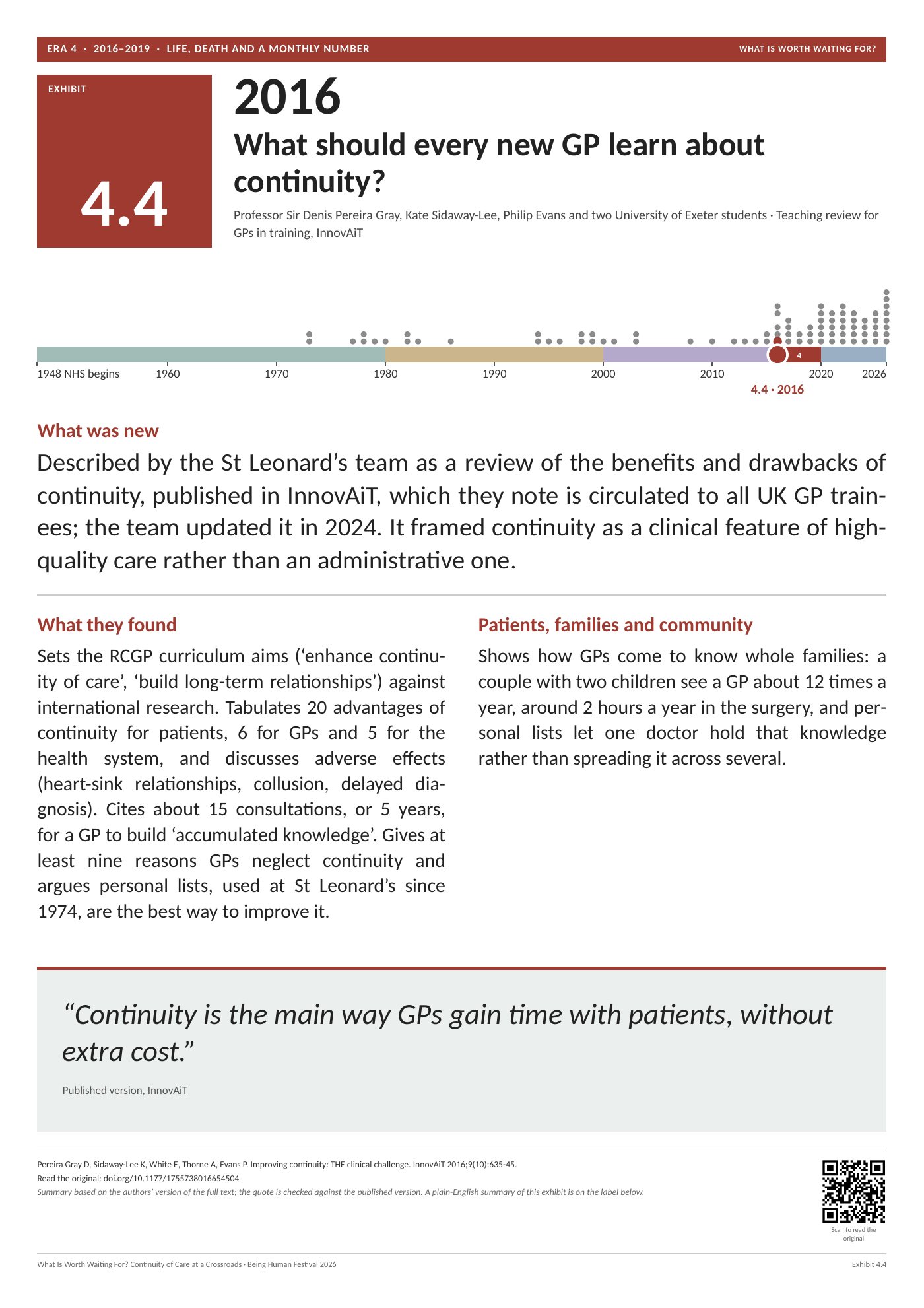
In plain English. In 2016 the St Leonard’s team wrote a teaching article for doctors training to become GPs. They gathered research from many countries linking continuity of care, seeing the same GP over time, with more trust, greater satisfaction, more preventive care, fewer hospital admissions and fewer deaths. They were open about downsides too, such as familiarity sometimes delaying a diagnosis. They argued that giving every patient a named personal doctor, as their practice had done since 1974, is the best way to protect these benefits.
Why it is on the wall. At a time when many practices let ‘any doctor’ see patients, this article told the next generation of GPs that improving continuity was ‘THE clinical challenge’, and that time with a known doctor is worth protecting.
What was new. Described by the St Leonard’s team as a review of the benefits and drawbacks of continuity, published in InnovAiT, which they note is circulated to all UK GP trainees; the team updated it in 2024. It framed continuity as a clinical feature of high-quality care rather than an administrative one.
What they found. Sets the RCGP curriculum aims (‘enhance continuity of care’, ‘build long-term relationships’) against international research. Tabulates 20 advantages of continuity for patients, 6 for GPs and 5 for the health system, and discusses adverse effects (heart-sink relationships, collusion, delayed diagnosis). Cites about 15 consultations, or 5 years, for a GP to build ‘accumulated knowledge’. Gives at least nine reasons GPs neglect continuity and argues personal lists, used at St Leonard’s since 1974, are the best way to improve it.
Patients, families and community. Shows how GPs come to know whole families: a couple with two children see a GP about 12 times a year, around 2 hours a year in the surgery, and personal lists let one doctor hold that knowledge rather than spreading it across several.
Source: Pereira Gray D, Sidaway-Lee K, White E, Thorne A, Evans P. Improving continuity: THE clinical challenge. InnovAiT 2016;9(10):635-45. Read the original
Summary based on the authors’ version of the full text; the quote is checked against the published version.
Editorial, BMJ
With Martin Marshall, warned that general practice was being reorganised ‘quietly but rapidly’ into bigger units and networks, with too little attention to what might be lost, when ‘a commitment to continuity of care’ underpins its benefits.
Source: Marshall M, Pereira Gray D. General practice is making a leap in the dark [editorial]. BMJ 2016;355:i5698. Read the original
Summary based on the full text.
Letter, The Lancet
Argued that GPs save lives not only through prevention and treatment: ‘There is a human interpersonal effect also’.
Source: Pereira Gray D, Sidaway-Lee K, Evans P. The role of general practice in reducing mortality [letter]. Lancet 2016;388(10058):2354. Read the original
Summary based on the full text.
Letter, BMJ
Welcomed a study linking continuity with 12.5% fewer potentially avoidable hospital admissions in older people, noting a Canadian study had found the same in 2006.
Source: Pereira Gray D. Continuity of care generates a bespoke medical service [letter]. BMJ 2017;356:j1070. Read the original
Summary based on the full text.
Letter, BMJ
Written as representatives of a patient charity. Argued that a study of ‘telephone first’ systems undervalued the harms to patients and the extra hospital costs, and that the system reduces patients’ ‘ability to see their GP of choice’.
Source: Pereira Gray D, Wilkie P. Patient perspectives on telephone first system [letter]. BMJ 2017;359:j4925. Read the original
Summary based on the full text.
Article, Education for Primary Care
Recalled studies linking bereavement, a loving wife and hopelessness with illness and death, and argued that ‘in terms of homes and families’ the family doctor is more the expert than hospital doctors.
Source: Pereira Gray D. The scientific basis of medical Generalism. Educ Prim Care 2017;28(6):344-345. Read the original
Summary based on the full text.
Student research poster · University of Exeter Medical School, 2017–18 · Molly Dineen, then a fourth-year medical student, supervised by Professor Philip Evans and Professor Sir Denis Pereira Gray, with data prepared by Dr Kate Sidaway-Lee, St Leonard’s Practice, Exeter
In plain English. A fourth-year medical student studied the records of 482 people diagnosed with type 2 diabetes at St Leonard’s Practice between 2000 and 2016. People who had been registered with the practice for longer before their diagnosis tended to have slightly lower blood sugar readings (HbA1c), both when they were diagnosed and at their most recent check. The link was small, and years registered is only one way of measuring continuity, so the student recommended a fuller analysis that also takes account of age and lifestyle.
Why it is on the wall. It shows the next generation learning the craft on the practice’s own records, and asks in miniature the question this wall asks at scale: does being known by a practice for longer make care better?
Source: Dineen M. Is there an association between continuity of care in general practice and diabetic control, in patients with type 2 diabetes mellitus? Student research poster, University of Exeter Medical School, 2017–18. Courtesy of the author and St Leonard’s Practice, Exeter.
At the exhibition the original poster was shown in a frame, as it was first presented. It is not reproduced on this site.
Systematic review, BMJ Open, 2018 · Professor Sir Denis Pereira Gray, Kate Sidaway-Lee and Philip Evans with Eleanor White and Angus Thorne
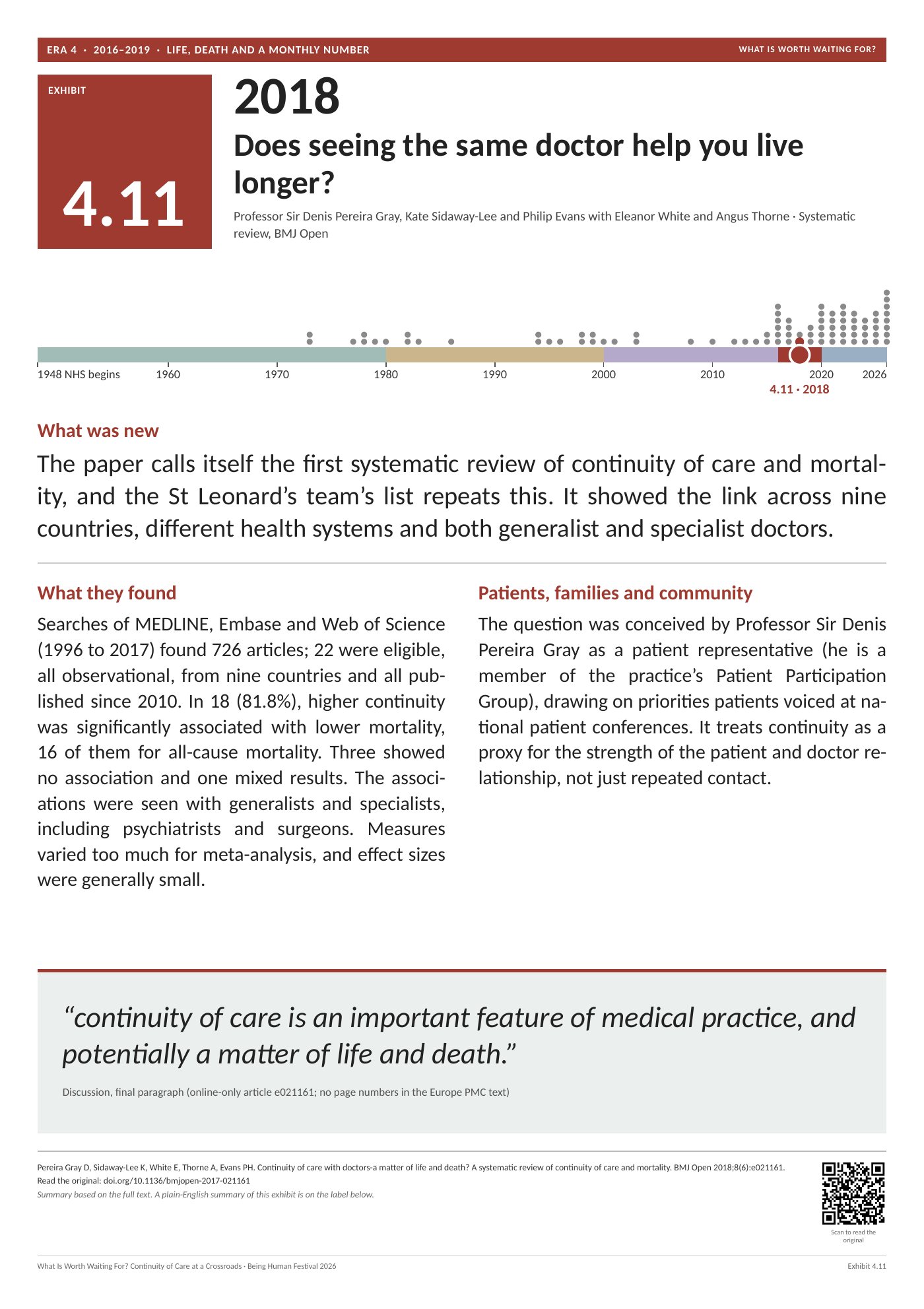
In plain English. Continuity of care means seeing the same doctor over time. In a systematic review published in 2018 (a careful search and assessment of the research on one question), the St Leonard’s team asked: is continuity linked to how long people live? They found 22 studies from nine countries. In 18 of them, people with more continuity had lower death rates. This held for family doctors and for specialists. The studies show a link rather than proof of cause, but the pattern was consistent.
Why it is on the wall. Written when an editorial in a leading American journal suggested non-personal care should become the ‘default option’, this review weighed the other road. If continuity is ‘potentially a matter of life and death’, is waiting to see your own doctor worth it?
What was new. The paper calls itself the first systematic review of continuity of care and mortality, and the St Leonard’s team’s list repeats this. It showed the link across nine countries, different health systems and both generalist and specialist doctors.
What they found. Searches of MEDLINE, Embase and Web of Science (1996 to 2017) found 726 articles; 22 were eligible, all observational, from nine countries and all published since 2010. In 18 (81.8%), higher continuity was significantly associated with lower mortality, 16 of them for all-cause mortality. Three showed no association and one mixed results. The associations were seen with generalists and specialists, including psychiatrists and surgeons. Measures varied too much for meta-analysis, and effect sizes were generally small.
Patients, families and community. The question was conceived by Professor Sir Denis Pereira Gray as a patient representative (he is a member of the practice’s Patient Participation Group), drawing on priorities patients voiced at national patient conferences. It treats continuity as a proxy for the strength of the patient and doctor relationship, not just repeated contact.
Source: Pereira Gray D, Sidaway-Lee K, White E, Thorne A, Evans PH. Continuity of care with doctors-a matter of life and death? A systematic review of continuity of care and mortality. BMJ Open 2018;8(6):e021161. Read the original
Summary based on the full text.
Letter, Journal of the Royal Society of Medicine
Pointed out that 60% of people live within ‘pram pushing’ distance of a GP surgery, and that patients in practices with personal lists were more satisfied.
Source: Pereira Gray D, Sidaway-Lee K, Evans P, Harding A. The strengths of general practice [letter]. J R Soc Med 2018;111(8):264. Read the original
Summary based on the full text.
Conference poster · Society for Academic Primary Care, 2019; the paper appeared in the British Journal of General Practice the same year · Dr Kate Sidaway-Lee, Professor Sir Denis Pereira Gray and Professor Philip Evans, St Leonard’s Practice, Exeter
In plain English. At St Leonard’s Practice every patient has a named personal doctor. The team looked at every face-to-face GP appointment in 2016 and 2017 and created a simple monthly score, the St Leonard’s Index of Continuity of Care (SLICC): the share of appointments that patients on a doctor’s list had with that doctor. Just over half of appointments (51.7%) were with the patient’s own doctor, rising to nearly two in three (64.9%) for people aged 65 and over. Because the score is simple, any practice with personal lists can track its continuity month by month.
Why it is on the wall. Measuring is the first step to improving. The SLICC is the ‘monthly number’ in this era’s title: a figure any practice can watch, and one St Leonard’s still reports today.
Source: Sidaway-Lee K, Pereira Gray D, Evans P. A method for measuring continuity of care in day-to-day general practice: a quantitative analysis of appointment data. Br J Gen Pract 2019;69(682):e356–e362. Poster courtesy of St Leonard’s Practice, Exeter. Read the original
At the exhibition the original poster was shown in a frame, as it was first presented. It is not reproduced on this site.
Letter, BMJ
Argued that giving patients a named GP on paper is not enough: without further interventions it remains ‘an administrative process only’, and practices need to encourage patients to see their named doctor.
Source: Pereira Gray D, Sidaway-Lee K, Evans P, Harding A. Having a named doctor in general practice is not enough to improve continuity of care [letter]. BMJ 2019;367:l6106. Read the original
Summary based on the full text.
Online letter, British Journal of General Practice
Objected to continuity being called ‘nebulous’, citing studies linking it with lower mortality and fewer hospital admissions.
Source: Pereira Gray D, Sidaway-Lee K, Dineen M, Evans P, Harding A. Continuity of care is not nebulous [eLetter]. Br J Gen Pract 2019 Nov 7. Read the original
Summary based on the full text.
← Era 3: Trust, theory and evidence · All five eras · Era 5: At the crossroads →