
What Is Worth Waiting For? Continuity of Care at a Crossroads
As NHS planning put accessibility ahead of continuity, with walk-in centres and telephone triage, the Exeter group worked with colleagues in the United States and Canada to study what grows over time: trust, liking and a doctor’s responsiveness. In 2003 they set out a theory of continuity and warned that it might be ‘phased out of NHS planning’. In 2013 a Devon study found that a shorter time registered with a practice was associated with a higher risk of emergency admission to hospital.
What this era added. A theory of continuity, and evidence from patients in Britain, the United States and Canada that trust and a doctor’s responsiveness go with longer relationships.
The community thread. Patients’ own voices, through surveys in three countries and a national patient charity.
On the wall in this era: 11 exhibits (1 large poster, 4 posters and 6 cards). The posters explain the main studies; the cards are the shorter pieces, mostly letters. Every entry links to the original.
Book, Radcliffe Medical Press
A book by Michael Dixon and Kieran Sweeney, with a foreword by Professor Sir Denis Pereira Gray, on the healing power of the doctor-patient relationship: the ‘human effect’.
Source: Dixon M, Sweeney K. The human effect in medicine: theory, research and practice. Abingdon: Radcliffe Medical Press; 2000. Reissued by CRC Press, 2017. Read the original
Summary based on the publisher’s description.
Family Medicine (2001) and Scandinavian Journal of Primary Health Care (2003) · Professor Sir Denis Pereira Gray with colleagues in Leicester and the United States
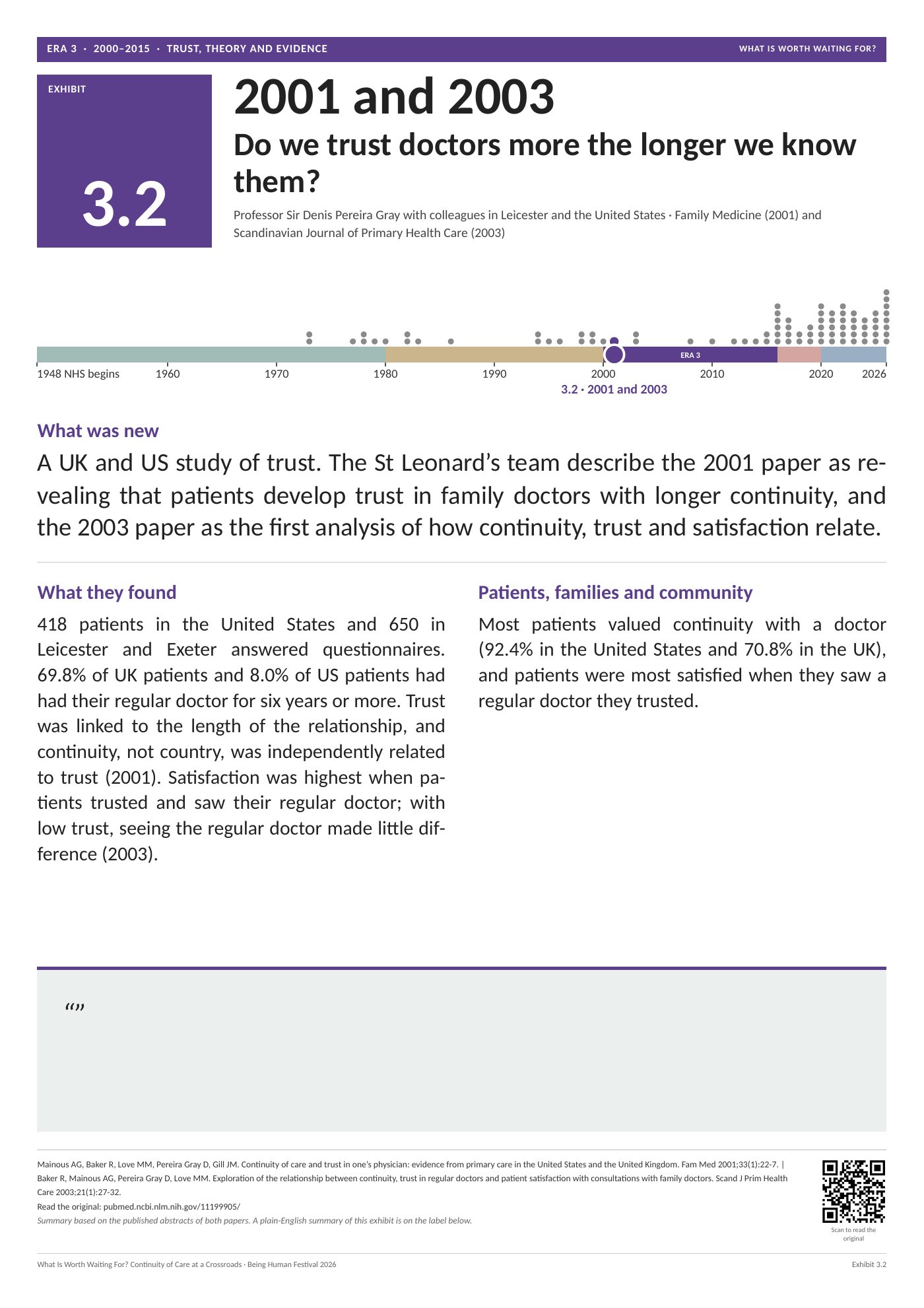
In plain English. What makes patients trust their family doctor? In a study run in the United States and England, 418 American patients and 650 patients in Leicester and Exeter answered questions about their regular family doctor. Most British patients had had the same doctor for six years or more; few Americans had. Trust was higher the longer the relationship had lasted, and once this was taken into account, the country people lived in made no difference to trust. A second paper from the same study found patients were most satisfied when they saw a regular doctor they trusted.
Why it is on the wall. Trust was higher the longer a relationship had lasted, and satisfaction was highest when patients saw the regular doctor they trusted. A quick appointment with whoever is free may not offer that: one answer to what is worth waiting for.
What was new. A UK and US study of trust. The St Leonard’s team describe the 2001 paper as revealing that patients develop trust in family doctors with longer continuity, and the 2003 paper as the first analysis of how continuity, trust and satisfaction relate.
What they found. 418 patients in the United States and 650 in Leicester and Exeter answered questionnaires. 69.8% of UK patients and 8.0% of US patients had had their regular doctor for six years or more. Trust was linked to the length of the relationship, and continuity, not country, was independently related to trust (2001). Satisfaction was highest when patients trusted and saw their regular doctor; with low trust, seeing the regular doctor made little difference (2003).
Patients, families and community. Most patients valued continuity with a doctor (92.4% in the United States and 70.8% in the UK), and patients were most satisfied when they saw a regular doctor they trusted.
Source: Mainous AG, Baker R, Love MM, Pereira Gray D, Gill JM. Continuity of care and trust in one’s physician: evidence from primary care in the United States and the United Kingdom. Fam Med 2001;33(1):22-7. | Baker R, Mainous AG, Pereira Gray D, Love MM. Exploration of the relationship between continuity, trust in regular doctors and patient satisfaction with consultations with family doctors. Scand J Prim Health Care 2003;21(1):27-32. Read the original
Summary based on the published abstracts of both papers.
Review, Journal of the Royal Society of Medicine, 2003 · Professor Sir Denis Pereira Gray, Philip Evans, Kieran Sweeney, Pam Lings and colleagues in Exeter
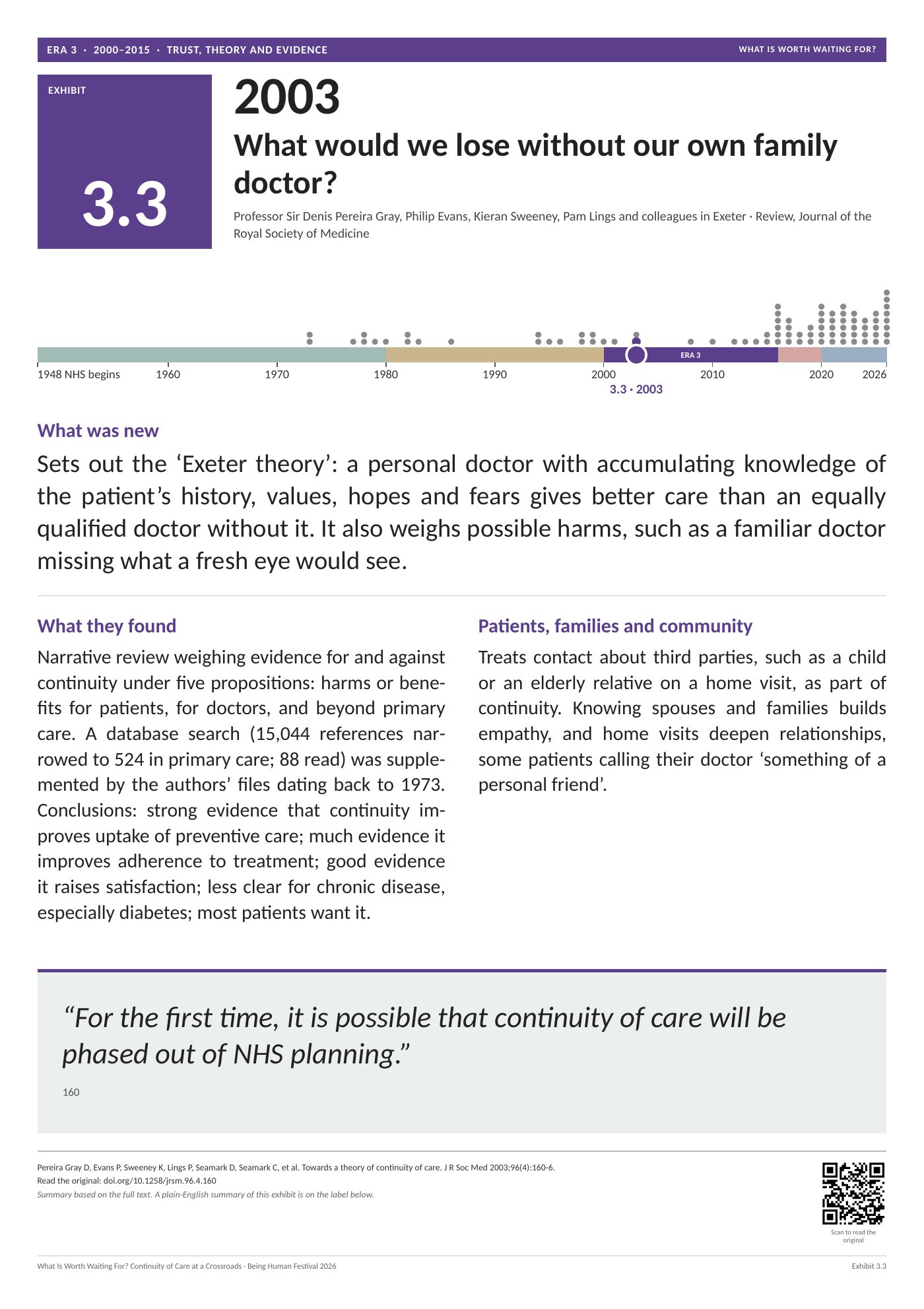
In plain English. In 2003, as the NHS opened walk-in centres and planning put accessibility ahead of continuity, eight members of an Exeter research group reviewed the evidence on continuity of care, seeing the same doctor over time. They set out an ‘Exeter theory’: a personal doctor who builds up knowledge of your history, values, hopes and fears gives better care. They were honest about downsides, such as a familiar doctor missing something a fresh eye would spot. Overall, they concluded that continuity improves preventive care, taking treatment as advised, and satisfaction.
Why it is on the wall. Written when, as the authors warned, continuity might for the first time be ‘phased out of NHS planning’ in favour of easy access. It marks an early crossroads between speed and relationship that the NHS still faces today.
What was new. Sets out the ‘Exeter theory’: a personal doctor with accumulating knowledge of the patient’s history, values, hopes and fears gives better care than an equally qualified doctor without it. It also weighs possible harms, such as a familiar doctor missing what a fresh eye would see.
What they found. Narrative review weighing evidence for and against continuity under five propositions: harms or benefits for patients, for doctors, and beyond primary care. A database search (15,044 references narrowed to 524 in primary care; 88 read) was supplemented by the authors’ files dating back to 1973. Conclusions: strong evidence that continuity improves uptake of preventive care; much evidence it improves adherence to treatment; good evidence it raises satisfaction; less clear for chronic disease, especially diabetes; most patients want it.
Patients, families and community. Treats contact about third parties, such as a child or an elderly relative on a home visit, as part of continuity. Knowing spouses and families builds empathy, and home visits deepen relationships, some patients calling their doctor ‘something of a personal friend’.
Source: Pereira Gray D, Evans P, Sweeney K, Lings P, Seamark D, Seamark C, et al. Towards a theory of continuity of care. J R Soc Med 2003;96(4):160-6. Read the original
Summary based on the full text.
Study of a US family practice, Journal of the Royal Society of Medicine, 2003 · Pam Lings, Philip Evans, Professor Sir Denis Pereira Gray and colleagues in Exeter
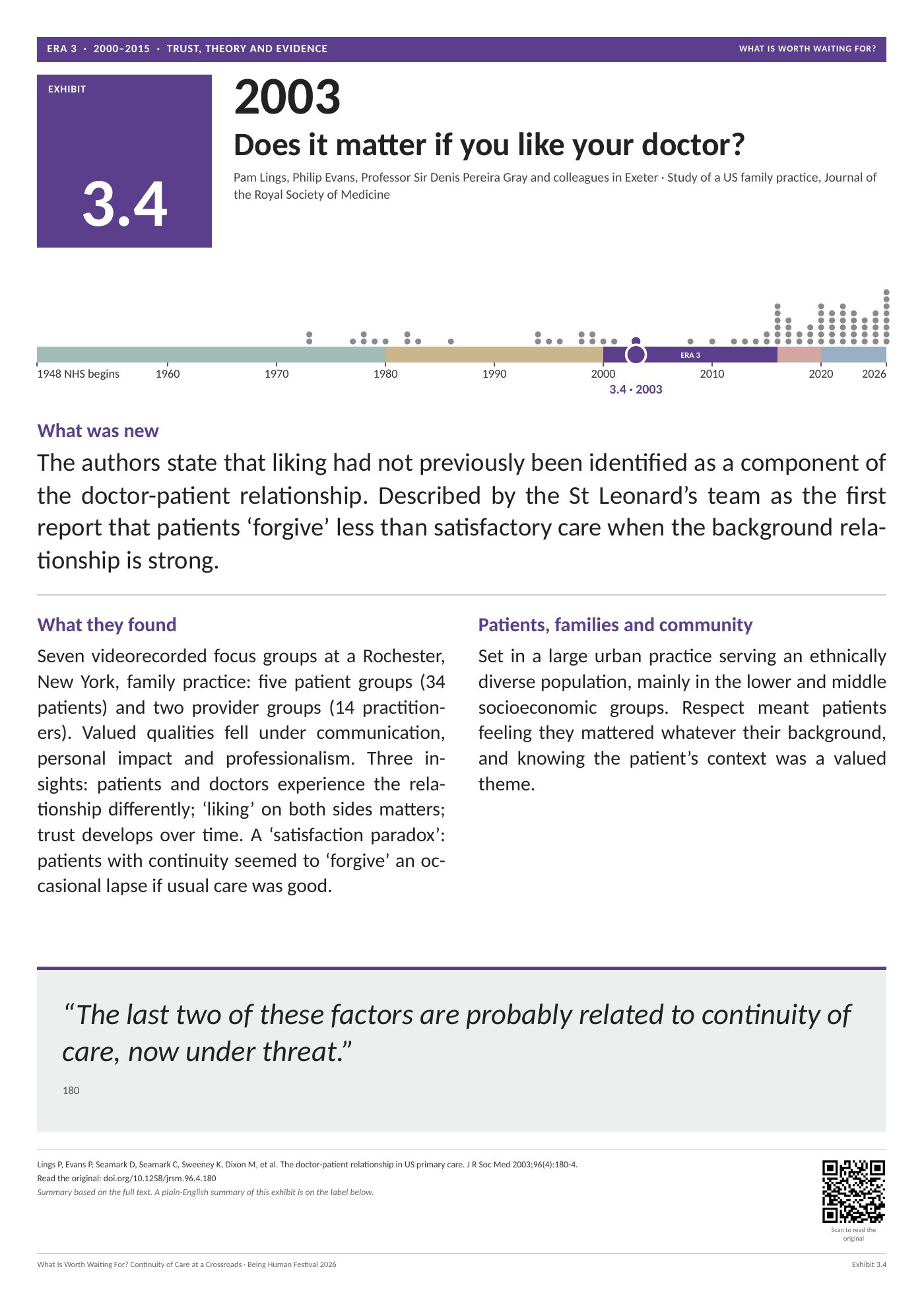
In plain English. Exeter researchers studied focus groups of patients and staff at a family practice in Rochester, New York, to understand what makes a good doctor-patient relationship. Patients valued being listened to, cared about and respected. Two things stood out: liking each other, and trust that grows over time. Patients who knew their doctor well seemed to forgive an occasional lapse if their usual care was good. The authors warned that these relationships, built through continuity, were under threat from the push for quicker access.
Why it is on the wall. Written as UK primary care was being reorganised to improve access, at a possible cost to relationships, it suggests what could be lost at that fork: trust and mutual liking take time to grow, which is exactly what may be worth waiting for.
What was new. The authors state that liking had not previously been identified as a component of the doctor-patient relationship. Described by the St Leonard’s team as the first report that patients ‘forgive’ less than satisfactory care when the background relationship is strong.
What they found. Seven videorecorded focus groups at a Rochester, New York, family practice: five patient groups (34 patients) and two provider groups (14 practitioners). Valued qualities fell under communication, personal impact and professionalism. Three insights: patients and doctors experience the relationship differently; ‘liking’ on both sides matters; trust develops over time. A ‘satisfaction paradox’: patients with continuity seemed to ‘forgive’ an occasional lapse if usual care was good.
Patients, families and community. Set in a large urban practice serving an ethnically diverse population, mainly in the lower and middle socioeconomic groups. Respect meant patients feeling they mattered whatever their background, and knowing the patient’s context was a valued theme.
Source: Lings P, Evans P, Seamark D, Seamark C, Sweeney K, Dixon M, et al. The doctor-patient relationship in US primary care. J R Soc Med 2003;96(4):180-4. Read the original
Summary based on the full text.
Basic and Applied Social Psychology, 2008 · Professor Sir Denis Pereira Gray with colleagues in the United States, Canada and Singapore
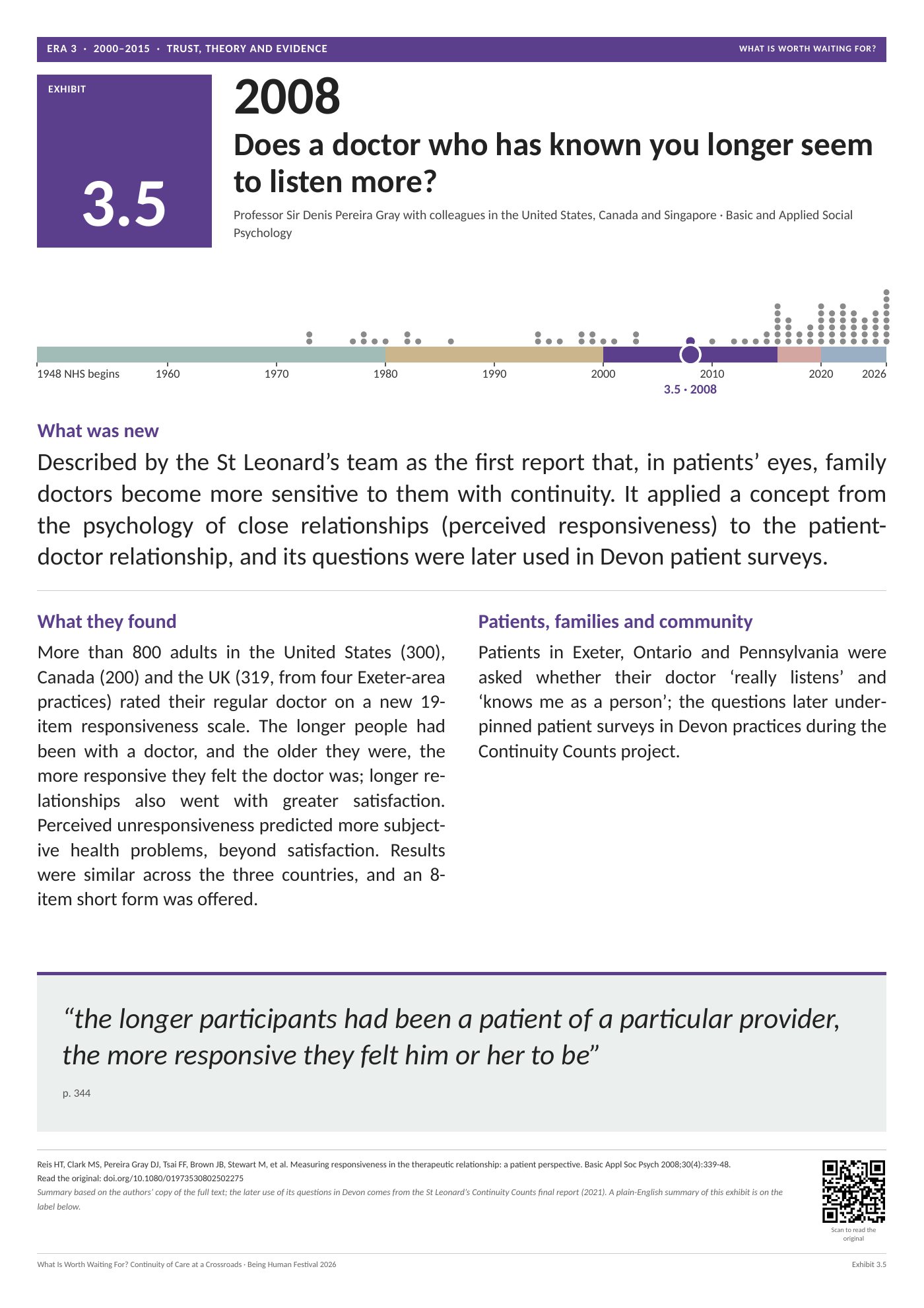
In plain English. Researchers asked more than 800 people in the United States, Canada and the UK about their regular family doctor: did the doctor really listen, understand them and take their worries seriously? The UK patients came from four practices in and near Exeter, including St Leonard’s. The longer people had been with the same doctor, the more responsive they felt that doctor was, and the more satisfied they were. Feeling unheard was linked with more day-to-day health problems. Questions from the study were later used to ask Devon patients about their GPs.
Why it is on the wall. Patients felt their doctor was more responsive the longer they had been with that doctor. A one-off survey cannot prove that responsiveness grows, but it hints that what matters may build up across years of visits rather than in any single appointment: one reason a familiar doctor may be worth waiting for.
What was new. Described by the St Leonard’s team as the first report that, in patients’ eyes, family doctors become more sensitive to them with continuity. It applied a concept from the psychology of close relationships (perceived responsiveness) to the patient-doctor relationship, and its questions were later used in Devon patient surveys.
What they found. More than 800 adults in the United States (300), Canada (200) and the UK (319, from four Exeter-area practices) rated their regular doctor on a new 19-item responsiveness scale. The longer people had been with a doctor, and the older they were, the more responsive they felt the doctor was; longer relationships also went with greater satisfaction. Perceived unresponsiveness predicted more subjective health problems, beyond satisfaction. Results were similar across the three countries, and an 8-item short form was offered.
Patients, families and community. Patients in Exeter, Ontario and Pennsylvania were asked whether their doctor ‘really listens’ and ‘knows me as a person’; the questions later underpinned patient surveys in Devon practices during the Continuity Counts project.
Source: Reis HT, Clark MS, Pereira Gray DJ, Tsai FF, Brown JB, Stewart M, et al. Measuring responsiveness in the therapeutic relationship: a patient perspective. Basic Appl Soc Psych 2008;30(4):339-48. Read the original
Summary based on the authors’ copy of the full text; the later use of its questions in Devon comes from the St Leonard’s Continuity Counts final report (2021).
Letter, Journal of the American Board of Family Medicine
Told American family doctors that a study claiming ‘few benefits’ from having a personal physician in diabetes did not support its own conclusion.
Source: Pereira Gray D, Evans P, Wright C, Langley P. Re: does having a personal physician improve quality of care in diabetes? [letter]. J Am Board Fam Med 2010;23(3):423-4; author reply 424. Read the original
Summary based on the full text.
Research, BMJ Open
A survey of 564 Essex GPs found high levels of burnout, lowest among long-serving single-handed GPs, who the authors suggested might benefit from longer relationships with their own patients.
Source: Orton P, Orton C, Pereira Gray D. Depersonalised doctors: a cross-sectional study of 564 doctors, 760 consultations and 1876 patient reports in UK general practice. BMJ Open 2012;2(1):e000274. Read the original
Summary based on the full text.
Research paper, Journal of Public Health, 2013 · Todd Chenore of NHS Devon with Professor Sir Denis Pereira Gray, Philip Evans and colleagues
In plain English. People aged 85 and over are the fastest growing group in the UK, and emergency hospital admissions are rising. Researchers built a Devon computer model to predict who would be admitted as an emergency in the next year. It worked better than the national model. Age, especially 85 and over, was among the strongest warning signs, and so was a short time registered with the GP practice: people who had been with their practice longer were less likely to have an emergency admission.
Why it is on the wall. If staying with one practice is linked with fewer emergency admissions, then keeping a long link with a practice matters for hospitals too, as the population ages.
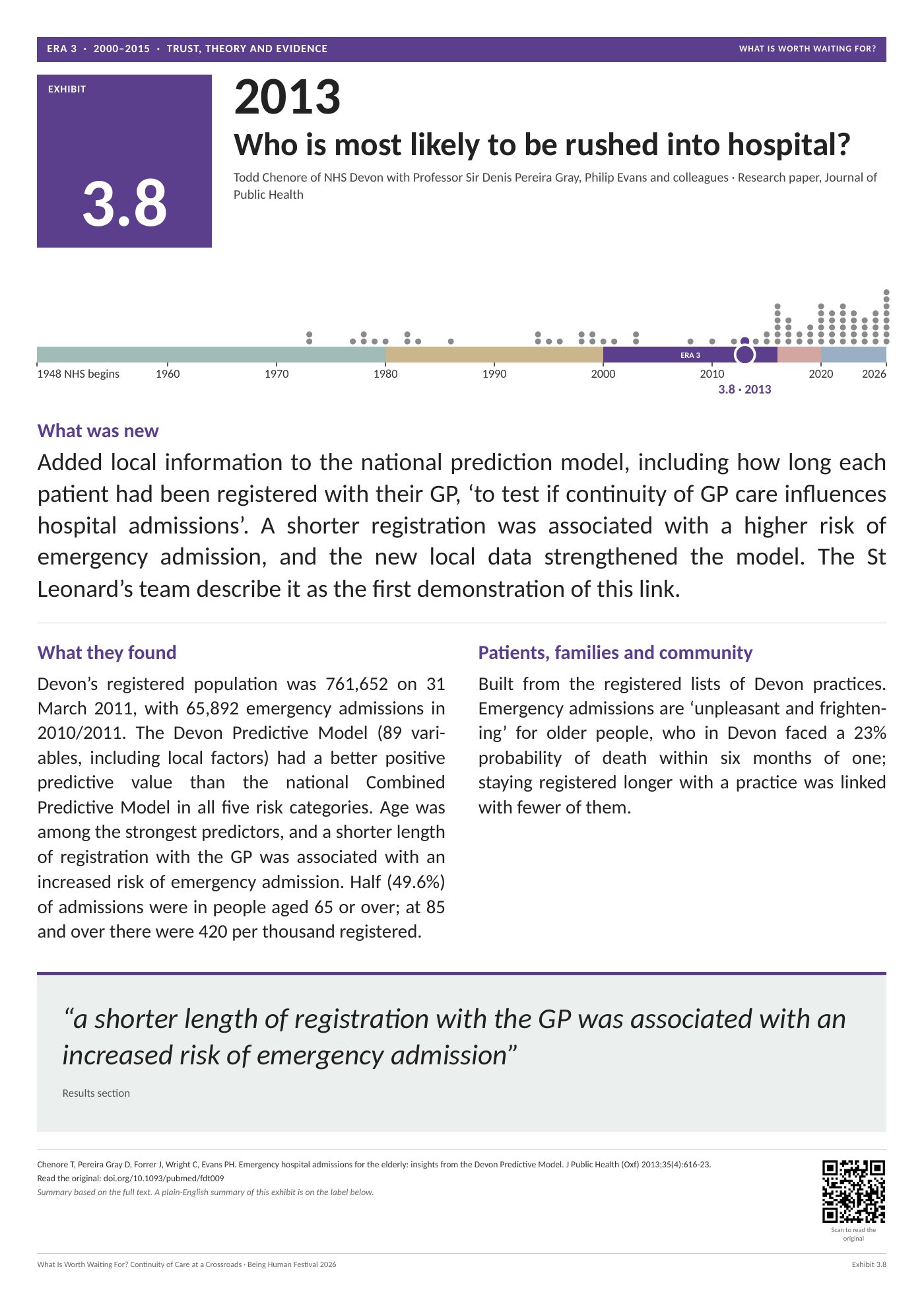
What was new. Added local information to the national prediction model, including how long each patient had been registered with their GP, ‘to test if continuity of GP care influences hospital admissions’. A shorter registration was associated with a higher risk of emergency admission, and the new local data strengthened the model. The St Leonard’s team describe it as the first demonstration of this link.
What they found. Devon’s registered population was 761,652 on 31 March 2011, with 65,892 emergency admissions in 2010/2011. The Devon Predictive Model (89 variables, including local factors) had a better positive predictive value than the national Combined Predictive Model in all five risk categories. Age was among the strongest predictors, and a shorter length of registration with the GP was associated with an increased risk of emergency admission. Half (49.6%) of admissions were in people aged 65 or over; at 85 and over there were 420 per thousand registered.
Patients, families and community. Built from the registered lists of Devon practices. Emergency admissions are ‘unpleasant and frightening’ for older people, who in Devon faced a 23% probability of death within six months of one; staying registered longer with a practice was linked with fewer of them.
Source: Chenore T, Pereira Gray D, Forrer J, Wright C, Evans PH. Emergency hospital admissions for the elderly: insights from the Devon Predictive Model. J Public Health (Oxf) 2013;35(4):616-23. Read the original
Summary based on the full text.
Letter, British Journal of General Practice
Answered a clinical director of an NHS clinical commissioning group who called the evidence ‘equivocal’ with ‘three really big gains’: satisfaction, preventive care and fewer emergency admissions.
Source: Pereira Gray D, White E, Evans P. The importance of continuity of care [letter]. Br J Gen Pract 2014;64(626):446. Read the original
Summary based on the full text.
Letter, The Lancet
Written with a patient charity. Read a major telephone triage trial from the patient’s side: triaged patients used out-of-hours care more and were less satisfied.
Source: Pereira Gray D, Wilkie P. Patient perspectives on telephone triage in general practice [letter]. Lancet 2015;385(9969):687-8. Read the original
Summary based on the full text.
Letter, British Journal of General Practice
Argued that about 100 studies show a positive association with continuity and only three an adverse effect, so that ‘on the balance of probabilities’ it benefits patients.
Source: Pereira Gray D, Sidaway-Lee K, White E, Evans P. Continuity of care is very important [letter]. Br J Gen Pract 2015;65(636):340. Read the original
Summary based on the full text.
← Era 2: The relationship as medicine · All five eras · Era 4: Life, death and a monthly number →