
What Is Worth Waiting For? Continuity of Care at a Crossroads
The Covid-19 pandemic changed how patients reached their GP. In 2020 Professor Sir Denis Pereira Gray and colleagues called it ‘a fork in the road’ and argued for ‘a personal not an impersonal future’. The team helped five Devon practices measure continuity (four improved it), linked it with better care for people with dementia, gave evidence to Parliament and wrote a guide to personal lists. MPs recommended measuring continuity in every practice. By 2026 researchers in Norway and Finland were using the St Leonard’s measure, and the team’s message was that continuity, once lost, can be regained.
What this era added. Turning evidence into practice and policy: guides, measures for every practice, and international uptake.
The community thread. Patients as partners and fairness: patient continuity champions, and an ‘inverse continuity law’ in which those who may need continuity most are least likely to get it.
On the wall in this era: 39 exhibits (3 large posters, 13 posters and 23 cards). The posters explain the main studies; the cards are the shorter pieces, mostly letters. Every entry links to the original.
Article, British Journal of General Practice
Proposed eight simple figures every practice should collect, including how long patients have been registered and how often they see their own GP.
Source: Pereira Gray D, Sidaway-Lee K, Kingdon H, Dineen M, Evans P, Harding A. Core management data in general practice. Br J Gen Pract 2020;70(690):36-37. Read the original
Summary based on the full text.
Leaflet, Continuity Counts project
A leaflet for patients explaining continuity, its benefits and its drawbacks: ‘You may need to wait a little longer to see your own doctor rather than any doctor.’
Source: St Leonard’s Research Practice. Continuity of care in general practice: a guide for patients [leaflet]. Exeter: St Leonard’s Research Practice (Continuity Counts project); 2020. Read the original
Summary based on the full text.
Article, British Journal of General Practice
Asked whether home visits should leave the GP contract, noting that patients feel their relationship with their GP improves when they are visited at home.
Source: Mitchell S, Hillman S, Rapley D, Pereira Gray D, Dale J. GP home visits: essential patient care or disposable relic? Br J Gen Pract 2020;70(695):306-307. Read the original
Summary based on the full text.
Letter, British Journal of General Practice
St Leonard’s own appointment records showed what happened when NHS guidance in March 2020 cut face-to-face care: within weeks, in-person consultations fell by 92.5% and telephone consultations rose by 85.6%.
Source: Pereira Gray D, Sidaway-Lee K, Harding A, Evans P. Reduction in face-to-face GP consultations [letter]. Br J Gen Pract 2020;70(696):328. Read the original
Summary based on the full text.
Editorial, BMJ, 2020 · Professor Sir Denis Pereira Gray and Catherine Johns, interim chair of the St Leonard’s patient participation group, with George Freeman and Martin Roland
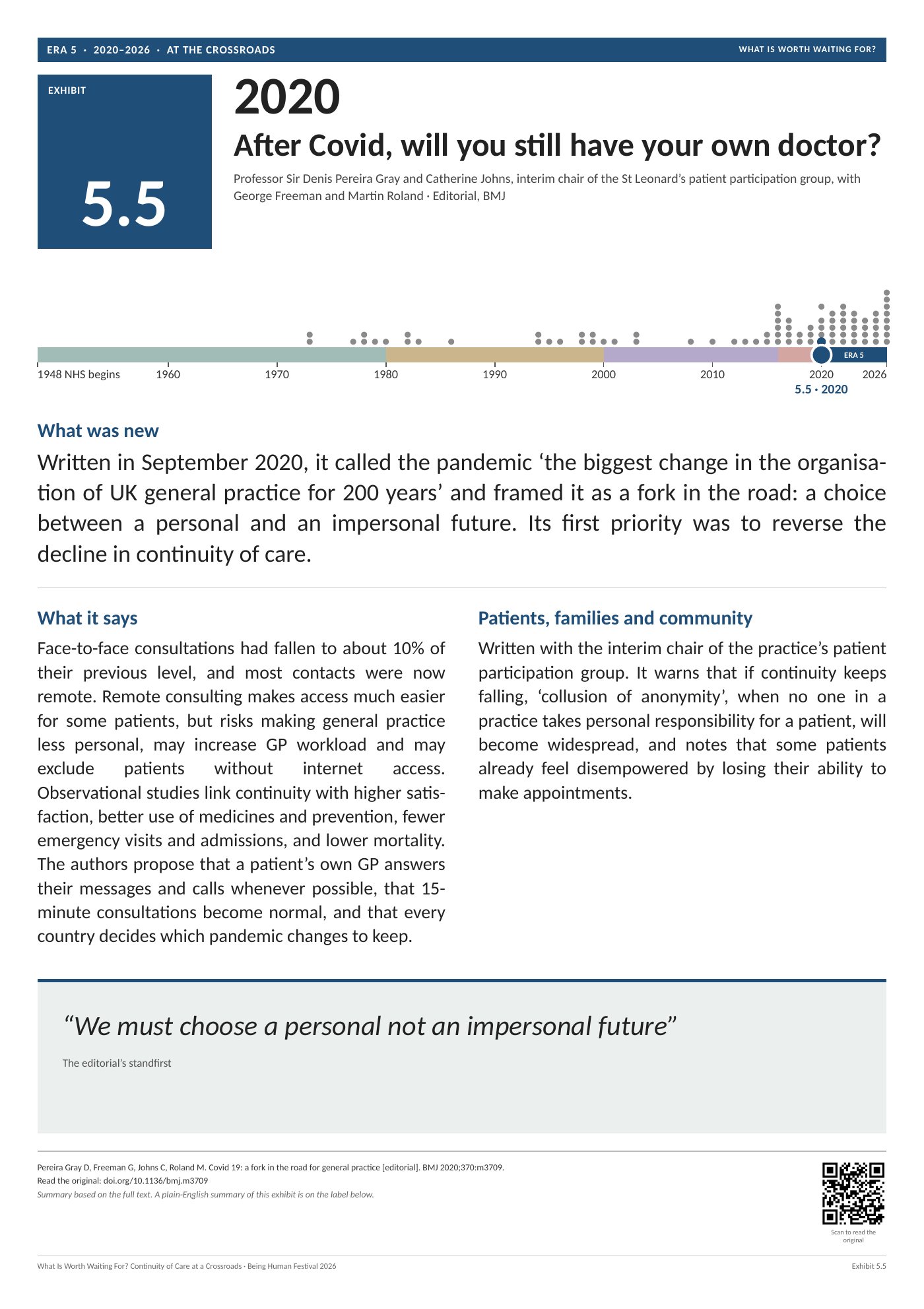
In plain English. In September 2020, during the Covid-19 pandemic, Professor Sir Denis Pereira Gray and Catherine Johns, interim chair of the St Leonard’s patient participation group, wrote a BMJ editorial with Professors George Freeman and Martin Roland. Face-to-face GP appointments had fallen to about a tenth of their usual number, and most care had moved to phone, video and online messages. This could make the GP easier to reach for some patients, but less personal. Their first priority was to reverse the fall in continuity, seeing the same doctor over time, for example by having your own GP answer your messages and calls whenever possible.
Why it is on the wall. Its title makes the festival theme explicit: the pandemic as a fork in the road, with general practice asked to choose a personal, not an impersonal, future.
What was new. Written in September 2020, it called the pandemic ‘the biggest change in the organisation of UK general practice for 200 years’ and framed it as a fork in the road: a choice between a personal and an impersonal future. Its first priority was to reverse the decline in continuity of care.
What it says. Face-to-face consultations had fallen to about 10% of their previous level, and most contacts were now remote. Remote consulting makes access much easier for some patients, but risks making general practice less personal, may increase GP workload and may exclude patients without internet access. Observational studies link continuity with higher satisfaction, better use of medicines and prevention, fewer emergency visits and admissions, and lower mortality. The authors propose that a patient’s own GP answers their messages and calls whenever possible, that 15-minute consultations become normal, and that every country decides which pandemic changes to keep.
Patients, families and community. Written with the interim chair of the practice’s patient participation group. It warns that if continuity keeps falling, ‘collusion of anonymity’, when no one in a practice takes personal responsibility for a patient, will become widespread, and notes that some patients already feel disempowered by losing their ability to make appointments.
Source: Pereira Gray D, Freeman G, Johns C, Roland M. Covid 19: a fork in the road for general practice [editorial]. BMJ 2020;370:m3709. Read the original
Summary based on the full text.
Article, British Journal of General Practice
Weighed the pandemic move to remote consulting, citing research that knowing the GP matters: ‘GPs are not interchangeable.’
Source: Tzortziou Brown V, Gregory S, Pereira Gray D. The power of personal care: the value of the patient-GP consultation. Br J Gen Pract 2020;70(701):596-597. Read the original
Summary based on the full text.
Analysis, British Journal of General Practice, 2021 · Kate Sidaway-Lee, Professor Sir Denis Pereira Gray, Alex Harding and Philip Evans
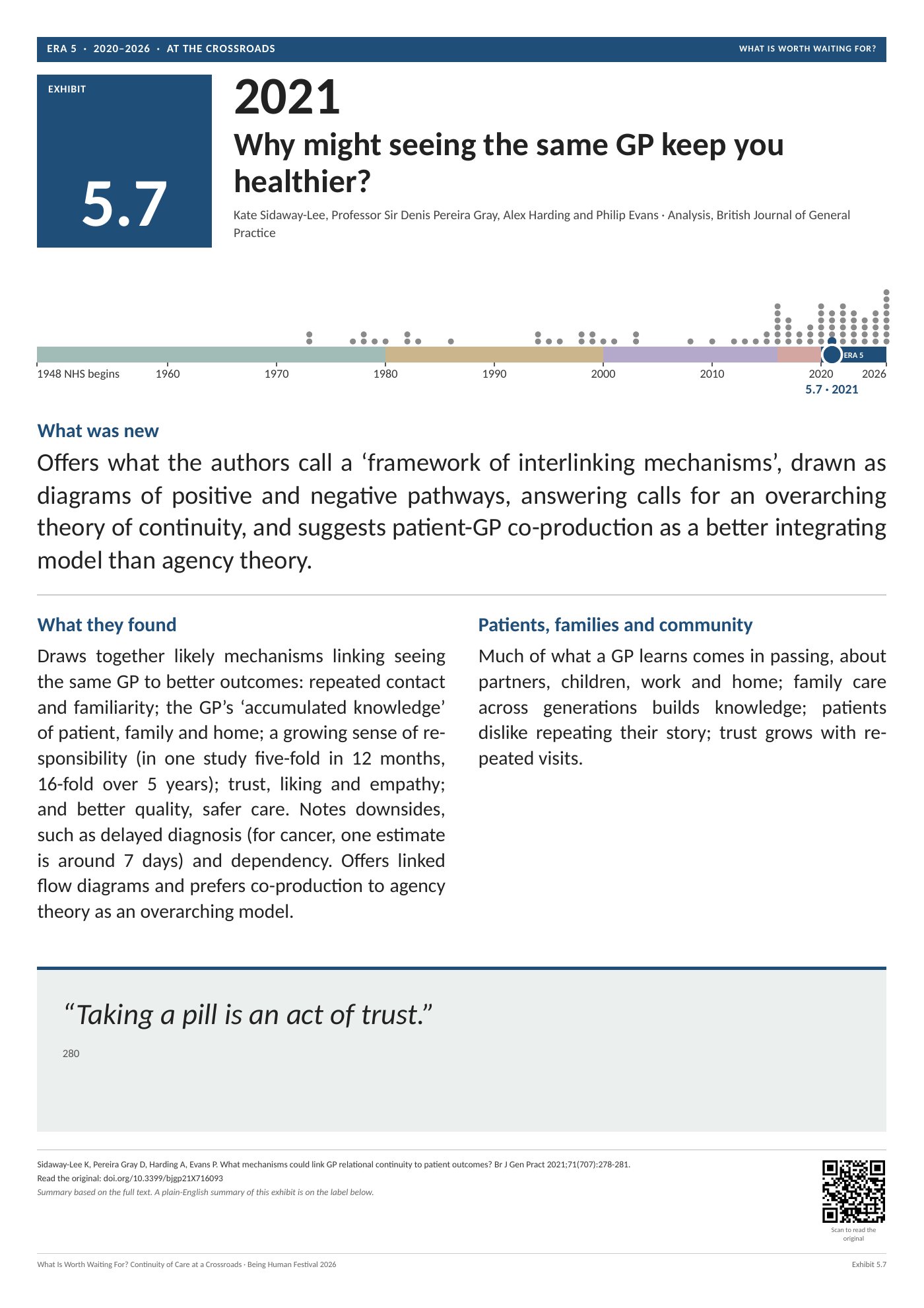
In plain English. Many studies link seeing the same GP with better health, but why? The St Leonard’s team gathered the likely reasons. Over repeated visits, doctors learn things never written down, about family, work and home, and feel more responsible for their patients. Patients come to trust and like their doctor, share more, and follow advice more often. Care becomes more tailored and safer. There are risks too: a familiar doctor may avoid awkward topics, delaying a diagnosis. The team drew these links as diagrams.
Why it is on the wall. A deep relationship takes time: one study cited found it took eight consultations with the same GP, on average, for a 50% chance of a ‘deep’ relationship. This paper explains what that patience buys.
What was new. Offers what the authors call a ‘framework of interlinking mechanisms’, drawn as diagrams of positive and negative pathways, answering calls for an overarching theory of continuity, and suggests patient-GP co-production as a better integrating model than agency theory.
What they found. Draws together likely mechanisms linking seeing the same GP to better outcomes: repeated contact and familiarity; the GP’s ‘accumulated knowledge’ of patient, family and home; a growing sense of responsibility (in one study five-fold in 12 months, 16-fold over 5 years); trust, liking and empathy; and better quality, safer care. Notes downsides, such as delayed diagnosis (for cancer, one estimate is around 7 days) and dependency. Offers linked flow diagrams and prefers co-production to agency theory as an overarching model.
Patients, families and community. Much of what a GP learns comes in passing, about partners, children, work and home; family care across generations builds knowledge; patients dislike repeating their story; trust grows with repeated visits.
Source: Sidaway-Lee K, Pereira Gray D, Harding A, Evans P. What mechanisms could link GP relational continuity to patient outcomes? Br J Gen Pract 2021;71(707):278-281. Read the original
Summary based on the full text.
Letter, British Journal of General Practice
Reported large-scale measurements of continuity in Belgium, nationwide, and in Catalonia, and warned that the UK appeared to be falling seriously behind.
Source: Pereira Gray D, Sidaway-Lee K, Evans P, Harding A. Measuring GP continuity at scale [letter]. Br J Gen Pract 2021;71(707):255. Read the original
Summary based on the full text.
Final report of the Continuity Counts project, funded by the Health Foundation, 2021 · St Leonard’s Research Practice with five Devon practices
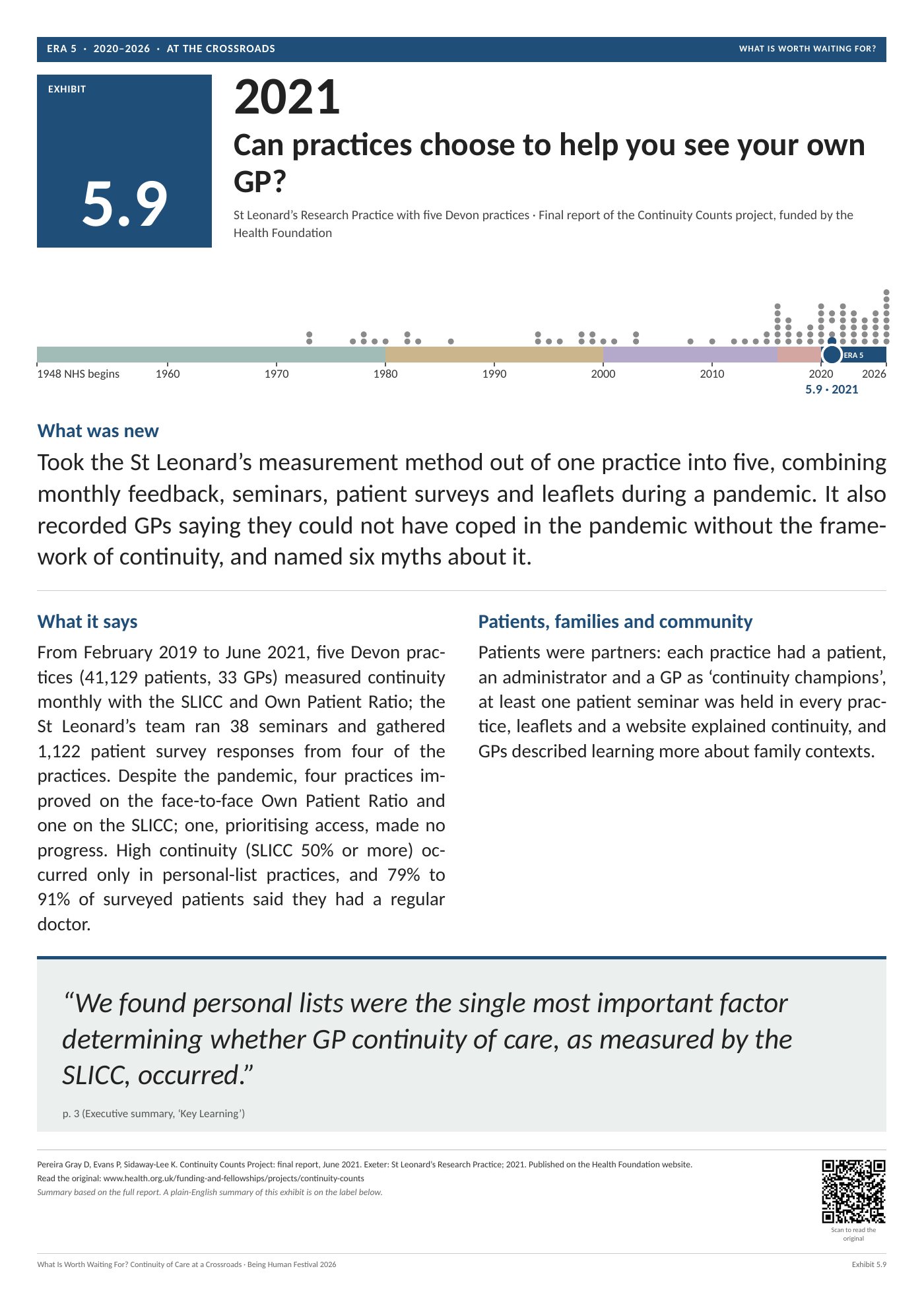
In plain English. Between 2019 and 2021 the St Leonard’s team worked with five Devon GP practices, in the city, by the sea and in the countryside, to help patients see their own GP more often. Practices measured this every month, the team held discussions with GPs, staff and patients, and over 1,100 patients in four of the practices were asked about their consultations. Even through the pandemic, most practices improved. Practices that gave every patient a named personal doctor (a personal list) did best, and GPs said knowing their patients helped them cope.
Why it is on the wall. Shows five practices at a real crossroads during the pandemic: one prioritised access and made no progress, while those with personal lists did best, and GPs said they could not have coped without the framework of continuity.
What was new. Took the St Leonard’s measurement method out of one practice into five, combining monthly feedback, seminars, patient surveys and leaflets during a pandemic. It also recorded GPs saying they could not have coped in the pandemic without the framework of continuity, and named six myths about it.
What it says. From February 2019 to June 2021, five Devon practices (41,129 patients, 33 GPs) measured continuity monthly with the SLICC and Own Patient Ratio; the St Leonard’s team ran 38 seminars and gathered 1,122 patient survey responses from four of the practices. Despite the pandemic, four practices improved on the face-to-face Own Patient Ratio and one on the SLICC; one, prioritising access, made no progress. High continuity (SLICC 50% or more) occurred only in personal-list practices, and 79% to 91% of surveyed patients said they had a regular doctor.
Patients, families and community. Patients were partners: each practice had a patient, an administrator and a GP as ‘continuity champions’, at least one patient seminar was held in every practice, leaflets and a website explained continuity, and GPs described learning more about family contexts.
Source: Pereira Gray D, Evans P, Sidaway-Lee K. Continuity Counts Project: final report, June 2021. Exeter: St Leonard’s Research Practice; 2021. Published on the Health Foundation website. Read the original
Summary based on the full report.
Letter, British Journal of General Practice
Argued that the relationship itself, more than shared records, is ‘by far the most important part’ of continuity.
Source: Pereira Gray D, Sidaway-Lee K, Harding A, Evans PH. Beyond relational continuity [letter]. Br J Gen Pract 2021;71(711):444. Read the original
Summary based on the full text.
Letter, Canadian Family Physician
Told Canadian family doctors that continuity is not a thing of the past: measure it, and link patients with doctors who feel responsible for them.
Source: Pereira Gray D, Sidaway-Lee K. Continuity of care suggestions [letter]. Can Fam Physician 2021;67(10):721. Read the original
Summary based on the full text.
Guide for GPs and practice managers, published on the Royal College of General Practitioners’ website, 2022 · Professor Sir Denis Pereira Gray, Kate Sidaway-Lee and Philip Evans
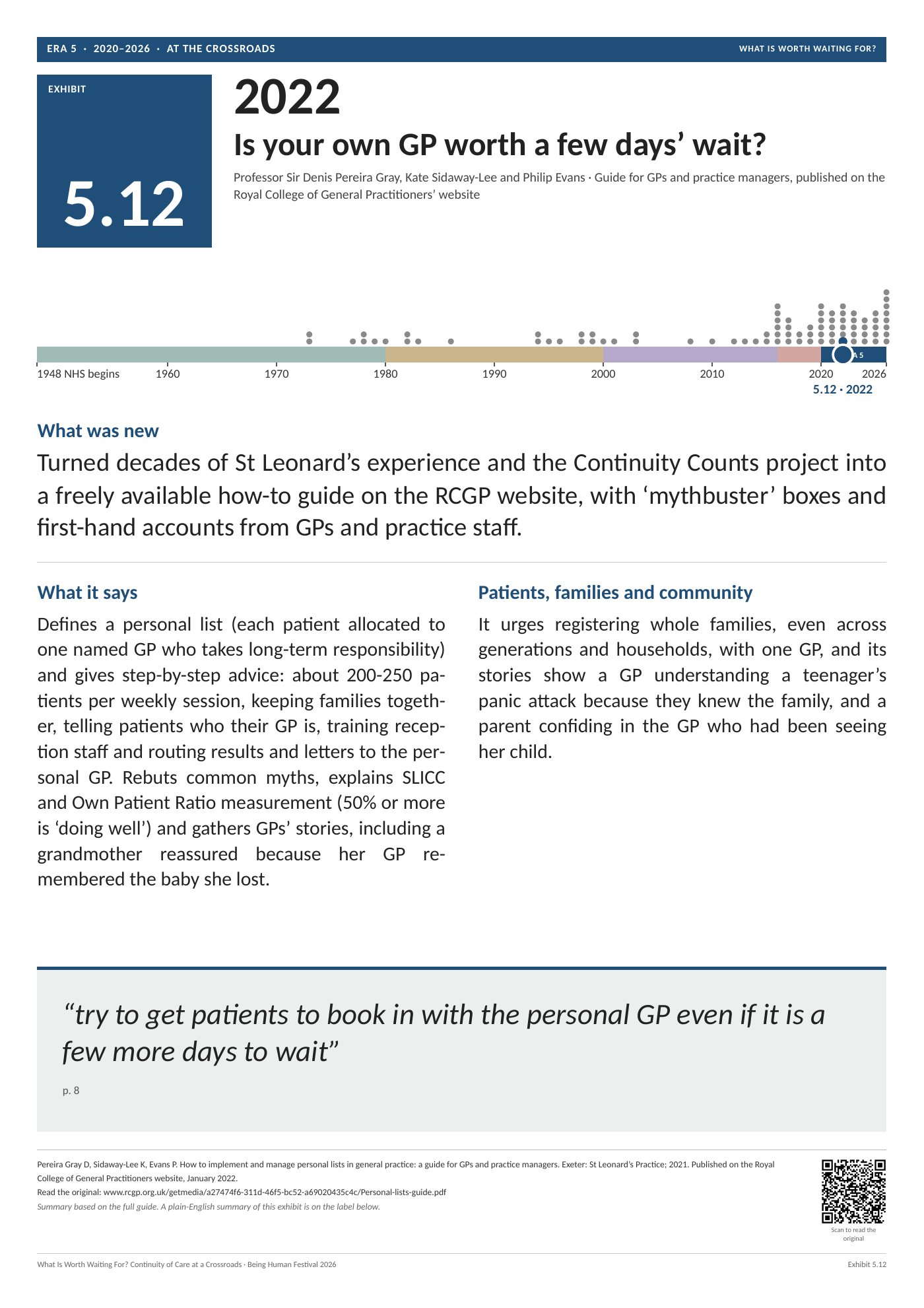
In plain English. This guide, written by the St Leonard’s team and published on the Royal College of GPs’ website in 2022, explains how practices can give every patient a named personal GP who looks after them over the long term. It covers setting up lists, keeping families together and measuring how often patients see their own doctor. It is honest that this sometimes means waiting a few more days. GPs’ stories show why it matters, such as a grandmother comforted because her doctor remembered the baby she lost years before.
Why it is on the wall. Directly addresses ‘What is worth waiting for?’: it advises staff to help patients book with their personal GP ‘even if it is a few more days to wait’, arguing that a doctor who knows you is worth it.
What was new. Turned decades of St Leonard’s experience and the Continuity Counts project into a freely available how-to guide on the RCGP website, with ‘mythbuster’ boxes and first-hand accounts from GPs and practice staff.
What it says. Defines a personal list (each patient allocated to one named GP who takes long-term responsibility) and gives step-by-step advice: about 200-250 patients per weekly session, keeping families together, telling patients who their GP is, training reception staff and routing results and letters to the personal GP. Rebuts common myths, explains SLICC and Own Patient Ratio measurement (50% or more is ‘doing well’) and gathers GPs’ stories, including a grandmother reassured because her GP remembered the baby she lost.
Patients, families and community. It urges registering whole families, even across generations and households, with one GP, and its stories show a GP understanding a teenager’s panic attack because they knew the family, and a parent confiding in the GP who had been seeing her child.
Source: Pereira Gray D, Sidaway-Lee K, Evans P. How to implement and manage personal lists in general practice: a guide for GPs and practice managers. Exeter: St Leonard’s Practice; 2021. Published on the Royal College of General Practitioners website, January 2022. Read the original
Summary based on the full guide.
Research paper, British Journal of General Practice, 2022 · João Delgado and University of Exeter colleagues with Philip Evans, Professor Sir Denis Pereira Gray and Kate Sidaway-Lee
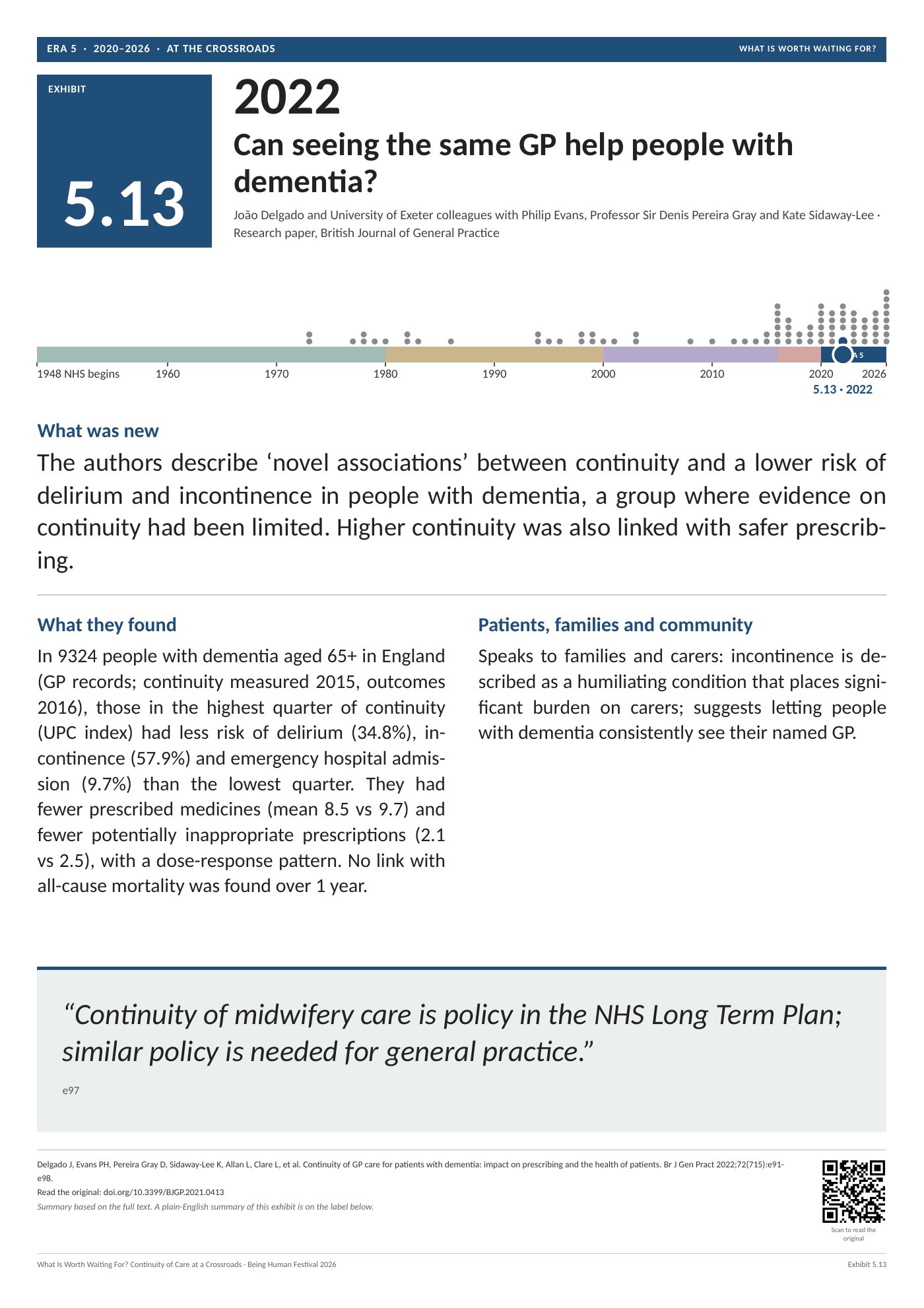
In plain English. People with dementia often have other conditions and take many medicines. Researchers from the University of Exeter and St Leonard’s studied the GP records of 9,324 people with dementia in England. Those who most often saw the same GP were less likely over the next year to develop sudden confusion (delirium) or incontinence, or to need emergency hospital admission, and were prescribed fewer potentially harmful medicines. The study shows links rather than proof, but suggests helping people with dementia to see their named GP.
Why it is on the wall. For someone with dementia, a familiar doctor may matter most. The authors suggest prioritising these patients to see their named GP now, a practical choice at the crossroads while wider continuity is rebuilt.
What was new. The authors describe ‘novel associations’ between continuity and a lower risk of delirium and incontinence in people with dementia, a group where evidence on continuity had been limited. Higher continuity was also linked with safer prescribing.
What they found. In 9324 people with dementia aged 65+ in England (GP records; continuity measured 2015, outcomes 2016), those in the highest quarter of continuity (UPC index) had less risk of delirium (34.8%), incontinence (57.9%) and emergency hospital admission (9.7%) than the lowest quarter. They had fewer prescribed medicines (mean 8.5 vs 9.7) and fewer potentially inappropriate prescriptions (2.1 vs 2.5), with a dose-response pattern. No link with all-cause mortality was found over 1 year.
Patients, families and community. Speaks to families and carers: incontinence is described as a humiliating condition that places significant burden on carers; suggests letting people with dementia consistently see their named GP.
Source: Delgado J, Evans PH, Pereira Gray D, Sidaway-Lee K, Allan L, Clare L, et al. Continuity of GP care for patients with dementia: impact on prescribing and the health of patients. Br J Gen Pract 2022;72(715):e91-e98. Read the original
Summary based on the full text.
Editorial, British Journal of General Practice, 2022 · Professor Sir Denis Pereira Gray, Kate Sidaway-Lee and Philip Evans
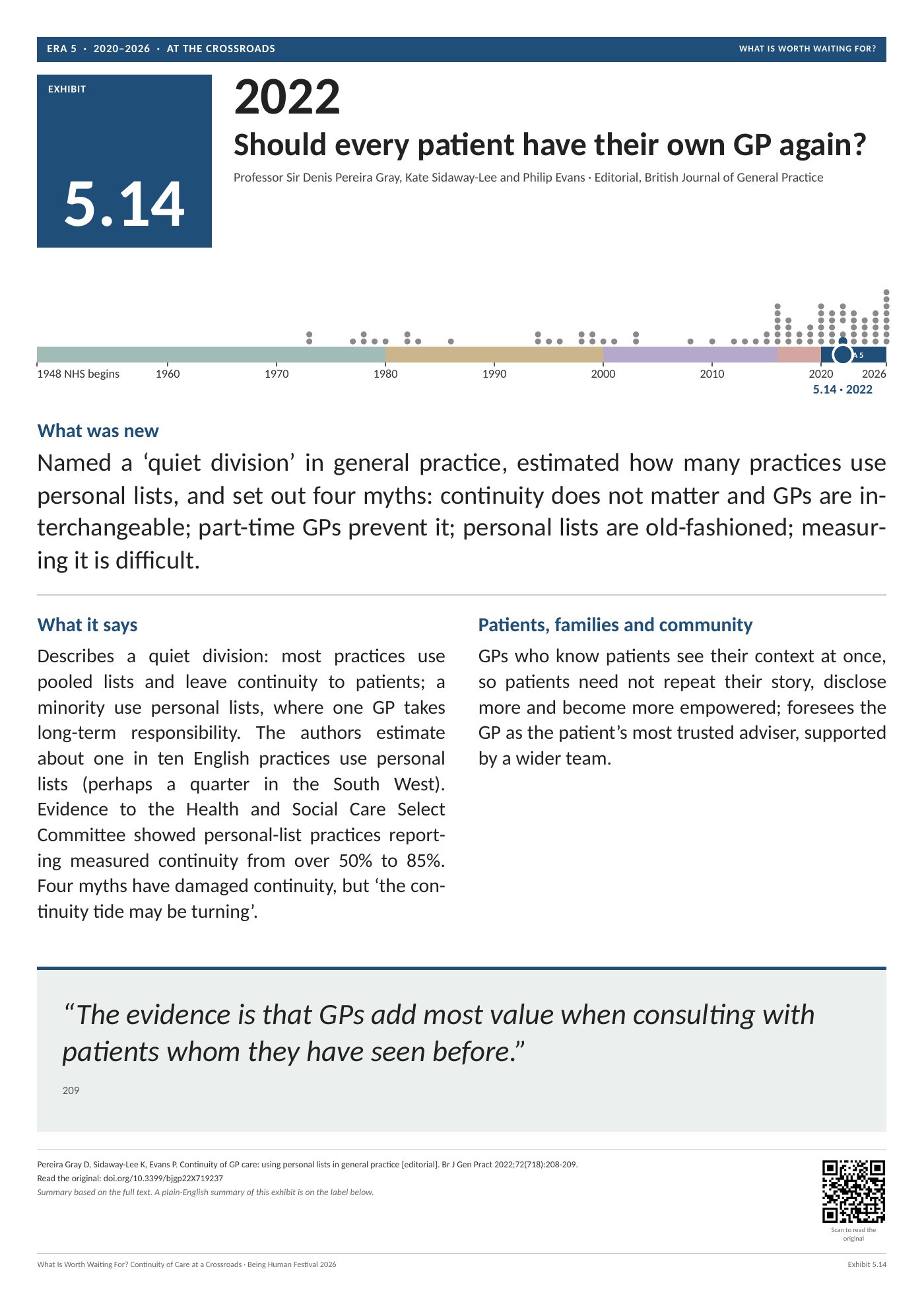
In plain English. In most practices today patients are on a shared list and may see any doctor. A minority, including St Leonard’s for 48 years, give each patient a personal GP who takes long-term responsibility for them. This 2022 editorial argued that these personal-list practices achieve good continuity and seem more in control of their workload, probably because doctors who know their patients work more quickly and give better care. It challenged four myths, including that GPs are interchangeable, and suggested the tide may be turning.
Why it is on the wall. The clearest statement of the crossroads: general practice has quietly divided between pooled lists and personal lists. The editorial argues the personal-list road gives patients a doctor who knows them and GPs a more manageable workload.
What was new. Named a ‘quiet division’ in general practice, estimated how many practices use personal lists, and set out four myths: continuity does not matter and GPs are interchangeable; part-time GPs prevent it; personal lists are old-fashioned; measuring it is difficult.
What it says. Describes a quiet division: most practices use pooled lists and leave continuity to patients; a minority use personal lists, where one GP takes long-term responsibility. The authors estimate about one in ten English practices use personal lists (perhaps a quarter in the South West). Evidence to the Health and Social Care Select Committee showed personal-list practices reporting measured continuity from over 50% to 85%. Four myths have damaged continuity, but ‘the continuity tide may be turning’.
Patients, families and community. GPs who know patients see their context at once, so patients need not repeat their story, disclose more and become more empowered; foresees the GP as the patient’s most trusted adviser, supported by a wider team.
Source: Pereira Gray D, Sidaway-Lee K, Evans P. Continuity of GP care: using personal lists in general practice [editorial]. Br J Gen Pract 2022;72(718):208-209. Read the original
Summary based on the full text.
Letter, The Lancet
Two former presidents of the Royal College of GPs defended empathy, and the 1967 book A Fortunate Man, with research linking empathy and continuity to better health.
Source: Heath I, Pereira Gray D. The importance of empathy [letter]. Lancet 2022;400(10348):271-272. Read the original
Summary based on the full text.
With evidence from Kate Sidaway-Lee, Professor Sir Denis Pereira Gray and Philip Evans, 2022 · House of Commons Health and Social Care Committee
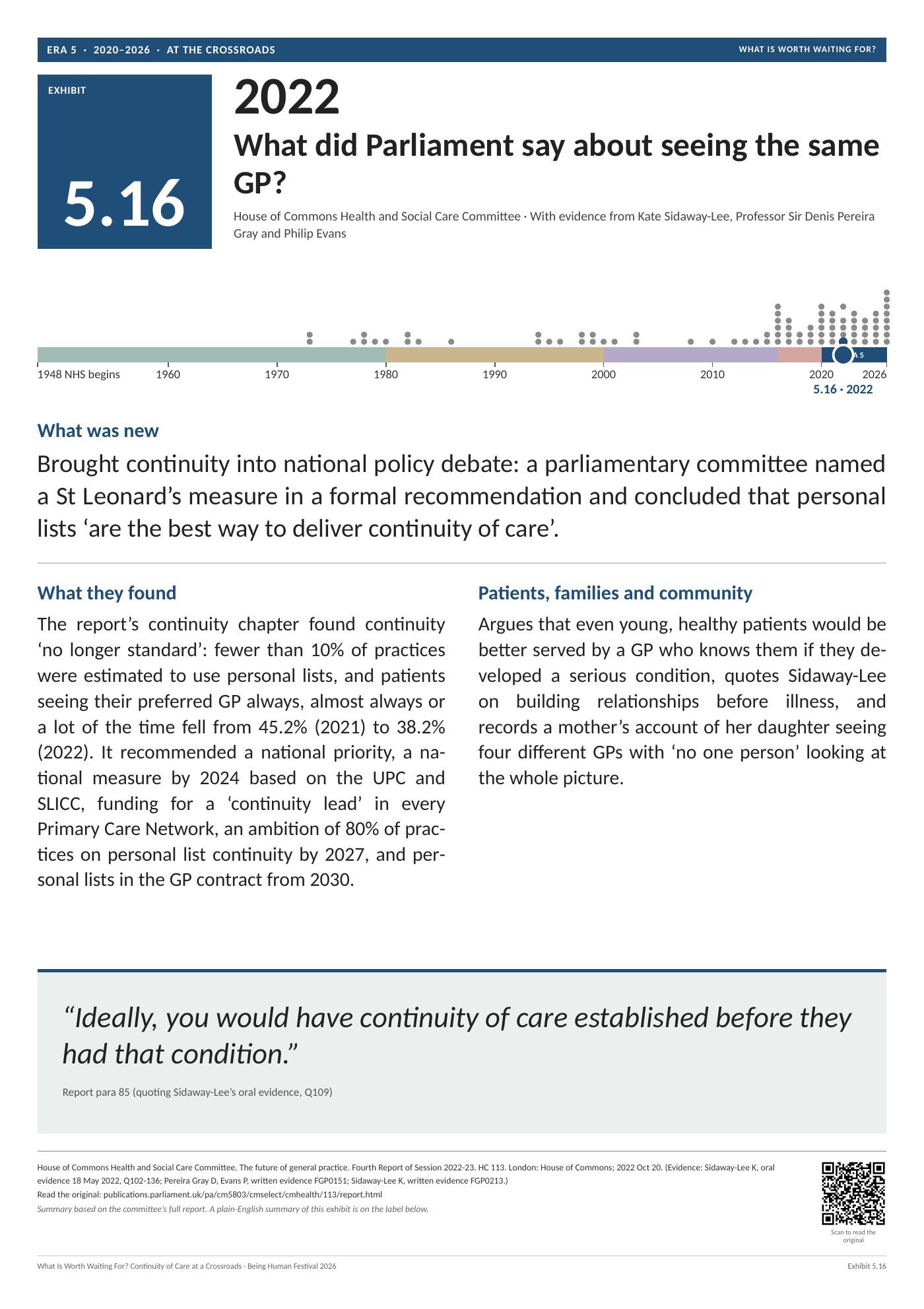
In plain English. In 2022 a committee of MPs investigated the future of general practice. Kate Sidaway-Lee from St Leonard’s gave evidence in person, and Professor Sir Denis Pereira Gray and Philip Evans sent written evidence. The MPs said they were ‘extremely concerned’ that continuity, seeing the same GP over time, was declining. They recommended measuring it in every practice, using measures including the St Leonard’s Index, and bringing back personal lists, with an ambition that 80% of practices use them by 2027.
Why it is on the wall. A policy crossroads made explicit: MPs weighed fast access against knowing your doctor, keeping ‘the choice to receive quicker access’ for those who need it while setting an ambition of continuity for all.
What was new. Brought continuity into national policy debate: a parliamentary committee named a St Leonard’s measure in a formal recommendation and concluded that personal lists ‘are the best way to deliver continuity of care’.
What they found. The report’s continuity chapter found continuity ‘no longer standard’: fewer than 10% of practices were estimated to use personal lists, and patients seeing their preferred GP always, almost always or a lot of the time fell from 45.2% (2021) to 38.2% (2022). It recommended a national priority, a national measure by 2024 based on the UPC and SLICC, funding for a ‘continuity lead’ in every Primary Care Network, an ambition of 80% of practices on personal list continuity by 2027, and personal lists in the GP contract from 2030.
Patients, families and community. Argues that even young, healthy patients would be better served by a GP who knows them if they developed a serious condition, quotes Sidaway-Lee on building relationships before illness, and records a mother’s account of her daughter seeing four different GPs with ‘no one person’ looking at the whole picture.
Source: House of Commons Health and Social Care Committee. The future of general practice. Fourth Report of Session 2022-23. HC 113. London: House of Commons; 2022 Oct 20. (Evidence: Sidaway-Lee K, oral evidence 18 May 2022, Q102-136; Pereira Gray D, Evans P, written evidence FGP0151; Sidaway-Lee K, written evidence FGP0213.) Read the original
Summary based on the committee’s full report.
Letter, British Journal of General Practice
Noted that bigger practices have lower patient satisfaction and lower continuity, and called personal lists the only evidence-based way to keep continuity in them.
Source: Pereira Gray D, Sidaway-Lee K, Whitaker P, Evans P. Adverse effects for patients in big group practices [letter]. Br J Gen Pract 2022;72(724):518. Read the original
Summary based on the full text.
Analysis, British Journal of General Practice, 2023 · Professor Sir Denis Pereira Gray, Kate Sidaway-Lee, Philip Evans and a medical student
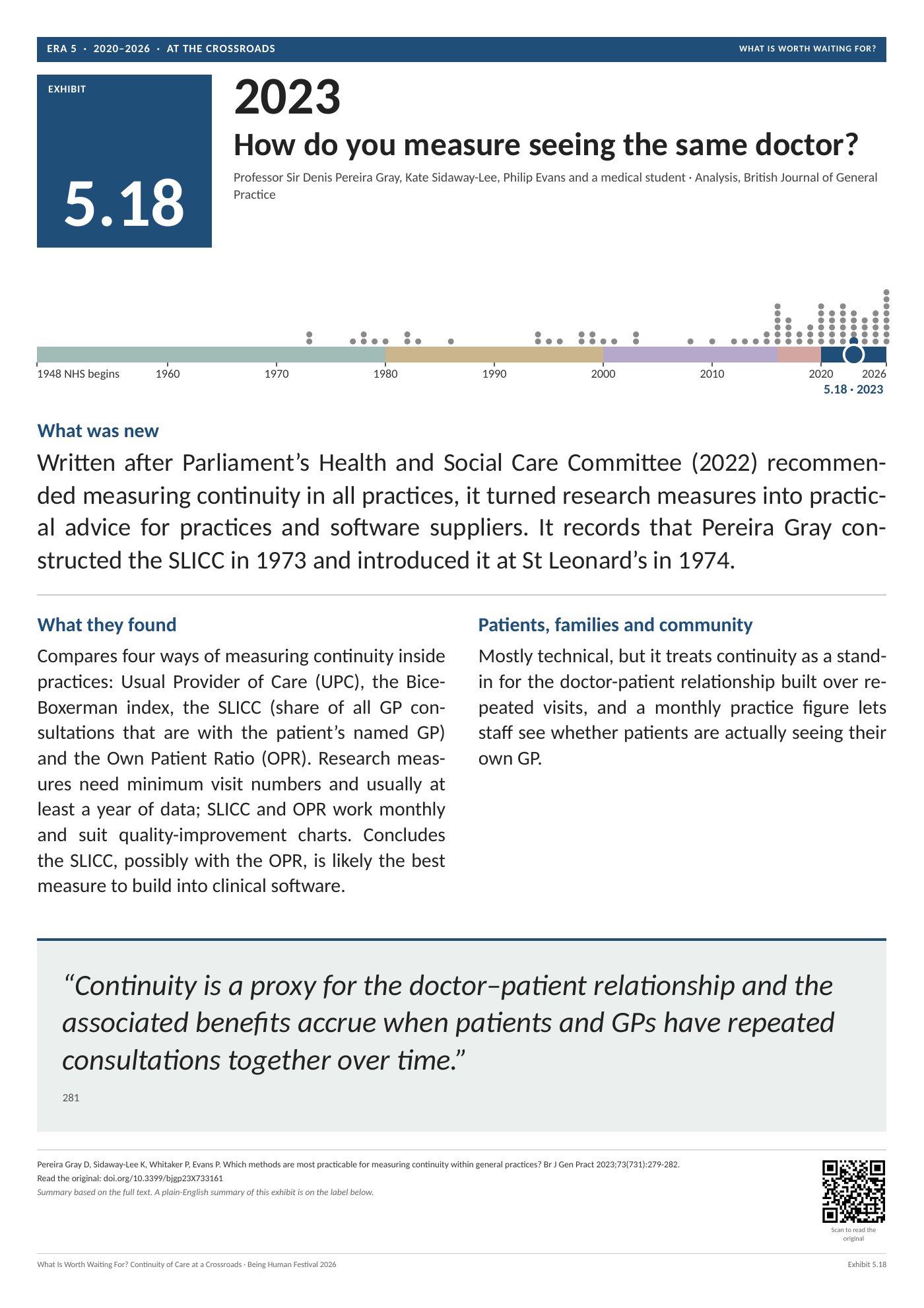
In plain English. In 2022, a committee of MPs recommended that every GP practice should measure continuity of care, meaning how often patients see the same doctor over time. But there are several ways to measure it, and they can give different answers for the same patients. The St Leonard’s team compared four methods. They concluded that a simple monthly figure, the share of GP appointments that are with the patient’s own named GP, is likely the best one to build into practice computer systems.
Why it is on the wall. England stood at a measuring crossroads in 2022-23: MPs wanted continuity counted in every practice, but with which ruler? The authors warn that different methods give different figures for the same patients, so the choice of measure matters.
What was new. Written after Parliament’s Health and Social Care Committee (2022) recommended measuring continuity in all practices, it turned research measures into practical advice for practices and software suppliers. It records that Pereira Gray constructed the SLICC in 1973 and introduced it at St Leonard’s in 1974.
What they found. Compares four ways of measuring continuity inside practices: Usual Provider of Care (UPC), the Bice-Boxerman index, the SLICC (share of all GP consultations that are with the patient’s named GP) and the Own Patient Ratio (OPR). Research measures need minimum visit numbers and usually at least a year of data; SLICC and OPR work monthly and suit quality-improvement charts. Concludes the SLICC, possibly with the OPR, is likely the best measure to build into clinical software.
Patients, families and community. Mostly technical, but it treats continuity as a stand-in for the doctor-patient relationship built over repeated visits, and a monthly practice figure lets staff see whether patients are actually seeing their own GP.
Source: Pereira Gray D, Sidaway-Lee K, Whitaker P, Evans P. Which methods are most practicable for measuring continuity within general practices? Br J Gen Pract 2023;73(731):279-282. Read the original
Summary based on the full text.
Letter, British Journal of General Practice
Argued that continuity across a lifetime of illnesses is better than continuity within a single episode of illness.
Source: Pereira Gray D, Evans P. Continuity of care [letter]. Br J Gen Pract 2023;73(733):347. Read the original
Summary based on the full text.
Editorial, British Journal of General Practice
Called general practice ‘the integrating discipline’: GPs have ‘the longest and deepest working relationships with patients of any branch of medical practice’.
Source: Pereira Gray D. General practice – the integrating discipline [editorial]. Br J Gen Pract 2023;73(734):388-390. Read the original
Summary based on the full text.
Letter, BMJ
Replied to a claim that better primary care is unlikely to save money: continuity of GP care is linked with fewer hospital admissions and emergency visits, and each emergency admission of an older person costs over £8000 on average.
Source: Pereira Gray D, Sidaway-Lee K, Evans P. Cost effectiveness of continuity in general practice [letter]. BMJ 2023;383:2398. Read the original
Summary based on the full text.
Analysis, BMJ, 2023 · Professor Sir Denis Pereira Gray, Kate Sidaway-Lee, Catherine Johns (patient representative), Mark Rickenbach and Philip Evans
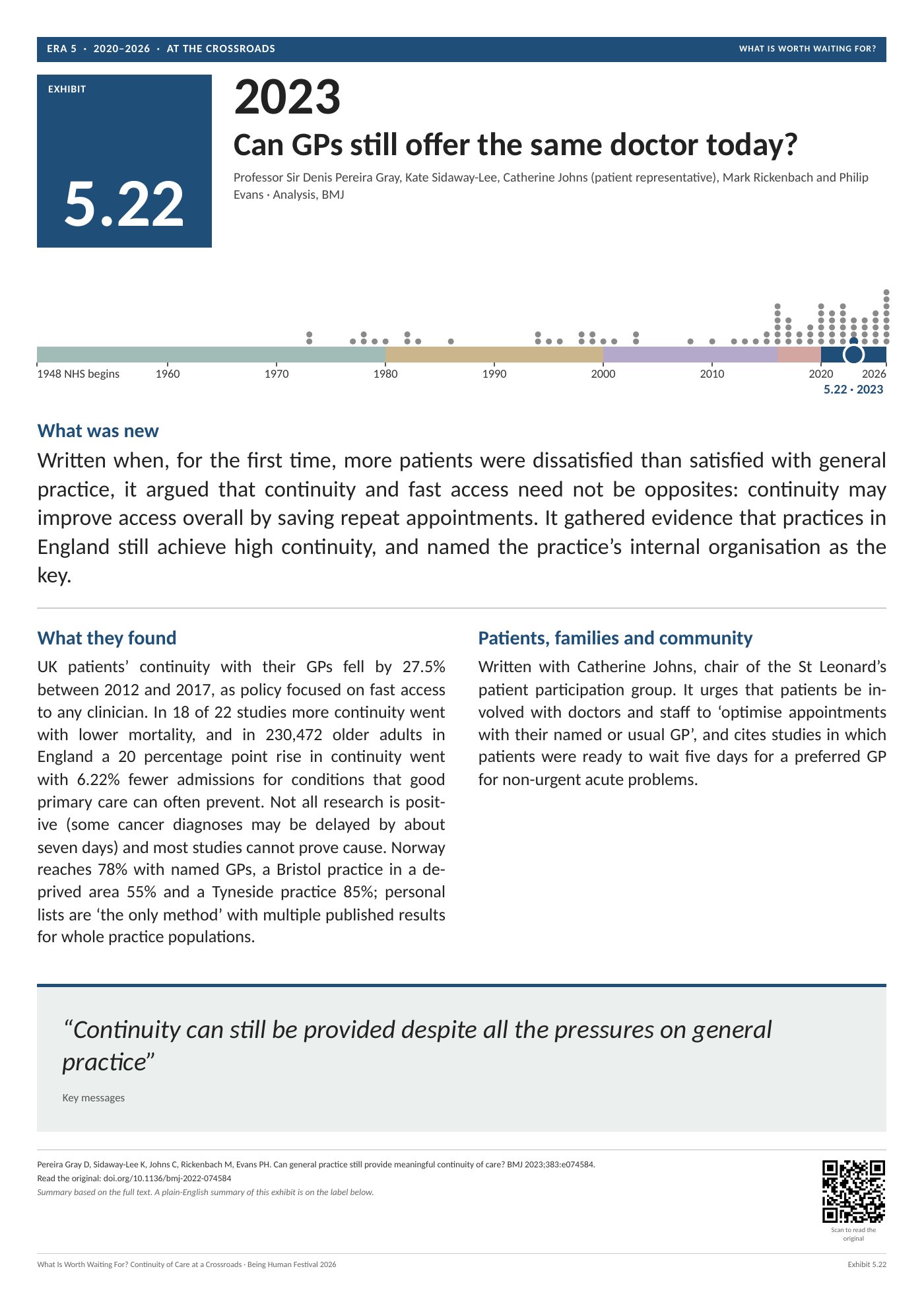
In plain English. By 2023 general practice was in crisis: fewer GPs, low morale and, for the first time, more patients dissatisfied than satisfied. Continuity, seeing the same GP over time, had fallen by more than a quarter in five years as policy pushed for quick access to any clinician. Writing in the BMJ with a patient representative, the St Leonard’s team argued that continuity can still be provided, that it may even free up appointments by reducing repeat visits, and that how a practice organises itself is the key.
Why it is on the wall. The crossroads in a sentence: accept the loss of the personal doctor as inevitable, or choose to rebuild it. The authors argue the second road is still open.
What was new. Written when, for the first time, more patients were dissatisfied than satisfied with general practice, it argued that continuity and fast access need not be opposites: continuity may improve access overall by saving repeat appointments. It gathered evidence that practices in England still achieve high continuity, and named the practice’s internal organisation as the key.
What they found. UK patients’ continuity with their GPs fell by 27.5% between 2012 and 2017, as policy focused on fast access to any clinician. In 18 of 22 studies more continuity went with lower mortality, and in 230,472 older adults in England a 20 percentage point rise in continuity went with 6.22% fewer admissions for conditions that good primary care can often prevent. Not all research is positive (some cancer diagnoses may be delayed by about seven days) and most studies cannot prove cause. Norway reaches 78% with named GPs, a Bristol practice in a deprived area 55% and a Tyneside practice 85%; personal lists are ‘the only method’ with multiple published results for whole practice populations.
Patients, families and community. Written with Catherine Johns, chair of the St Leonard’s patient participation group. It urges that patients be involved with doctors and staff to ‘optimise appointments with their named or usual GP’, and cites studies in which patients were ready to wait five days for a preferred GP for non-urgent acute problems.
Source: Pereira Gray D, Sidaway-Lee K, Johns C, Rickenbach M, Evans PH. Can general practice still provide meaningful continuity of care? BMJ 2023;383:e074584. Read the original
Summary based on the full text.
Letter, British Journal of General Practice
Argued that empathy grows when GPs see the same patients repeatedly, ending: ‘Continuity counts.’
Source: Pereira Gray D, Sidaway-Lee K, Khan N, Evans P. Enhancing empathy in GP consultations [letter]. Br J Gen Pract 2024;74(742):204. Read the original
Summary based on the full text.
Book, CRC Press
Professor Sir Denis Pereira Gray’s memoir, drawn from his diaries, of a career in general practice from 1962, including the St Leonard’s Research Practice.
Source: Pereira Gray D. Just a GP: diaries from a career in general practice. Boca Raton (FL): CRC Press; 2024. Read the original
Summary based on the publisher’s description.
Teaching review for GPs in training, InnovAiT, 2024 · Kate Sidaway-Lee, Professor Sir Denis Pereira Gray, Nada Khan, Philip Evans and a medical student
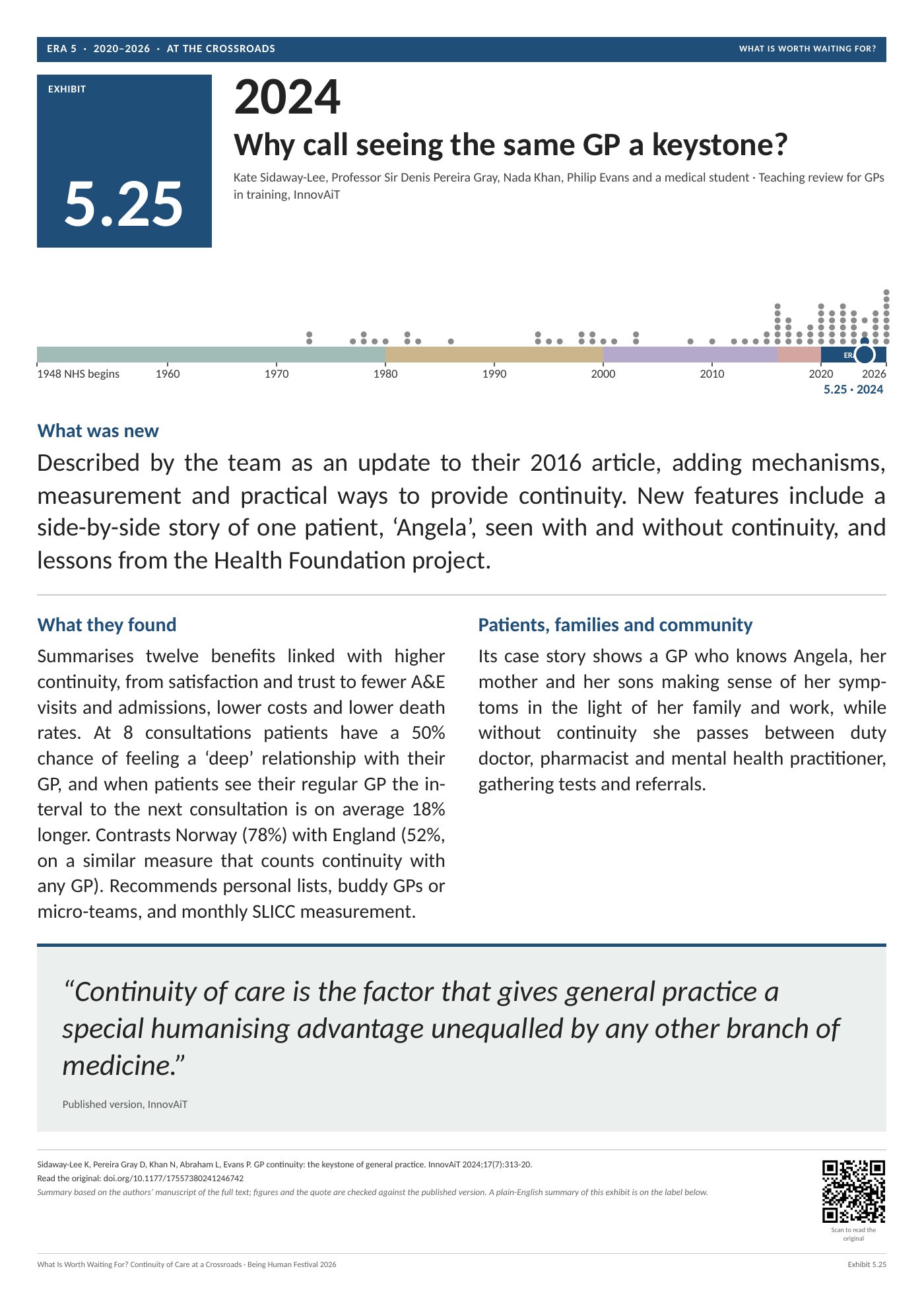
In plain English. In 2024 the St Leonard’s team updated their guide for trainee GPs. They describe continuity of care, seeing the same GP over time, as the keystone that holds general practice together. Research links it with trust, following medical advice, fewer emergency visits and hospital stays, lower costs and fewer deaths. A story of one woman, Angela, shows a GP who knows her family making sense of her symptoms, while a series of strangers order tests and referrals. The article sets out practical ways practices can offer continuity.
Why it is on the wall. Asks the crossroads question directly: not whether continuity should be provided but whether it can be, and how. It also admits a cost, that patients may wait too long for their preferred GP.
What was new. Described by the team as an update to their 2016 article, adding mechanisms, measurement and practical ways to provide continuity. New features include a side-by-side story of one patient, ‘Angela’, seen with and without continuity, and lessons from the Health Foundation project.
What they found. Summarises twelve benefits linked with higher continuity, from satisfaction and trust to fewer A&E visits and admissions, lower costs and lower death rates. At 8 consultations patients have a 50% chance of feeling a ‘deep’ relationship with their GP, and when patients see their regular GP the interval to the next consultation is on average 18% longer. Contrasts Norway (78%) with England (52%, on a similar measure that counts continuity with any GP). Recommends personal lists, buddy GPs or micro-teams, and monthly SLICC measurement.
Patients, families and community. Its case story shows a GP who knows Angela, her mother and her sons making sense of her symptoms in the light of her family and work, while without continuity she passes between duty doctor, pharmacist and mental health practitioner, gathering tests and referrals.
Source: Sidaway-Lee K, Pereira Gray D, Khan N, Abraham L, Evans P. GP continuity: the keystone of general practice. InnovAiT 2024;17(7):313-20. Read the original
Summary based on the authors’ manuscript of the full text; figures and the quote are checked against the published version.
Research from Norway, PLOS ONE
Researchers in Norway used the St Leonard’s Index to measure continuity across the whole country: about 62% to 64% of consultations were with the patient’s own GP.
Source: Delalic L, Grøsland M, Godager G, Øien H. Continuity of care in general practice in Norway. PLoS One 2024;19(7):e0305164. Read the original
Summary based on the full text.
Research paper, British Journal of General Practice, 2025 · Harshita Kajaria-Montag and business-school colleagues with Professor Sir Denis Pereira Gray, Kate Sidaway-Lee and Philip Evans
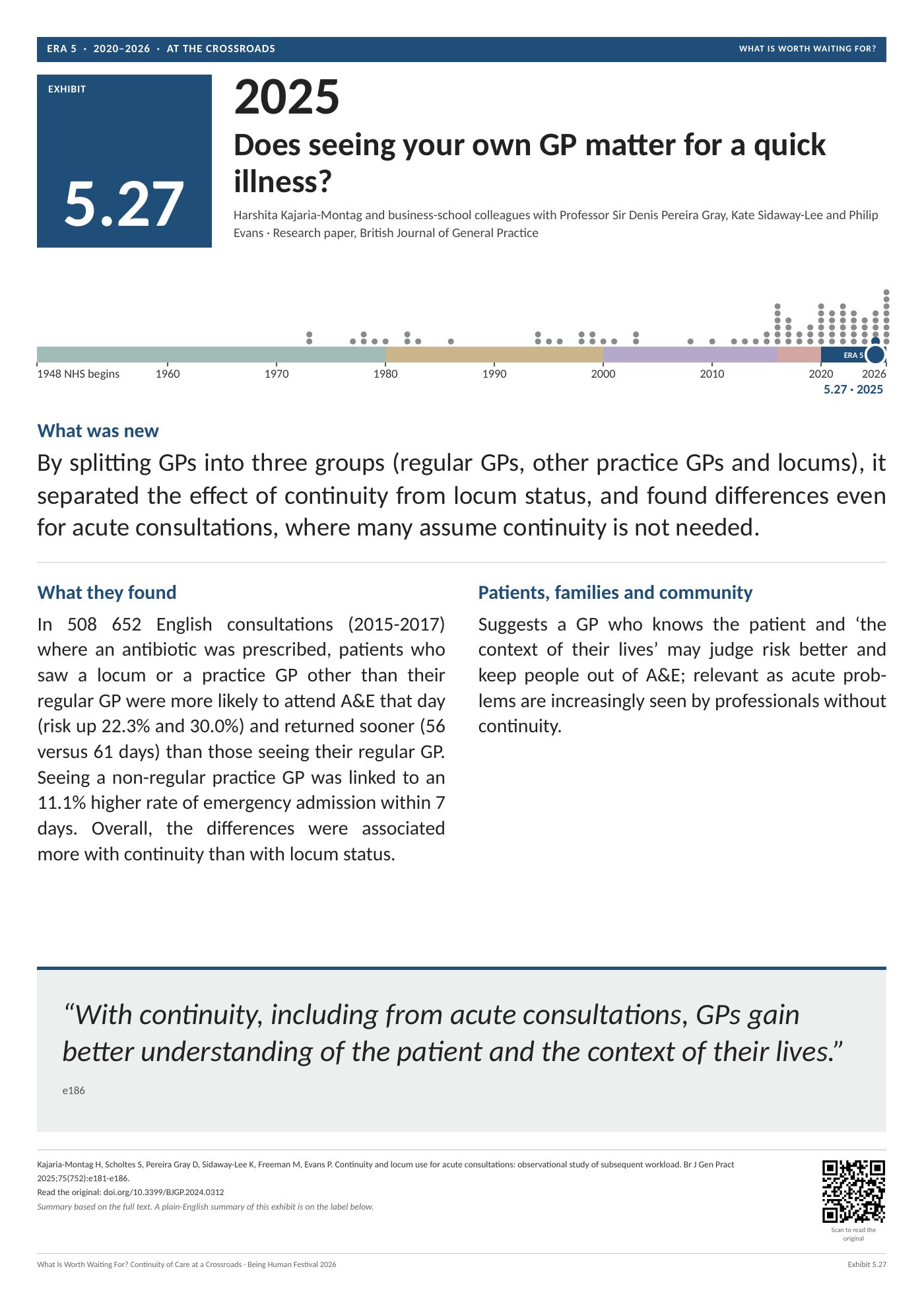
In plain English. This study looked at over half a million GP appointments in England where an antibiotic was prescribed, a sign of a short-term illness such as an infection. Patients who saw their regular GP came back to the surgery later on average (61 days, against 56) and were less likely to go to A&E than those who saw a locum or another GP at the practice. Knowing the patient seemed to matter more than whether the doctor was a locum.
Why it is on the wall. Acute problems are increasingly sent to whoever is free. This study questions that road: even for acute consultations where an antibiotic was prescribed, seeing your regular GP was linked with fewer A&E visits and fewer return trips, easing pressure on practices and hospitals.
What was new. By splitting GPs into three groups (regular GPs, other practice GPs and locums), it separated the effect of continuity from locum status, and found differences even for acute consultations, where many assume continuity is not needed.
What they found. In 508 652 English consultations (2015-2017) where an antibiotic was prescribed, patients who saw a locum or a practice GP other than their regular GP were more likely to attend A&E that day (risk up 22.3% and 30.0%) and returned sooner (56 versus 61 days) than those seeing their regular GP. Seeing a non-regular practice GP was linked to an 11.1% higher rate of emergency admission within 7 days. Overall, the differences were associated more with continuity than with locum status.
Patients, families and community. Suggests a GP who knows the patient and ‘the context of their lives’ may judge risk better and keep people out of A&E; relevant as acute problems are increasingly seen by professionals without continuity.
Source: Kajaria-Montag H, Scholtes S, Pereira Gray D, Sidaway-Lee K, Freeman M, Evans P. Continuity and locum use for acute consultations: observational study of subsequent workload. Br J Gen Pract 2025;75(752):e181-e186. Read the original
Summary based on the full text.
Two extracts from Just a GP, Journal of the Royal Society of Medicine
Two extracts from Professor Sir Denis Pereira Gray’s memoir, Just a GP. He describes learning general practice from patients’ stories and from his father, also a GP, and how repeated consultations over time are ‘how most GPs and patients get to know each other’. When he retired from clinical work, 7% of the patients on his personal list had a four-generation relationship with him.
Source: Pereira Gray D. Learning the craft – general practice stories. J R Soc Med 2025;118(4):121-125. Pereira Gray D. Learning the craft – own experience. J R Soc Med 2025;118(5):153-156. Read the original
Summary based on the full text.
Letter, British Journal of General Practice
Welcomed GP contracts that, ‘for the first time since 1948’, value and partly fund GP continuity, though only for small groups of patients.
Source: Pereira Gray D, Sidaway-Lee K, Evans P, Khan N, Dineen M, Harding A. New directions in policy in NHS GP contracts [letter]. Br J Gen Pract 2025;75(754):203-204. Read the original
Summary based on the full text.
Editorial, British Journal of General Practice, 2025 · Molly Dineen, Serge Engamba, Nada Khan, Kate Sidaway-Lee, Philip Evans, Professor Sir Denis Pereira Gray and Bristol colleagues
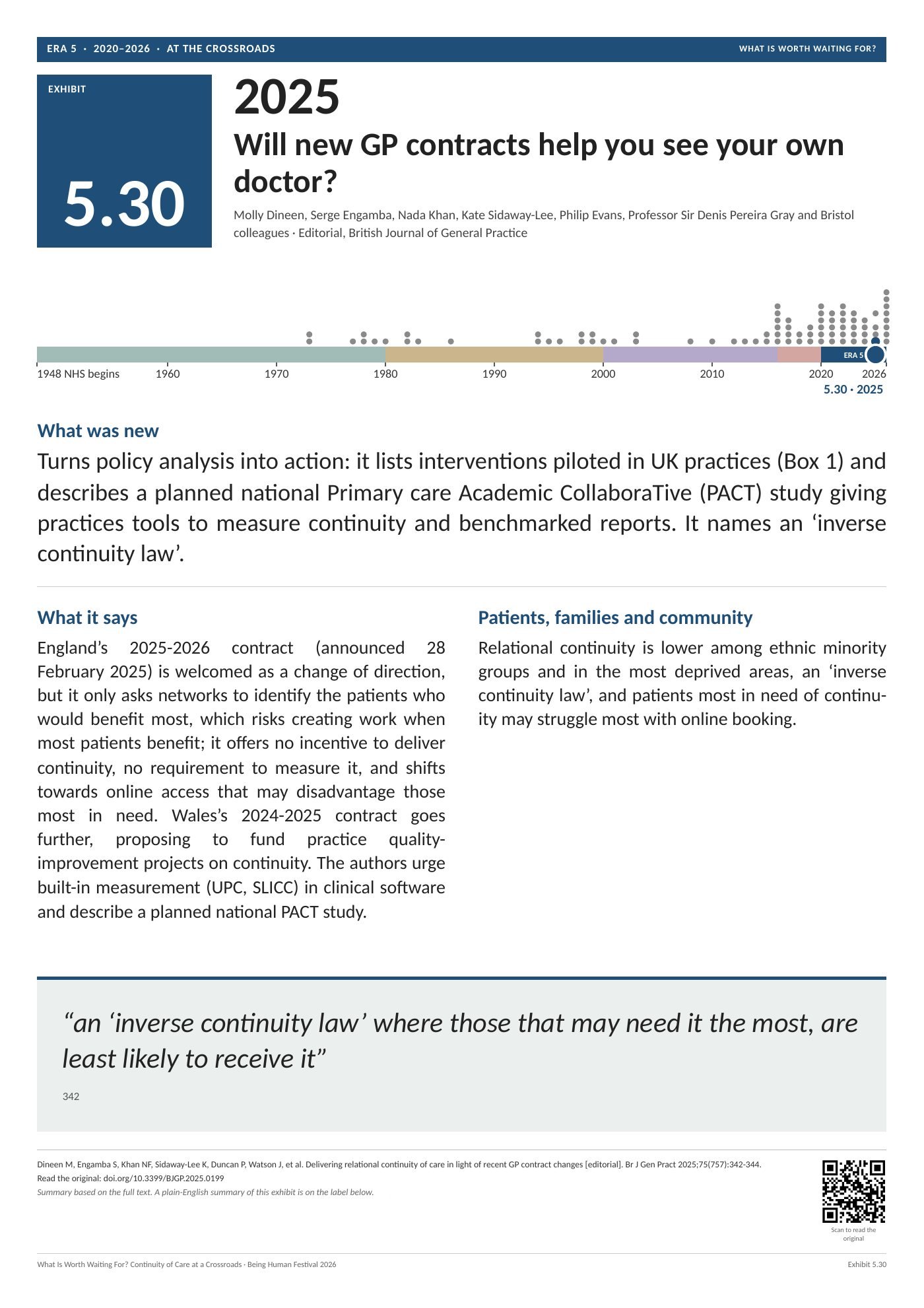
In plain English. By 2025, the latest GP contracts in England (2025-26) and Wales (2024-25) had begun to recognise continuity of care, meaning seeing a regular GP. This editorial welcomed the change but found gaps. England asked groups of practices to identify who needs continuity most, but did not reward providing it or require measuring it. Wales proposed funding practices to measure and improve it. The authors argue that measuring continuity is the first step, and describe a planned national study to help practices do this.
Why it is on the wall. Policy reached a fork in 2025: England targeted continuity at selected patients while moving towards online access; Wales proposed funding practices to measure and improve it. The authors argue measuring comes first: ‘if you don’t measure it, you can’t manage it’.
What was new. Turns policy analysis into action: it lists interventions piloted in UK practices (Box 1) and describes a planned national Primary care Academic CollaboraTive (PACT) study giving practices tools to measure continuity and benchmarked reports. It names an ‘inverse continuity law’.
What it says. England’s 2025-2026 contract (announced 28 February 2025) is welcomed as a change of direction, but it only asks networks to identify the patients who would benefit most, which risks creating work when most patients benefit; it offers no incentive to deliver continuity, no requirement to measure it, and shifts towards online access that may disadvantage those most in need. Wales’s 2024-2025 contract goes further, proposing to fund practice quality-improvement projects on continuity. The authors urge built-in measurement (UPC, SLICC) in clinical software and describe a planned national PACT study.
Patients, families and community. Relational continuity is lower among ethnic minority groups and in the most deprived areas, an ‘inverse continuity law’, and patients most in need of continuity may struggle most with online booking.
Source: Dineen M, Engamba S, Khan NF, Sidaway-Lee K, Duncan P, Watson J, et al. Delivering relational continuity of care in light of recent GP contract changes [editorial]. Br J Gen Pract 2025;75(757):342-344. Read the original
Summary based on the full text. Dr Serge Engamba, who curated the exhibition, is an author of this piece.
Student research poster · University of Exeter Medical School; presented at the RCGP Annual Conference 2025 (Highly Commended) · Azhar Khan, supervised by Professor Richard Neal
In plain English. A medical student at Exeter asked whether practices where people can see a doctor they know also refer suspected cancer more accurately. Using national data for 1,068 practices in England, the study compared each practice’s two-week-wait referral ‘conversion rate’ (the share of urgent cancer referrals that turn out to be cancer, 2018–22) with how many of its patients told the GP Patient Survey that they had a preferred GP, and that they could see that GP. Practices where more people both had and saw a preferred GP had slightly higher conversion rates: a weak but statistically significant link, and one that was stronger for seeing the preferred GP than for simply having one. Practices in more deprived areas scored lower on both. The study cannot prove cause and effect, and it calls for further work that allows for age, practice size and other differences between practices.
Why it is on the wall. The newest student work on the wall, and the first to ask whether being known by your GP shows up in something as concrete as a cancer referral, an association the poster says had not been studied before. Like Molly Dineen’s poster (exhibit 4.10), it is the next generation testing this wall’s question, this time on data from every practice in England.
Source: Khan A, Neal R. Is there an association between two-week-wait referral conversion rates and patient reported continuity of care in general practice? Student research poster, University of Exeter Medical School; RCGP Annual Conference 2025. Courtesy of the authors.
At the exhibition the original poster was shown in a frame, as it was first presented. It is not reproduced on this site.
Letter, British Journal of General Practice
Disagreed that seeing the same GP will never again be the norm: a minority of practices still achieve it for more than half their patients.
Source: Pereira Gray D, Sidaway-Lee K, Evans P. Continuity in general practice: time for a broader definition [letter]. Br J Gen Pract 2026;76(765):156. Read the original
Summary based on the full text.
International Journal for Quality in Health Care, 2026 · Professor Sir Denis Pereira Gray, Kate Sidaway-Lee, Nada Khan and Philip Evans
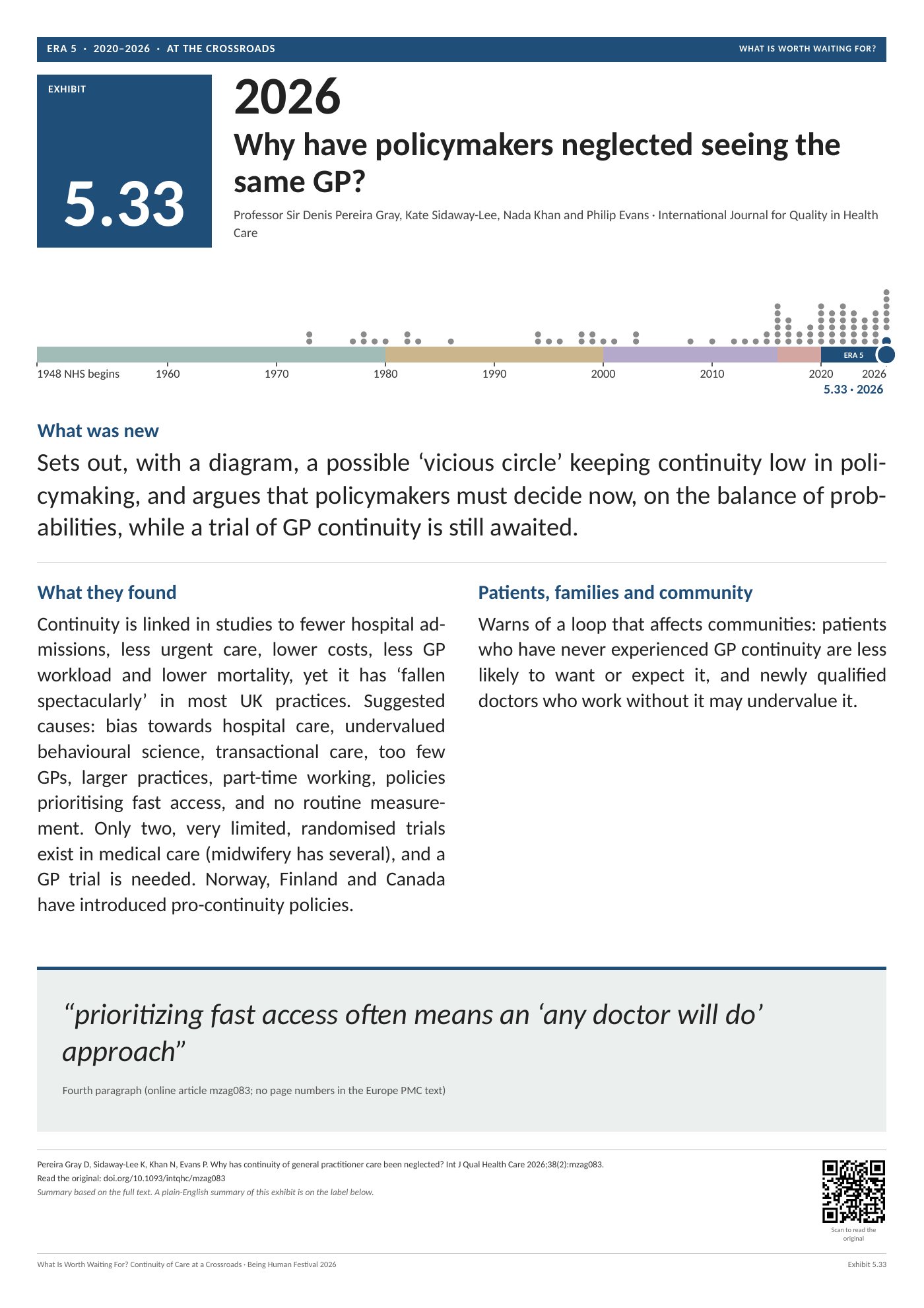
In plain English. Imagine a treatment linked to fewer hospital stays, lower costs, less GP workload and fewer deaths. The authors say it already exists: continuity of care, seeing the same family doctor over time. Yet in the UK it has fallen sharply. They blame a mix of causes, including policies that reward fast access to any doctor and the lack of routine measurement. They call for a proper trial, but say decisions cannot wait, and note that Norway, Finland and Canada are already changing course.
Why it is on the wall. The crossroads in miniature: policies chasing fast access often mean ‘any doctor will do’ and make booking your own doctor ahead harder. The authors argue continuity and access can coexist, and see a possible turning point.
What was new. Sets out, with a diagram, a possible ‘vicious circle’ keeping continuity low in policymaking, and argues that policymakers must decide now, on the balance of probabilities, while a trial of GP continuity is still awaited.
What they found. Continuity is linked in studies to fewer hospital admissions, less urgent care, lower costs, less GP workload and lower mortality, yet it has ‘fallen spectacularly’ in most UK practices. Suggested causes: bias towards hospital care, undervalued behavioural science, transactional care, too few GPs, larger practices, part-time working, policies prioritising fast access, and no routine measurement. Only two, very limited, randomised trials exist in medical care (midwifery has several), and a GP trial is needed. Norway, Finland and Canada have introduced pro-continuity policies.
Patients, families and community. Warns of a loop that affects communities: patients who have never experienced GP continuity are less likely to want or expect it, and newly qualified doctors who work without it may undervalue it.
Source: Pereira Gray D, Sidaway-Lee K, Khan N, Evans P. Why has continuity of general practitioner care been neglected? Int J Qual Health Care 2026;38(2):mzag083. Read the original
Summary based on the full text.
Study plan, BJGP Open
The plan for a review of how, why and for whom efforts to increase relational continuity in general practice work.
Source: Engamba S, Smith J, Khan N, Sidaway-Lee K, Burch P, Marshall T, et al. Enhancing understanding of interventions to increase relational continuity in general practice: a realist review protocol. BJGP Open 2026;10(1):BJGPO.2025.0119. Read the original
Summary based on the full text. Dr Serge Engamba, who curated the exhibition, is the first author of this piece.
Letter, British Journal of General Practice
Argued that patients who slip through the net of care are a subset of those without continuity, and that personal lists help GPs feel responsible for everyone on their list.
Source: Pereira Gray D, Sidaway-Lee K, Evans PH. Missingness is a subset of discontinuity [letter]. Br J Gen Pract 2026;76(768):305. Read the original
Summary based on the full text.
Research paper, British Journal of General Practice, 2026 · Kate Sidaway-Lee, Professor Sir Denis Pereira Gray, Philip Evans and colleagues
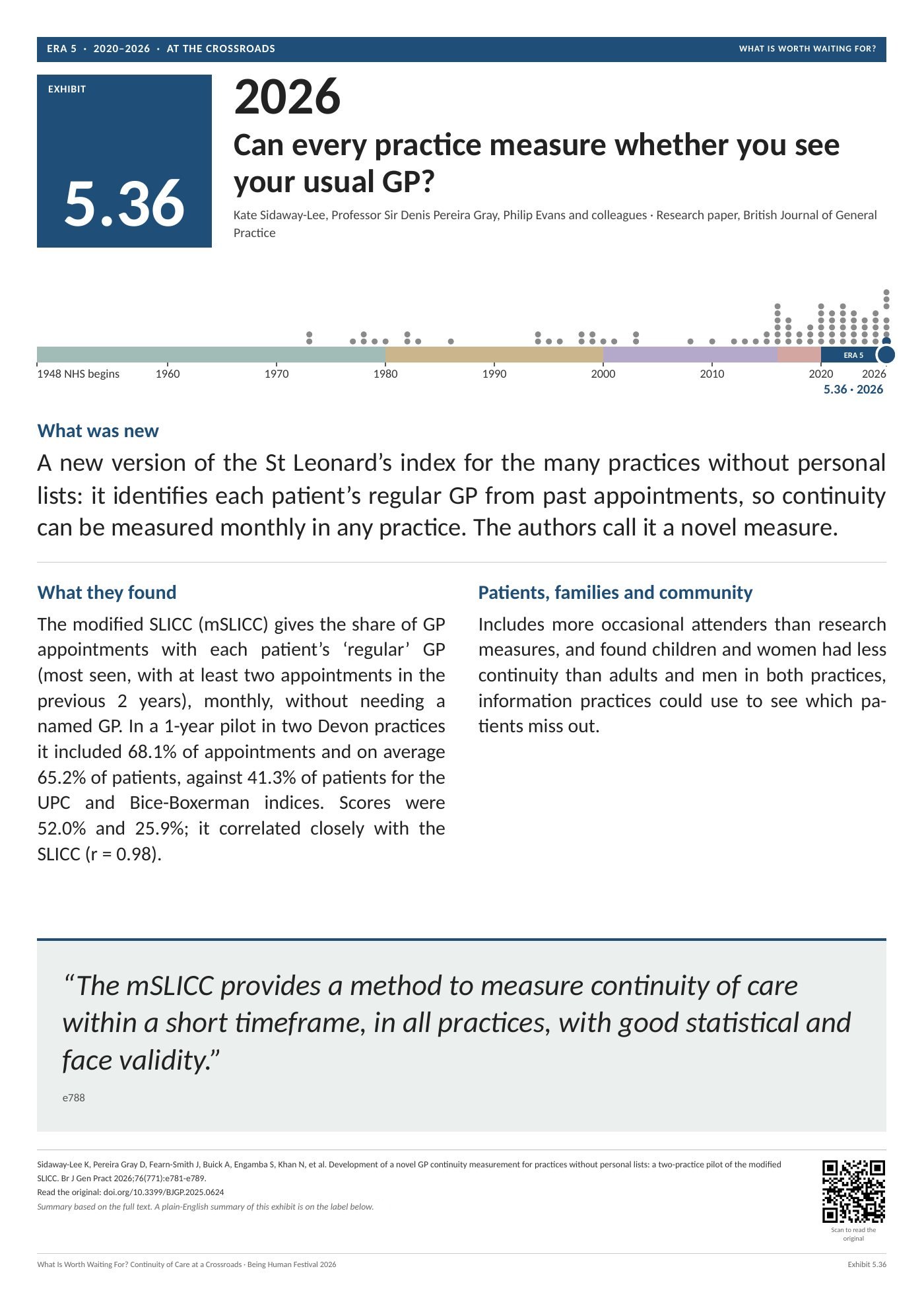
In plain English. St Leonard’s has long measured continuity, how often patients see their own GP, by counting appointments with each patient’s named doctor. But only a minority of practices run personal lists, so that measure does not suit most of them. The team designed a new version that works out each patient’s regular GP from their past appointments. Tested for a year in two Devon practices, it worked monthly, included more patients than older research measures, and closely matched the original.
Why it is on the wall. Most practices took a different road from personal lists. This adapted St Leonard’s measure lets them count continuity month by month wherever they are now, the first step towards improving it.
What was new. A new version of the St Leonard’s index for the many practices without personal lists: it identifies each patient’s regular GP from past appointments, so continuity can be measured monthly in any practice. The authors call it a novel measure.
What they found. The modified SLICC (mSLICC) gives the share of GP appointments with each patient’s ‘regular’ GP (most seen, with at least two appointments in the previous 2 years), monthly, without needing a named GP. In a 1-year pilot in two Devon practices it included 68.1% of appointments and on average 65.2% of patients, against 41.3% of patients for the UPC and Bice-Boxerman indices. Scores were 52.0% and 25.9%; it correlated closely with the SLICC (r = 0.98).
Patients, families and community. Includes more occasional attenders than research measures, and found children and women had less continuity than adults and men in both practices, information practices could use to see which patients miss out.
Source: Sidaway-Lee K, Pereira Gray D, Fearn-Smith J, Buick A, Engamba S, Khan N, et al. Development of a novel GP continuity measurement for practices without personal lists: a two-practice pilot of the modified SLICC. Br J Gen Pract 2026;76(771):e781-e789. Read the original
Summary based on the full text. Dr Serge Engamba, who curated the exhibition, is an author of this piece.
Letter, British Journal of General Practice, 2026 · Serge Engamba, Kate Sidaway-Lee, Philip Evans and Professor Sir Denis Pereira Gray
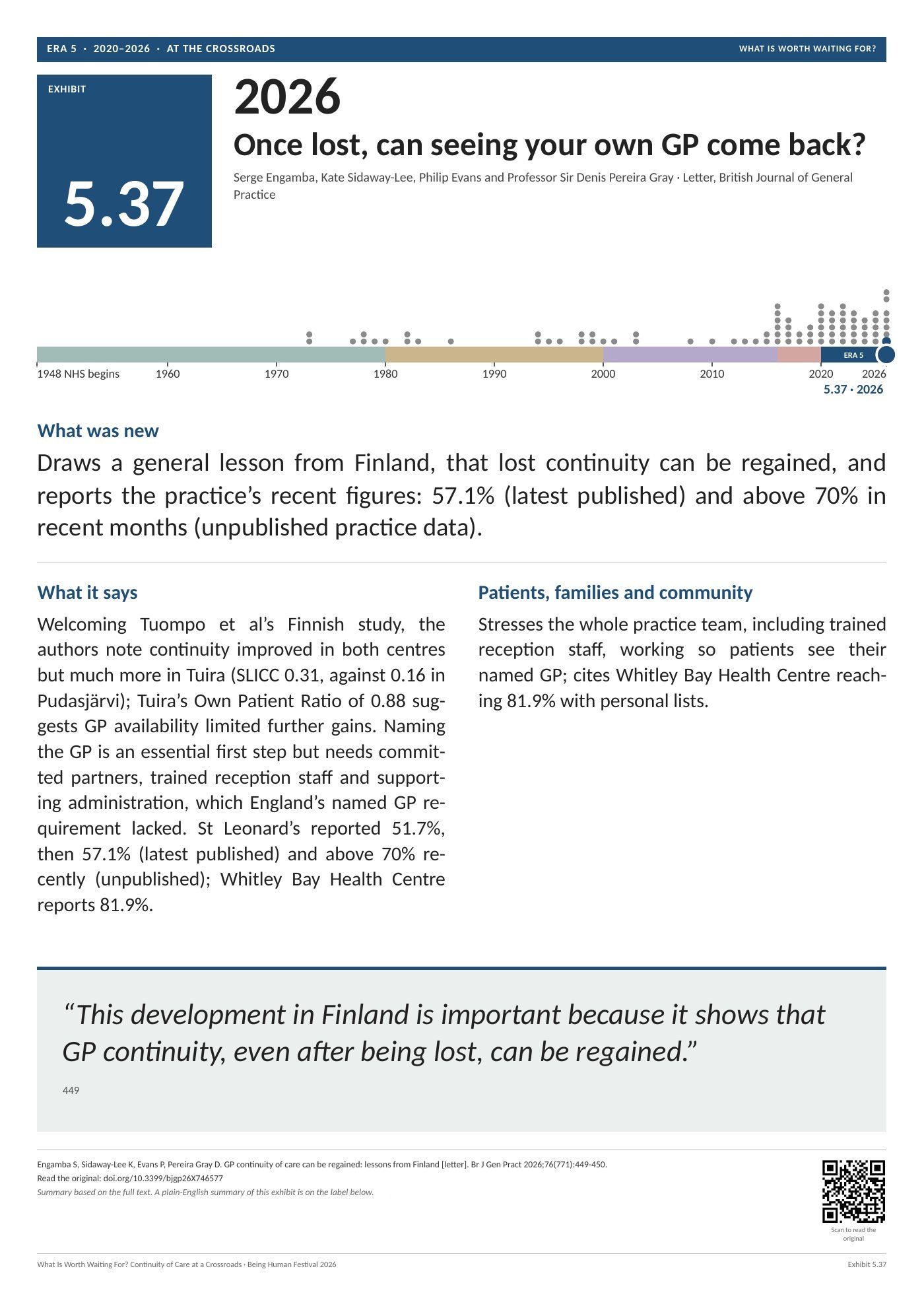
In plain English. Finland is trying to regain named GP lists after losing them. Writing in 2026, the St Leonard’s team welcomed the Finnish results and drew a lesson: giving each patient a named GP is the essential first step, but it also needs committed GP partners, trained receptionists and good administration. Practices that work this way can do well: at St Leonard’s, GP continuity has been above 70% in recent months (practice figures, not yet published). Continuity, once lost, can be regained.
Why it is on the wall. A closing message for the wall: continuity is not only a lost past. Finland shows the road back exists, and St Leonard’s figures show how far it can go when a whole practice is organised so patients see their named GP.
What was new. Draws a general lesson from Finland, that lost continuity can be regained, and reports the practice’s recent figures: 57.1% (latest published) and above 70% in recent months (unpublished practice data).
What it says. Welcoming Tuompo et al’s Finnish study, the authors note continuity improved in both centres but much more in Tuira (SLICC 0.31, against 0.16 in Pudasjärvi); Tuira’s Own Patient Ratio of 0.88 suggests GP availability limited further gains. Naming the GP is an essential first step but needs committed partners, trained reception staff and supporting administration, which England’s named GP requirement lacked. St Leonard’s reported 51.7%, then 57.1% (latest published) and above 70% recently (unpublished); Whitley Bay Health Centre reports 81.9%.
Patients, families and community. Stresses the whole practice team, including trained reception staff, working so patients see their named GP; cites Whitley Bay Health Centre reaching 81.9% with personal lists.
Source: Engamba S, Sidaway-Lee K, Evans P, Pereira Gray D. GP continuity of care can be regained: lessons from Finland [letter]. Br J Gen Pract 2026;76(771):449-450. Read the original
Summary based on the full text. Dr Serge Engamba, who curated the exhibition, is an author of this piece.
Research from Finland, British Journal of General Practice
Finnish researchers used St Leonard’s measures to show that a named GP works only with real organisational change, not as a paper exercise.
Source: Tuompo W, Mäkelä J, Timonen M, Auvinen J. Sustaining named GP continuity requires organisational change: a comparative implementation analysis in Finland. Br J Gen Pract 2026;76(771):e818-e827. Read the original
Summary based on the full text. Dr Serge Engamba, who curated the exhibition, is thanked in this paper as an external reader.
Article, British Journal of General Practice
Compared the UK and the US: neither runs systematic nationwide measurement of continuity, and ‘measurement is the first step to improvement’.
Source: Dineen M, Pereira Gray D, Sidaway-Lee K, Evans P, Bazemore A. Continuity of care measurement across health systems: UK and US insights for global primary care. Br J Gen Pract 2026;76(771):469-471. Read the original
Summary based on the full text.
← Era 4: Life, death and a monthly number · All five eras · Landmarks from abroad →