
What Is Worth Waiting For? Continuity of Care at a Crossroads
The exhibition has come down, but the conversation has not. The three things visitors did most in the room, you can still do here: drop your chips, write a prescription for general practice, and leave a thought. It takes a minute or two, and nothing here asks for your name.
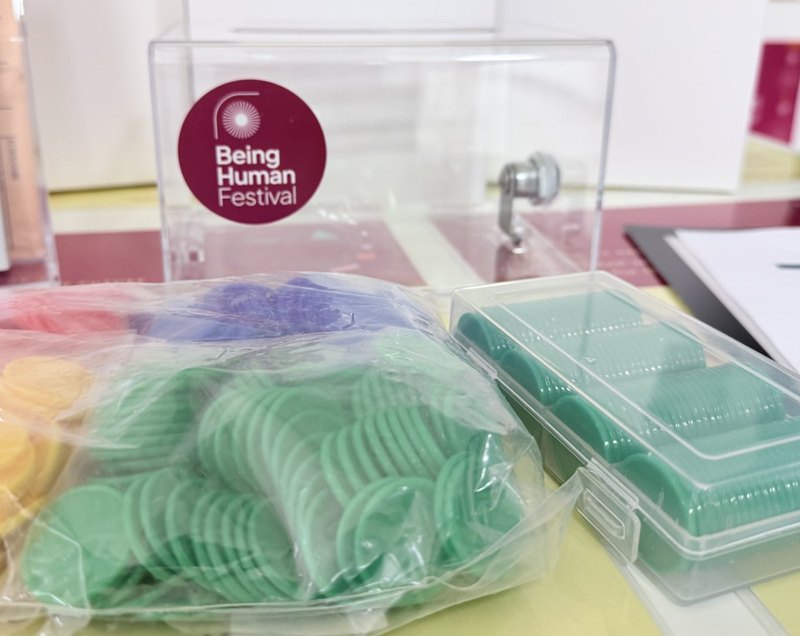
At the future table in the exhibition, every visitor was given up to five chips: blue for patients and members of the public, green for people who work in health or social care. The question was: if you were designing general practice from scratch, what would you want it to deliver?
You have five chips. Put them all in one box if one thing matters most, or spread them out. Any you do not want to use can stay in the bowl.
As in the room, the boxes are opaque: you will not see how others have chosen. How the chips fell during the exhibition is on What you told us.
NHS general practice was 78 years old in 2026. In the exhibition, visitors wrote it a prescription on a card like this one and pegged it on a line for others to read.
NOT A REAL PRESCRIPTION · WHAT IS WORTH WAITING FOR? · BEING HUMAN FESTIVAL 2026
PATIENT
The NHS: general practice, aged 78 (born 1948)
DATE
Added when you hand it in
What should general practice keep, change or start, so that it is worth waiting for?
DISPENSED BY
The future
REPEAT
Every generation
Please do not write anything that identifies you or anyone else. A longer story of waiting to tell? Share it at waitingtimes.exeter.ac.uk.
A selection of short extracts, without names, is on What you told us.
A memory of a doctor who knew you, something from the exhibition that stayed with you, or what you would say to whoever designs general practice next.
What Are You Waiting For? is the living archive of the Waiting Times project, where your story of waiting can be kept with your consent.
This is public engagement, not a research study. We do not ask for your name, your email address or any other personal details, and please do not write anything that identifies you or anyone else.
What you send is stored on the University of Exeter’s website system and read by the project team. We may count it, describe it and use short extracts, without names, on this website, in our festival report, and in presentations and publications about this public engagement work and what it taught us about how people see continuity of care.
If you would like something you sent to be removed, email per@exeter.ac.uk with the date you sent it and its first few words, and they will pass it on. The University of Exeter explains how it uses personal data at exeter.ac.uk/about/oursite/privacy.