Research Findings
KEY FINDING
Deforestation in the Amazon does not just remove trees — it triggers a carbon cascade beneath the soil, releasing the equivalent of 1.2 times the forest’s aboveground biomass in total carbon.
What we have found so far
Our measurements and modelling across southern Amazonia and the Colombian Andes, published in CATENA, Global Change Biology, and Communications Earth & Environment.
01
Deforestation and soil carbon stocks
Fire and deforestation interact to substantially reduce soil carbon stocks in southern Amazonia. Repeated burning following forest clearing depletes mineral-associated organic matter in the topsoil, with effects persisting across management cycles.
02
Fire and land-use interactions
Post-deforestation burning dramatically alters pyrogenic carbon (PyC) stocks and soil organic matter fractions. In Amazonian peatlands, wildfire legacies from historical burning persist in PyC stocks for decades. Repeated fire across the southern Amazon forest–savanna transition induces floristic degradation and structural simplification even in recovering vegetation.
03
Land management for carbon persistence
In the Colombian Andes, soil type and fire history interact with climate to determine how long carbon persists. Keeping forest on clay-rich, high-CEC soils gives soil carbon its strongest natural protection. Dry-season temperature extremes are rising fastest across 700,000 km² of central-north Amazonia, beyond the deforestation frontier, strengthening the case for keeping the frontier out of intact forest.
Science Brief & Policy Recommendations
Our findings are synthesised in a freely available science brief aimed at policymakers and carbon market practitioners. It sets out the evidence base and calls for soil carbon to be included in REDD+ and voluntary carbon market frameworks.
Publications
Barlow, J., Carvalho, N. S., Nunes, C. A., Aguiar, A. P. D., Alencar, A., Anderson, L. O., et al., & Feldpausch, T. R. (2026). Rapid increase of climate extremes reveals new areas of concern in Amazonia. Communications Earth & Environment, 7(1), 746. https://doi.org/10.1038/s43247-026-03975-1
Naval, M. L. M., Bieluczyk, W., Alvarez, F., Carvalho, L. C. da S., Maracahipes-Santos, L., Oliveira, E. A. de, Silva, K. G. da, Pereira, M. B., Brando, P. M., Marimon Junior, B. H., Camargo, P. B. de, & Feldpausch, T. R. (2025). Impacts of repeated forest fires and agriculture on soil organic matter and health in southern Amazonia. CATENA, 254, 108924. https://doi.org/10.1016/j.catena.2025.108924
Montes-Pulido, C. R., Bird, M., da Silva Carvalho, L., Serrano, J. C., Quesada, C. A., & Feldpausch, T. R. (2025). Climatic and edaphic drivers of soil organic carbon and pyrogenic carbon stocks across elevation and land-use gradients. Global Change Biology, 31(7). https://doi.org/10.1111/gcb.70135
Wang, Y., Gallego-Sala, A. V., Bird, M. I., Moss, P. T., McGowan, H. A., Benavides, J. C., et al. (2025). Wildfire legacies on pyrogenic carbon stocks in Amazonian peatlands. Communications Earth & Environment, 6(1), 678. https://doi.org/10.1038/s43247-025-02674-7
Additional papers from the field campaign are in preparation. Check back for updates, or follow our news page for announcements.
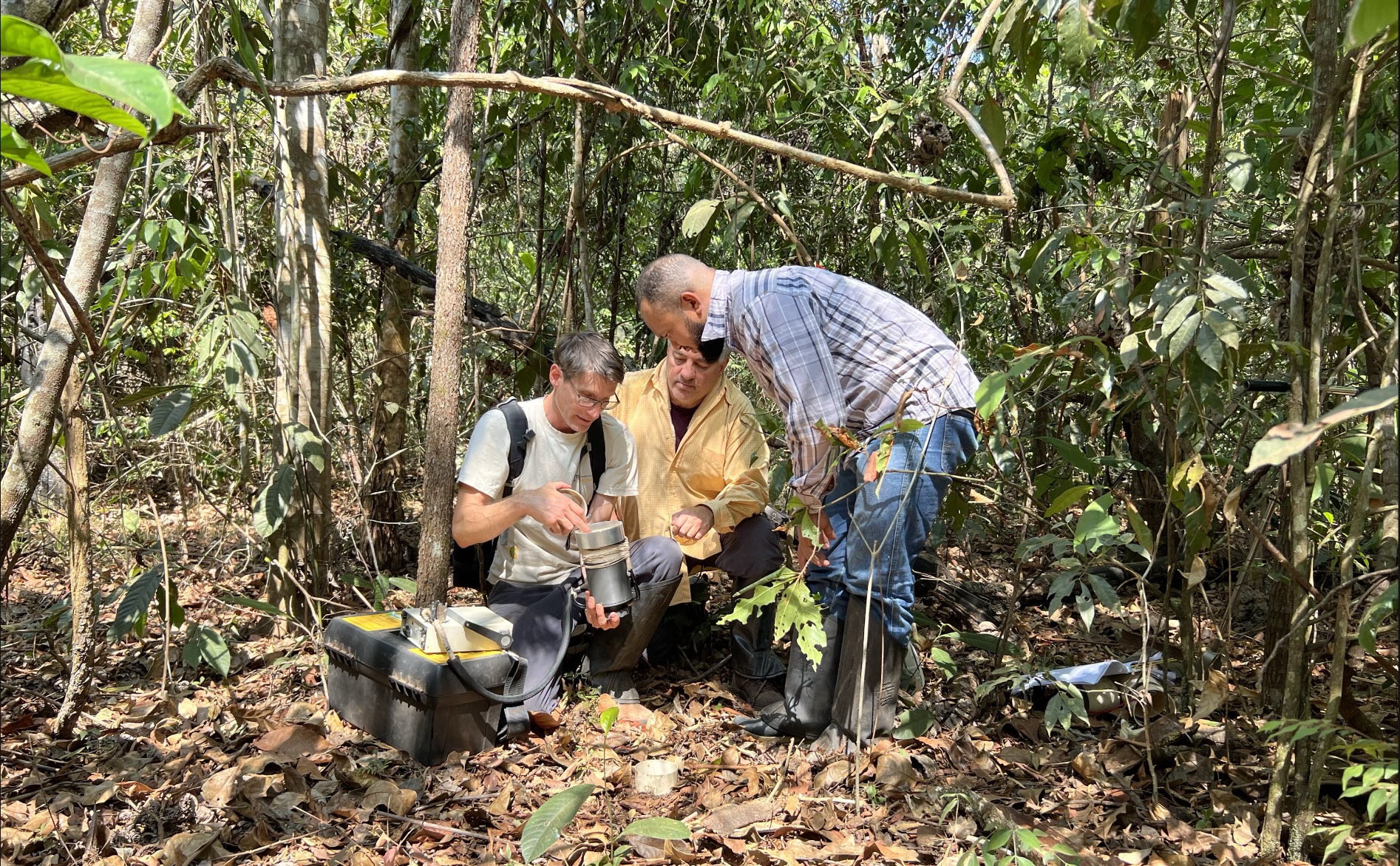
Header image credit: Ted Feldpausch