
Exeter Collaboration for Academic Primary Care (APEx) Blog
Exeter Collaboration for Academic Primary Care (APEx) Blog
Posted by ac1516
2 June 2026Sofiya Abedali is a PhD candidate at Amsterdam University Medical Center with a background in sociology and anthropology. Her research focuses on how team dynamics, workplace culture, and organizational structures influence well-being in physician teams and extends to medical education, where she explores how feedback practices and language in resident evaluations influence perceptions of role modelling.

Discussions about clinicians’ well-being often begin with the individual: resilience, coping strategies, work-life balance, or the ability to continue under pressure. These capacities are important, but they offer only a partial view of what enables clinicians to work well over time. Well-being is also shaped by the environments in which care is organized: by relationships, routines, responsibilities, and the degree to which people have the space and support to do their work in a meaningful way.
This broader understanding is the basis for the WellNext Scan GP. Rather than approaching well-being as an individual attribute alone, the scan creates a structured opportunity for teams to reflect on the working conditions that support or hinder well-being. It invites teams to look not only at how people are doing, but also at how the organization of everyday practice shapes their experiences of work.
The WellNext Scan GP builds on the validated WellNext Scan, a team-based tool developed to map physicians’ well-being alongside factors in the clinical work environment. Its adaptation for general practice extends this perspective to an explicitly interprofessional setting, where care is shaped not only by the work of GPs, but also by practice nurses, assistants, managers, and other team members who together sustain the functioning of the practice. These groups work around the same patients and within the same organizational structures, but from distinct roles, responsibilities, and positions in the team.
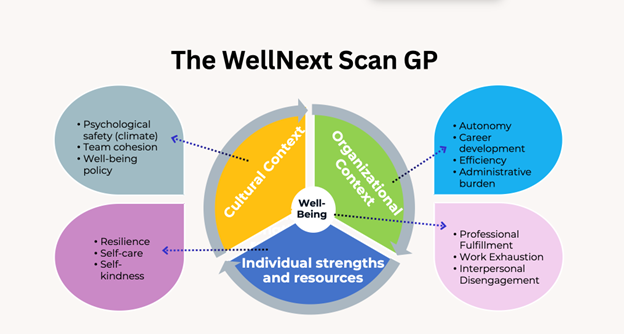
This makes general practice a particularly relevant setting for team reflection. Shared pressures such as workload, administrative demands, staff shortages, changing patient needs, and collaboration with regional care partners may affect the whole practice, but they are not necessarily experienced in the same way. Flexibility, for example, can support professional autonomy, but it can also create uncertainty when roles or expectations are unclear. Informal collaboration can make work more efficient and relational, but it may also leave some perspectives less visible.
The WellNext Scan GP is intended to make these interprofessional patterns visible and discussable. All professional groups within the practice are invited to complete the questionnaire, which maps well-being in relation to features of the working context, including practice culture, leadership, team support, administration, ICT, scheduling, task division, flexibility in patient care, and collaboration beyond the practice.
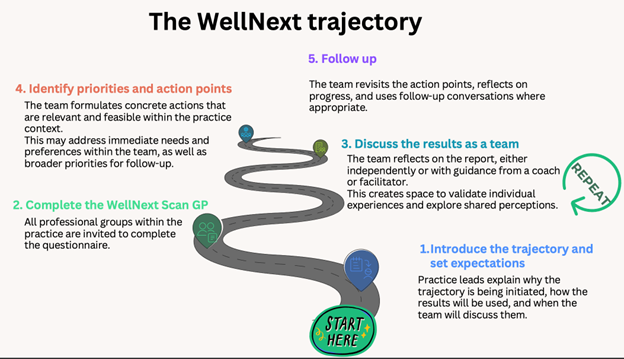
The questionnaire, however, is only one part of the process. Measurement can identify patterns, but it does not determine their meaning. A score may indicate that a certain area deserves attention, but it cannot explain by itself how that area is experienced in a particular practice, why it has become difficult, or what kind of change would be realistic. For this reason, the WellNext Scan GP is designed as a reflective trajectory rather than a stand-alone assessment.
After completion, the results are returned to the team as a basis for discussion. The report provides a shared reference point: a way to bring together different experiences of the same working environment and make them available for collective interpretation. Such a conversation can move the discussion beyond individual concern or general dissatisfaction. Some findings may point to aspects of the work that a team wants to protect, while others may clarify where work could be organized differently, where responsibilities have become unclear, or where certain voices and experiences require more attention.
At the same time, the discussion may reveal the limits of what a practice team can change on its own, particularly when pressures are tied to wider organizational, technological, or regional structures. Attention to well-being in general practice, therefore, cannot be separated from attention to how care is organized. The WellNext Scan GP does not solve this complexity, but it creates a structured space in which teams can begin to interpret together what their work requires, what currently supports them, and where change may need to begin. In doing so, well-being becomes less of an individual burden and more of a shared object of attention in the ongoing work of general practice.
This work was presented as part of a joint seminar between APEx and the University of Exeter Health Professions Education and Wellbeing Research Group