Exeter Collaboration for Academic Primary Care (APEx) Blog
Exeter Collaboration for Academic Primary Care (APEx) Blog
Posted by ma403
26 June 2026My first attempt at getting a PhD started in 1988. I had really enjoyed the experimental side of my degree particularly the final year projects, and a career in research really appealed. I loved the idea of working in a university and being paid to be inquisitive and to keep learning new things. I secured funding, which was tied to a single supervisor and not transferrable, and excitedly set off on what I had hoped was the perfect career for me. Rather ominously, one of the Readers in the department greeted me on my first day with “Ah, you’re Dr XXXX’s new student? I give you a year.” I ended my studies shortly after the Head of Department suggested I have a termination when I told him I was pregnant. The older me would probably have fought more, but I felt the situation was hopeless – there were no women in senior positions, and I could not see a path from where I was to where I wanted to be. An opportunity to work in publishing came up – one that offered the flexibility to combine work with parenting – and I took it.
Fast forward 20 years, and we had just moved to Devon because Rob had got a consultant post at the Royal Devon and Exeter Hospital. Our children, now adults, had left home, and my day-to-day job had not changed much for years. I had been working from home all that time and craved a new working environment and challenges.
Rob and I joined a group of medics on their Tuesday night bike rides – it was a great way to get to know people and discover beautiful Devon. Pedalling along, I got chatting with a rider called Ali who suggested I talk to her husband Willie about options at the university. I was wondering if there might be an opening for someone with my editorial experience, but he said that I would need a PhD if I were to get anywhere within a university and advised me to look out for adverts. A while later, one came up with him and I applied. I was interviewed by Willie, Tani, and Sal Stapley and felt beyond lucky when they offered me the post. I could not believe that I had been given a second chance at working in research just as I was turning 50. Starting work with DISCO was the biggest breath of fresh air I could imagine. The contrast with the years of isolated working in a very task-based job was huge. No two days were ever the same and it was fantastic to be learning again. It also felt wonderful to belong to the group, who were all so supportive and welcoming. It was a world away from my experiences of university life in the 1980s.
My PhD examined biases and data loss associated with lack of access to clinical information recorded in text fields. I was amazed when one of the findings made it through to the National Institute for Health and Care Excellence suspected cancer: recognition and referral guidance. I found the data science aspects of the work really interesting, particularly learning and using Stata. This was a surprise because I had suffered statistics as a necessary evil when I was an undergrad. I realised just how much my knowledge had grown when I was working with Gary, Bianca, Luke and Willie on new methodology to identify patterns of consulting in primary care before a cancer diagnosis. Gary had written some template Stata code and asked us to develop the mixed-effects, negative binomial time-series regression models from it. I remember puzzling over the code with Luke and Bianca, figuring it all out and getting it to run. Those models are now being used increasingly by researchers to estimate the timeliness of cancer diagnosis at a population level.
Over my 13 years at Exeter, with support from Willie and other mentors, I also learnt how to write grants (sometimes also securing funding) and in the last few years have been the co-PI or PI on many rewarding and diverse research projects. The OSCA Study focused on the difficulties of diagnosing cancer when patients already have anxiety and depression. Liz Shephard, Luke, Bianca and I worked closely on this project with Anne Spencer, who has always generously supported my development at Exeter. In The MODE Study, we collaborated with Queen Mary University of London and University of Oxford on a multi-methods approach to understanding missed opportunities in the form of an initial non-cancer diagnosis. The papers for that project are starting to come out, and the work is being taken forward in diverse ways, possibly even including an educational game for medical students and doctors in training. Most recently, I’ve been working with Luke and Liz again on a Cancer Research UK project investigating a possible new marker of undiagnosed cancer. And, finally, I’d like to mention a commissioned piece of work for Pancreatic Cancer UK to develop the evidence base to inform two key projects. First, to demonstrate if there is a need to update the suspected pancreatic cancer referral criteria. Second, to develop, improve and implement surveillance strategies to identify, assess and monitor those people at increased risk of pancreatic cancer. I found this an especially moving and meaningful project because my sister’s life was cruelly shortened by this unforgiving cancer.
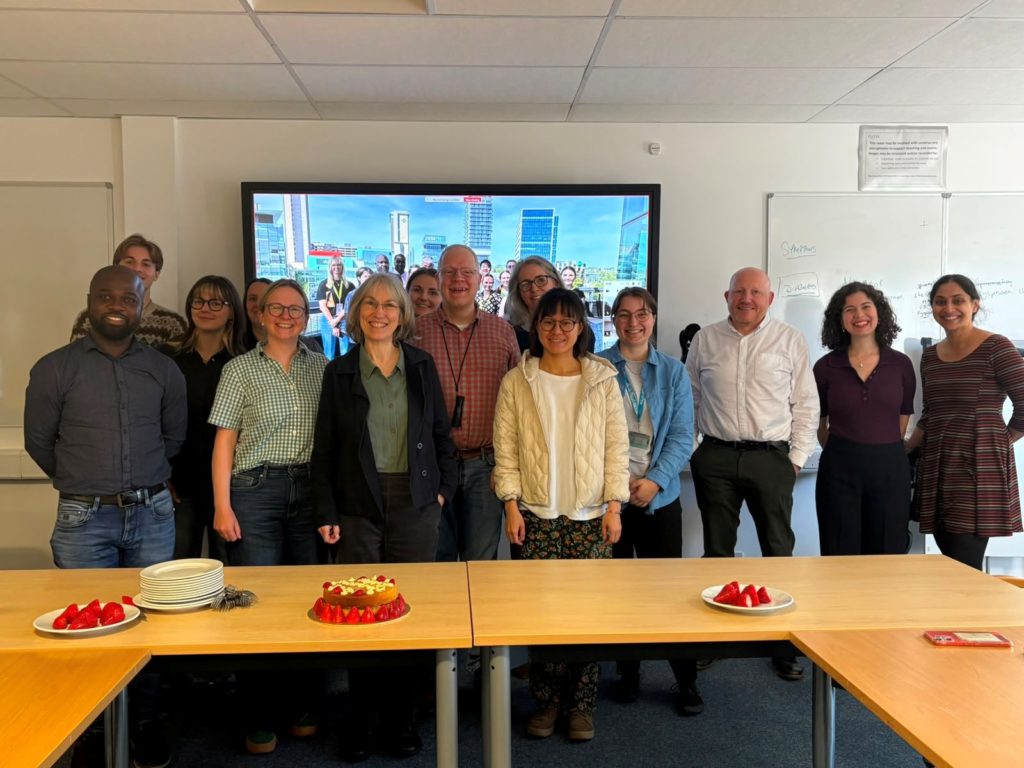
I have been so lucky to work alongside brilliant colleagues here at Exeter and further afield and feel great pride in being part of a research community that has contributed to improvements in early cancer diagnosis. I have developed skills and knowledge beyond anything I thought I could ever achieve and am so thankful to Willie for taking a chance on me in 2013. My contract is ending on 30th June, and I have very mixed feelings about leaving this department. I have loved working here and made many treasured friendships. Thank you to everyone for making my time here at Exeter so enjoyable, such fun, and also so rewarding. Turns out that I was right thinking that academia was the perfect career for me – I just took a slightly circuitous route to get here.
Sarah Price